

- 1 - 1 Person US$ 2,200
- 2 - 5 Person US$ 1,900
- 6 - 9 Person US$ 1,850
- 10 - 15 Person US$ 1,800
- 16 - 20 Person US$ 1,775
Hotel in Kathmandu and Lodge / Tea House during the trek
Breakfast in Kathmandu and all meals during the trek
Highlights
- Explore the mystical and serene Tsum Valley, often referred to as the “Hidden Valley of Happiness.”
- Journey through the remote and culturally preserved Tibetan Buddhist villages of Chumling, Chhokangparo, Rachen Gompa, and Mu Gompa.
- Witness ancient monasteries and sacred meditation caves visited by Guru Rinpoche and Milarepa.
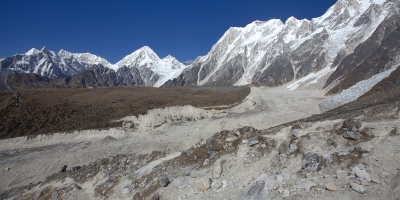
- Traverse the diverse landscapes – from subtropical forests to alpine valleys, glacial rivers, and windswept highlands.
- Cross the dramatic and scenic Larkya La Pass (5,160m), one of the highest trekking passes in Nepal.
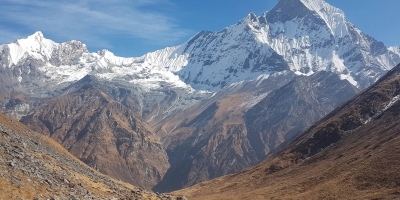
- Enjoy unobstructed views of towering Himalayan giants: Mt. Manaslu (8,163m), Himalchuli, Ganesh Himal, and Annapurna II.
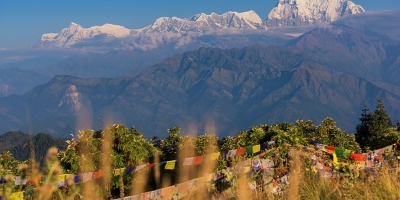
- Experience the rich Tibetan Buddhist culture – prayer wheels, mani walls, chortens, and fluttering prayer flags line the trail.
- Trek through the Mansiri Himalayan range, from east to west, exploring diverse ethnic communities like Gurung and Tibetan-Nepali.
- Visit Sama Gaon, the cultural heart of the Manaslu region, with side hikes to Birendra Lake and Manaslu Base Camp.
- Wildlife and natural diversity – chance to spot blue sheep, Himalayan Thar, snow leopards, and exotic birdlife.
- Full cultural immersion with homestays, monastery visits, and interaction with locals living traditional lifestyles.
Overview
The Tsum Valley and Manaslu Circuit Trek is one of the most fascinating and enriching trekking journeys in the Nepal Himalayas, offering trekkers a rare opportunity to explore two spectacular and culturally distinct regions in a single adventure. Organized by Everest Adventure Tour, this journey takes you deep into the secluded Tsum Valley—a sacred Himalayan pilgrimage site—before continuing on to the rugged and challenging Manaslu Circuit. The trek circumnavigates the majestic Mt. Manaslu (8,163m), the world’s eighth-highest peak, while uncovering ancient Buddhist traditions, remote villages, and awe-inspiring alpine scenery.
Tsum Valley, often referred to as the “Hidden Valley of Happiness,” is a remote and mystical region that remained closed to outsiders until 2008. The valley is deeply influenced by Tibetan Buddhism, and its isolation has helped preserve a unique cultural heritage that dates back centuries. Trekkers can expect to visit ancient monasteries like Rachen Gompa and Mu Gompa, witness traditional village life in places like Chumling and Chhokangparo, and enjoy a spiritual atmosphere unlike anywhere else in Nepal. The landscapes transition from lush forests and cultivated fields to windswept highlands that resemble the Tibetan plateau, all surrounded by dramatic Himalayan peaks.
From Tsum Valley, the trek merges back with the Manaslu Circuit, one of the most dramatic and adventurous high-altitude routes in the country. The journey gradually ascends through rhododendron and pine forests, terraced farmlands, and traditional Gurung and Tibetan-style villages such as Namrung, Lho, and Sama Gaon. These villages offer cultural insights into local life, with opportunities to visit monasteries, spin prayer wheels, and engage with warm-hearted locals who have lived in these mountains for generations. A key highlight here is the acclimatization day in Sama Gaon, which allows trekkers to explore Birendra Lake, Pungen Monastery, or even venture up to Manaslu Base Camp.
The most exhilarating part of the trek is the crossing of the Larkya La Pass (5,160m)—a physically demanding but immensely rewarding experience. From the summit of the pass, trekkers are greeted with jaw-dropping views of the Manaslu range, Himlung Himal, Cheo Himal, Kang Guru, and even part of the Annapurna range. The descent from the pass leads into the Annapurna region, transitioning again into lush forests and warmer lowlands. The trek concludes in Dharapani, from where a scenic drive brings you back to Kathmandu, full of unforgettable memories and the profound satisfaction of having completed one of Nepal's most comprehensive and spiritually enriching treks.
Major Places for Tsum Valley and Manaslu Circuit Trek
The Tsum Valley and Manaslu Circuit Trek takes you through some of the most captivating and culturally rich locations in the Himalayan region. Each destination on this journey contributes uniquely to the experience, offering a blend of stunning landscapes, ancient monasteries, and deep-rooted traditions. Starting from Machha Khola, the route gradually moves into higher elevations through Jagat, Lokpa, and into the mystical Tsum Valley. Within Tsum, major highlights include Chumling, Chhokangparo, Rachen Gompa, Nile, and the sacred Mu Gompa. These villages are not just stops along the way; they are living museums of Tibetan Buddhism, where prayer flags flutter in the wind and chortens mark the trail.
After exiting Tsum, the trail reconnects with the Manaslu Circuit, leading trekkers through spectacular Himalayan settlements like Deng, Namrung, Lho, and Sama Gaon. Each village offers its own charm—Lho is known for panoramic views of Mt. Manaslu, while Sama Gaon is a cultural gem where trekkers can visit Pungen Monastery or hike to Manaslu Base Camp. Beyond Samdo and Larkya Phedi, the crossing of the dramatic Larkya La Pass (5,160m) is a true high-altitude achievement. Finally, the descent through Bimthang and Dharapani completes the circle, transitioning from arid highlands to lush lowland forests.
Key Highlights:
- Ancient monasteries: Rachen Gompa, Mu Gompa, Pungen Monastery
- Remote villages: Chumling, Nile, Sama Gaon, Samdo
- Himalayan vistas: Mt. Manaslu, Ganesh Himal, Himalchuli
- Historic pass: Larkya La (5,160m), one of the most dramatic in Nepal
Best Season for Tsum Valley and Manaslu Circuit Trek
Choosing the right time for the Tsum Valley and Manaslu Circuit Trek is crucial to enjoying its full beauty and minimizing weather-related challenges. The best seasons for this trek are spring (March to May) and autumn (late September to November). During these months, the skies are generally clear, offering spectacular mountain views, stable weather conditions, and pleasant temperatures. The spring season brings blooming rhododendrons and wildflowers, especially in lower elevations around Jagat, Deng, and Namrung. This vibrant burst of color is a photographer’s delight and adds to the natural richness of the trail.
In autumn, the air is crisp and visibility is at its peak, making it ideal for high-altitude trekking and photography. This is also the time when many of the local festivals take place, such as Mani Rimdu and other regional Buddhist celebrations, allowing trekkers a chance to witness authentic cultural rituals. While monsoon season (June to early September) brings lush greenery, it is not ideal due to heavy rain, landslides, and leech-infested trails in the lower regions. Likewise, winter (December to February) can make high passes like Larkya La inaccessible due to snow and freezing temperatures, though the Tsum Valley may still be reachable with extra gear and preparation.
Best Time to Go:
- Spring (March–May): Flowers, warmer days, and vibrant valleys
- Autumn (Sept–Nov): Crystal-clear skies and perfect views of Manaslu
- Avoid monsoon and mid-winter for safety and comfort
Tsum Valley and Manaslu Circuit Trekking Difficulty Level
The Tsum Valley and Manaslu Circuit Trek is rated as a moderate to strenuous trek, suitable for trekkers with good physical fitness and some prior trekking experience. The journey spans over 19 days, including several days of continuous walking at high altitudes and crossing challenging terrain. The most difficult segment is the Larkya La Pass (5,160m), which demands a long, early morning ascent and a steep descent into Bimthang. Acclimatization days are built into the itinerary to help prevent altitude sickness, especially in Sama Gaon, which serves as a crucial rest and adjustment point before the high pass.
Though the trek doesn’t require technical mountaineering skills, it does involve long walking hours—often 6 to 8 hours per day—across steep trails, rocky sections, river crossings, and occasional landslide-prone areas. The remote nature of the Tsum Valley adds another layer of difficulty, as facilities are basic, and communication infrastructure is limited. Trekking in this area also means being mentally prepared for basic amenities, variable weather conditions, and limited access to emergency services. However, with proper acclimatization, pacing, and support from experienced guides like those from Everest Adventure Tour, the trek is both achievable and highly rewarding.
Difficulty Summary:
- Grade: Moderate to strenuous
- Maximum altitude: 5,160m (Larkya La Pass)
- Physical fitness: Good endurance and stamina required
- Recommended for: Experienced trekkers or fit beginners with prep
Food and Accommodation for Tsum Valley and Manaslu Circuit Trek
During the Tsum Valley and Manaslu Circuit Trek, trekkers will find basic but comfortable food and accommodation facilities provided by local teahouses and lodges. The rooms are typically twin-sharing, with wooden beds, mattresses, and warm blankets. Heating is minimal, especially in higher altitudes, so a good-quality sleeping bag is essential. In places like Sama Gaon, Lho, and Namrung, teahouses are more established and may offer solar showers, Wi-Fi (at extra cost), and basic charging stations. In contrast, remote villages such as Chumling, Mu Gompa, and Rachen Gompa offer more rustic accommodation, often in monastery guest rooms or traditional homestays.
In terms of food, the menu mainly includes traditional Nepali dishes such as dal bhat (rice, lentil soup, and curry), Tibetan bread, noodle soup (thukpa), momos, and pancakes. Tea and coffee are widely available, along with energy-boosting snacks like boiled eggs, potatoes, and garlic soup (useful for acclimatization). Most teahouses serve meals three times a day, and you can expect vegetarian-friendly options throughout the trail. In Tsum Valley, barley, buckwheat, and potatoes are staple foods due to the high-altitude climate. Everest Adventure Tour ensures that our trekkers are accommodated in the best available lodges, with attention to hygiene and dietary preferences.
Food & Stay Highlights:
- Lodging: Teahouses, basic guesthouses, monastery rooms
- Meals: Dal Bhat, thukpa, Tibetan bread, pancakes, momos
- Hygiene: Basic but manageable with proper precautions
- Extras: Solar showers, charging (limited), hot drinks available
Network and Communication for Tsum Valley and Manaslu Circuit Trek
Communication and internet access during the Tsum Valley and Manaslu Circuit Trek is limited and varies depending on the region. In lower altitudes such as Machha Khola, Jagat, and Deng, you may occasionally find mobile network coverage from Nepali providers like NCELL or Nepal Telecom. However, as you ascend further into remote areas—especially within Tsum Valley (Lokpa, Chumling, Nile, Mu Gompa) and high-altitude settlements like Samdo and Larkya Phedi—network connectivity becomes extremely sparse or entirely unavailable. This lack of consistent signal coverage adds to the feeling of true isolation and immersion in nature, but it also means that trekkers must plan for offline communication during large parts of the trek.
Some teahouses in larger villages such as Sama Gaon, Namrung, and Lho may offer Wi-Fi or satellite internet, often for an additional charge. However, the speed is generally slow, and the service is unreliable due to weather and power supply. For those who require more reliable communication, Everest Adventure Tour recommends renting or purchasing a satellite phone or using a trekking agency-supported communication system for emergencies. Our team also ensures that our guides carry radios or satellite-enabled devices when entering regions without network support to maintain a basic line of safety.
Key Points:
- Limited mobile coverage; stronger in lower altitudes only
- Satellite phones recommended for emergencies
- Wi-Fi available in selected teahouses (Namrung, Lho, Sama Gaon)
- Everest Adventure Tour staff are equipped with communication tools for safety
Tsum Valley and Manaslu Circuit Trekking Transportation
The transportation arrangement for the Tsum Valley and Manaslu Circuit Trek is a vital part of the trekking logistics, as there are no domestic flights involved. The journey begins with an overland drive from Kathmandu to Machha Khola, which typically takes 7 to 9 hours, depending on road and traffic conditions. The road passes through scenic countryside and small towns like Arughat and Soti Khola, but some sections are rough and unpaved, especially during or after the monsoon season. Everest Adventure Tour provides private jeeps or tourist-class vehicles to ensure a safe and comfortable journey for our clients, avoiding the delays and overcrowding often associated with local buses.
Once on the trail, transportation is solely by foot travel through the remote mountain terrain. There are no motorable roads beyond Machha Khola until the exit point at Dharapani, where the trek concludes. From Dharapani, another overland journey takes you back to Kathmandu via Besisahar—a hub for the Annapurna region. This return drive can take 9–10 hours and provides a scenic transition from highland forests back to Nepal’s hill and valley landscape. At both the beginning and end of the trek, Everest Adventure Tour arranges all logistics including permits, accommodations, and comfortable transportation options to ensure a stress-free experience.
Transportation Highlights:
- Private vehicle from Kathmandu to Machha Khola (starting point)
- Full trekking route is non-motorable—entirely on foot
- Return overland drive from Dharapani to Kathmandu via Besisahar
- Comfortable, insured vehicles arranged by Everest Adventure Tour
Tsum Valley and Manaslu Circuit Trekking Permits
The Tsum Valley and Manaslu Circuit Trek lies within restricted trekking zones of Nepal and requires multiple permits that must be arranged in advance. Everest Adventure Tour handles all permit processing for our clients, ensuring hassle-free preparation. For the Manaslu Circuit section (from Jagat onwards), trekkers need the Manaslu Restricted Area Permit (MRAP). This permit is only issued through a registered trekking agency and must be accompanied by a licensed guide. For the Tsum Valley extension, an additional Tsum Valley Restricted Area Permit (TVRAP) is required.
Besides the restricted area permits, trekkers also need the Manaslu Conservation Area Permit (MCAP) and the Annapurna Conservation Area Permit (ACAP), as the route exits through the Annapurna region. A valid Trekking Information Management System (TIMS) card is not required for this trek due to the restricted zone classification. All permits are checked at various checkpoints along the route by government authorities. Keep in mind that solo trekking is not allowed in these regions—a minimum of two trekkers (in most cases) with a registered guide is mandatory, unless special arrangements are made.
Required Permits:
- Manaslu Restricted Area Permit (MRAP)
- Tsum Valley Restricted Area Permit (TVRAP)
- Manaslu Conservation Area Permit (MCAP)
- Annapurna Conservation Area Permit (ACAP)
- Arranged and processed by Everest Adventure Tour with your passport and photos
Why Choose Tsum Valley and Manaslu Circuit Trek
The Tsum Valley and Manaslu Circuit Trek is an extraordinary Himalayan journey that blends breathtaking mountain landscapes with ancient Tibetan Buddhist culture. Unlike more commercialized trekking routes like the Everest Base Camp or Annapurna Circuit, this trek offers raw, untouched beauty and serenity, with fewer crowds and a more authentic experience. Tsum Valley, once considered a “hidden valley” due to its isolation, remains a spiritual haven. The presence of monasteries, mani walls, chortens, and sacred caves along the route speaks to centuries-old spiritual traditions that remain vibrantly alive in this remote part of Nepal.
Choosing this trek with Everest Adventure Tour ensures that you are in the hands of experts who specialize in off-the-beaten-path adventures. Our guides are not only licensed professionals but also culturally informed locals who can share deep insights into the history, customs, and significance of the places you visit. This trek also provides a well-rounded Himalayan experience—from lowland rice terraces to alpine glaciers, from riverside trails to a dramatic high mountain pass at Larkya La (5,160m). Whether you're a seasoned trekker or a passionate traveler seeking depth, this trek delivers in every aspect—scenery, culture, challenge, and fulfillment.
Why This Trek?
- Explore two iconic regions in one trek: Tsum Valley + Manaslu Circuit
- Culturally immersive experience in authentic Tibetan Buddhist villages
- Cross one of Nepal’s highest and most scenic passes: Larkya La (5,160m)
- Operated by Everest Adventure Tour with experienced guides and full support
Important Note
Trek Mode: Best available Tea-House / Lodge accommodation throughout the trek
Trek Grade: Moderate to Adventurous trekking with some challenging sections
Highest Point: Larke-La Pass – 5,106 meters / 16,752 feet
Trekking Region: North Mid-West Nepal, within the Gandaki Zone and Manaslu Conservation Area
Trek Duration: 16 nights / 17 days (including trekking and drive days)
Total Trip Duration: 18 nights / 19 days, from arrival to departure
Best Seasons for Tsum Valley & Manaslu Circuit Trek
The best time to undertake the Tsum Valley & Manaslu Circuit Trek is during the spring (March to May) and autumn (September to November) seasons.
Spring (March to May):
Spring is one of the most beautiful times for trekking in this region. The days are longer with extended daylight hours, providing ample time for scenic hikes. Typically, mornings to mid-afternoons are clear and sunny, though some afternoon clouds or brief showers may occur. Snowfall is still possible at higher elevations, especially early in the season.
One of the key highlights of spring is the vibrant rhododendron forests that blanket the mid-hills in vivid colors—ranging from deep reds to pinks and whites. These wildflowers are not only visually stunning but also represent Nepal’s national flower, offering a breathtaking natural experience.
Autumn (September to November):
The autumn months are considered peak trekking season, with stable weather and crystal-clear skies. This season offers ideal conditions for photography and panoramic views of the Himalayas. The days are pleasantly cool for hiking, while mornings and nights can be quite cold—especially at higher altitudes.
This period offers the best mountain visibility, but daylight hours are shorter, and there's a slight chance of early snowfall in November. By late autumn, many highland residents begin their seasonal migration to lower altitudes, as winter starts to settle in.
Culture and Religion in the Manaslu and Tsum Valley Region
The cultural and religious diversity encountered along the trek is one of the most enriching aspects of this journey. The lower Manaslu region, particularly areas like Soti Khola, Machha Khola, and Jagat, is inhabited by a mix of ethnic groups such as Gurungs and Magars. These communities practice a blend of Hinduism and Buddhism, and the culture reflects a harmonious interweaving of traditions.
As trekkers ascend higher—particularly beyond Jagat and Philim—the trail enters regions dominated by Tibetan Buddhism, especially in Tsum Valley and upper Manaslu villages like Samagaon and Samdo. This area follows the Mahayana branch, specifically the Nyingma sect of Tibetan Buddhism.
The people of Tsum Valley, known as Tsumbas, are of Tibetan descent, believed to have migrated from southwestern Tibet during the 15th–16th century. Their culture, dialect, and architecture remain deeply rooted in Tibetan traditions. Similarly, the Bhotia communities of Manaslu share strong spiritual and cultural ties with Tibet.
Several important festivals are celebrated in the region:
- Saga Dawa – commemorating the birth, enlightenment, and death of Lord Buddha
- Gyalbo Losar – the Tibetan New Year, observed in February or early March, based on the Tibetan lunar calendar
Throughout the trek, you’ll encounter monasteries, chortens, mani walls, prayer flags, and spinning wheels, which serve as a constant reminder of the spiritual and cultural depth of the Himalayas. Trekkers often find these cultural experiences just as captivating as the natural landscapes.
Trip Itinerary
Upon arrival at Tribhuvan International Airport in Kathmandu, you’ll be greeted by a representative from Everest Adventure Tour. You will then be transferred to your hotel where you can relax after your flight. The bustling capital city of Nepal offers a unique blend of ancient culture, vibrant street life, and historical monuments. Depending on your arrival time, you may have the opportunity to explore nearby areas like Thamel or take a short orientation with your guide about the adventure ahead. Overnight stay in Kathmandu.

Max. altitude

Accommodation

Meals
Max. altitude
Accommodation
Meals
Max. altitude
Accommodation
Meals
Max. altitude
Accommodation
Meals
Max. altitude
Accommodation
Meals
Max. altitude
Accommodation
Meals
Max. altitude
Accommodation
Meals
Max. altitude
Accommodation
Meals
Max. altitude
Accommodation
Meals
Max. altitude
Accommodation
Meals
Max. altitude
Accommodation
Meals
Max. altitude
Accommodation
Meals
Max. altitude
Accommodation
Meals
Max. altitude
Accommodation
Meals
Max. altitude
Accommodation
Meals
Max. altitude
Accommodation
Meals
Max. altitude
Accommodation
Meals
Max. altitude
Accommodation
Meals
Max. altitude
Accommodation
Meals
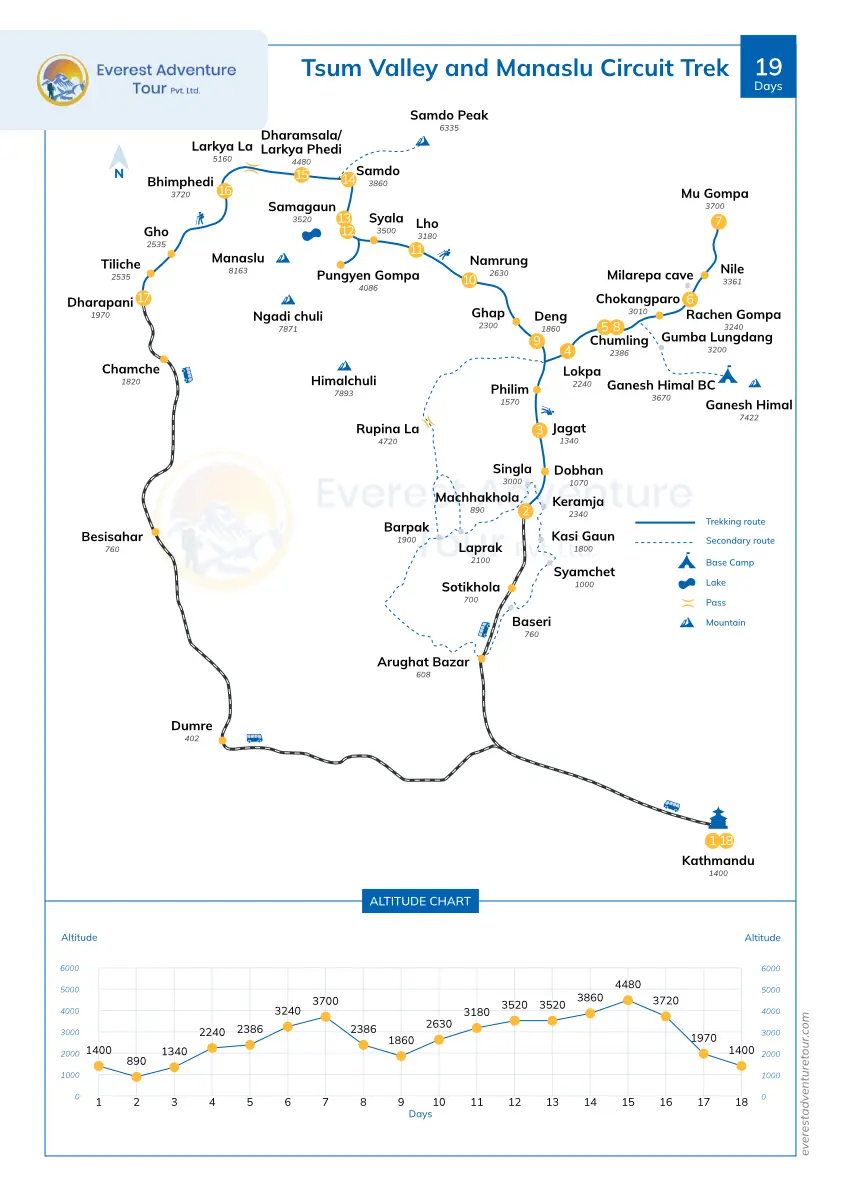
Route Map
Includes
- All Arrival and Departure Transfer from airport to hotel and vice-versa, vehicles according to group size.
- Three Star hotels in Kathmandu on bed and breakfast basis only.
- Transportation on start of trekking and after trek to and from Kathmandu.
- Full board trekking includes twin sharing accommodation on best available local lodges, includes Breakfast, lunch, dinner with afternoon tea / snacks.
- Service of guide, trekking staff as per size of a group with porters.
- Wages, meals, medical allowance of guides, trekking staff and porters.
- Applicable Special Trekking Permits for Restricted Areas for Manaslu and Tsum Valley.
- Includes MCA (Manaslu Conservation Area)
- ACAP (Annapurna Conservation Area Project) Entrance Fees.
- Comprehensive Medical Kit carried by our guide if required for minor wounds and sickness.
- Sightseeing tour around Kathmandu valley as per the itinerary.
- Welcome or Farewell dinner in Kathmandu.
Doesn't Include
- Nepal Visa, Personal Medical & Travel Insurance.?
- Expenses of personal nature, meals in Kathmandu and gratitude or tipping? for trekking staff, drivers, porters and guide, including extra snacks and refreshments.?
- Personal trekking gear, including sleeping bags and down jackets (if it is not? included on the trip cost).?
- Emergency Evacuation if required by any means of transportation, including? Helicopter Service.?
- Personal medical kit, as advised by you doctors.?
- Early return from the trek due to personal domestic or medical reasons, no refund will be entertained on breaking the journey.
- Excellent customer service. Our travel experts are ready to help you 24/7.
- Best price guaranteed.
- No credit card or booking fees.
- 100% financial protection.
- Environmentally-friendly tours.
Equipment List
- Thermal underwear (top and bottom)
- Moisture-wicking long-sleeved t-shirts
- Moisture-wicking underwear
- Fleece jacket or pullover
- Insulated down or synthetic jacket (lightweight and warm)
- Waterproof, windproof jacket (Gore-Tex or similar)
- Waterproof, windproof pants
- Trekking pants (convertible preferred)
- Warm beanie or wool hat
- Sun hat or baseball cap
- Neck gaiter, buff, or scarf
- Waterproof trousers (for rain and snow)
- Lightweight inner gloves (thermal or liner gloves)
- Insulated outer gloves or mittens (waterproof)
- Waterproof, broken-in hiking boots with ankle support
- Comfortable camp shoes or sandals (for evenings)
- Trekking socks (wool or synthetic, several pairs)
- Gaiters (optional, for snow and mud)
- Trekking backpack (30-40 liters) with rain cover
- Daypack (optional, for short hikes)
- Sleeping bag (rated to at least -10°C / 14°F)
- Insulated sleeping pad or foam mattress
- Adjustable trekking poles (with rubber tips)
- Insulated water bottles or hydration bladder (2-liter capacity recommended)
- Sunglasses with UV protection
- Headlamp with extra batteries
- Power bank and chargers (for electronics)
- Camera and extra batteries/memory cards
- Travel-size toiletries (toothbrush, toothpaste, biodegradable soap)
- Quick-dry towel
- Wet wipes and hand sanitizer
- Sunscreen (high SPF) and lip balm with SPF
- Personal first aid kit (bandages, blister pads, antiseptic, medication)
- Medications for altitude sickness (Diamox if prescribed)
- Pain relievers, anti-diarrheal, antihistamines
- Earplugs (for noisy lodges)
- Notebook and pen
- Portable solar charger (optional)
- Plastic zip-lock bags (to keep gear dry)
- Lightweight stuff sacks or packing cubes
- Snacks (energy bars, nuts, chocolates)
- Reusable water bottle or hydration system
- Small knife or multi-tool
- Passport-size photos (for permits if needed)
Frequently Asked Questions
Yes, both Tsum Valley and the Manaslu Circuit fall under Nepal’s Restricted Trekking Regions. Tsum Valley was officially opened to foreign trekkers in 2007, while Upper Manaslu has allowed access since 1991. These areas are located near the Tibet-China border and are culturally sensitive zones. Therefore, entry is only permitted with special Restricted Area Permits, which must be arranged through a registered trekking agency like Everest Adventure Tour. Additional conservation permits like MCAP (Manaslu Conservation Area Project) and ACAP (Annapurna Conservation Area Project) are also required. Trekking independently is not allowed—a licensed guide is mandatory.
Surprisingly, trekkers will find a wide variety of meals available even in remote areas. Teahouses along the route serve Nepali, Tibetan, Indian, Chinese, and some continental options like pasta, pancakes, and soups. Meals are mostly fresh and hygienic, though simpler in Tsum Valley due to its remoteness. Accommodation ranges from basic to moderate teahouses, especially in places like Jagat, Namrung, Lho, and Sama Gaon. However, in smaller villages like Chumling, Rachen Gompa, or Dharmasala, lodges are simpler with shared toilets and limited services. Despite basic infrastructure in some places, the hospitality is warm, and facilities are generally clean and comfortable.
The Tsum Valley and Manaslu Circuit Trek covers an approximate distance of 225 kilometers (140 miles) from Machha Khola to Dharapani. Trekkers typically walk 5 to 8 hours per day, depending on altitude, terrain, and weather. On some days—such as the Larkya La Pass crossing—you may walk up to 10 hours. Everest Adventure Tour carefully paces the trek to allow for acclimatization, rest, and sightseeing. Itineraries can also be customized to include shorter or longer durations, depending on your fitness level and interests.
Most teahouses along the trek are equipped with solar or micro-hydro power, allowing you to charge devices like cameras, phones, and power banks (for a small fee). However, charging is not always available during cloudy or stormy days. Internet and Wi-Fi services are available in select villages like Jagat, Namrung, Lho, and Sama Gaon, but are slow and often unreliable due to weather and remoteness. In deeper valleys, signals may be blocked entirely. We recommend purchasing a Nepali SIM card (like Ncell or NTC) in Kathmandu before the trek, which may work intermittently in some lower regions.
The best seasons are Spring (April to May) and Autumn (September to November). In spring, the trails come alive with colorful rhododendron forests, and the weather is warm and pleasant. Autumn offers the clearest skies and best mountain views, although temperatures are cooler, especially in the mornings and evenings. While monsoon (June–August) and winter (December–February) treks are possible, they are not ideal due to muddy trails, leeches, or heavy snowfall, especially over Larkya La Pass. Everest Adventure Tour recommends spring and autumn for the most enjoyable trekking experience.
Yes, acclimatization is crucial as the trek reaches over 5,000 meters at Larkya La Pass. Everest Adventure Tour includes at least one full rest day at Sama Gaon (3,520m), which offers short hikes to Birendra Lake, Pungen Monastery, or even Manaslu Base Camp. These excursions help the body adapt to higher elevations. We follow a “climb high, sleep low” principle and encourage a gradual pace throughout. Symptoms of Acute Mountain Sickness (AMS) can affect anyone, so we take health checks seriously, with our guides trained in first aid and altitude response.
While you don’t need to be an athlete, you should be in good physical condition with the ability to hike for several hours per day over steep, rugged terrain. The trek is rated moderate to strenuous, especially due to its length (19 days) and the high altitude crossing at Larkya La (5,160m). Prior trekking experience is helpful but not required. Regular cardio training, hill walking, or strength workouts before the trek will greatly enhance your stamina and enjoyment. Our itinerary is designed to allow proper acclimatization and rest, making it achievable for any determined, prepared trekker.
Everest Adventure Tour provides experienced, licensed guides fluent in English and local dialects. They are well-versed in mountain safety, cultural interpretation, and first-aid response. Our porters are insured, fairly paid, and follow the weight limit policy (usually 20–25 kg per porter). The guide-to-client ratio is kept optimal to ensure individual care and safety. Our support team assists with logistics, permits, accommodations, and emergency coordination, ensuring you focus fully on the trekking experience without stress.
Yes, Tsum Valley and the Manaslu region are culturally sensitive areas with a deep-rooted Tibetan Buddhist heritage. Trekkers are expected to respect local customs, such as walking clockwise around mani walls and chortens, and dressing modestly, especially near monasteries. Taking photos of people or sacred sites should be done with permission. Everest Adventure Tour educates all our clients on cultural etiquette and local traditions, ensuring a respectful and meaningful journey. Interacting with locals respectfully can be one of the most rewarding parts of this trek.
This trek requires a total of four permits:
Manaslu Restricted Area Permit (MRAP)
Tsum Valley Restricted Area Permit (TVRAP)
Manaslu Conservation Area Permit (MCAP)
Annapurna Conservation Area Permit (ACAP)
Permits can only be issued through a government-registered trekking agency, and solo trekking is not allowed in restricted zones. Everest Adventure Tour handles all permit arrangements, requiring only your passport copy and photos before the trek. These permits are strictly checked at multiple checkpoints along the trail, so having them properly prepared is essential for a smooth journey.