

- 1 - 1 Person US$ 750
- 2 - 5 Person US$ 650
- 6 - 12 Person US$ 620
- 13 - 20 Person US$ 599
3*** Hotel in Kathmandu and Pokhara and Lodge during the trek.
Breakfast in Kathmandu and all meals during the trek.
Highlights
- Following the historical Trans-Himalaya caravan route between Nepal and Tibet.
- Shortest and most picturesque country walks through the green hills of Annapurna.
- Fantastic panoramic views of three of the world’s highest mountain ranges from Poon Hill.
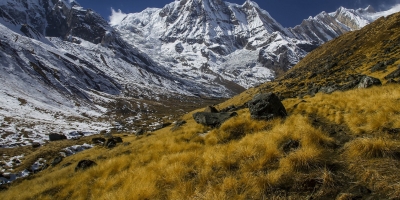
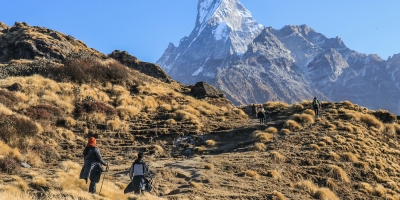
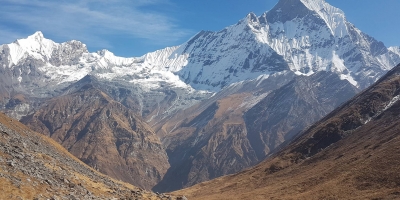
- Constant, breathtaking views of snow-capped peaks throughout the trek from Pokhara to Ghorepani.
- Spectacular sunrise views over a 360° wide range of the Himalayan mountain range from Poon Hill.
- Trekking through dense rhododendron and pine forests, especially vibrant during spring bloom.
- Visiting traditional Gurung villages such as Ghandruk, rich in culture and heritage.
- Opportunity to experience both Hindu and Buddhist mountain cultures firsthand.
- Stunning views of iconic peaks like Annapurna I, Dhaulagiri, and Manaslu.
- Diverse landscapes ranging from terraced farmland to alpine hills.
Overview
“Short and Scenic Adventure on the Southern Green Hills of the Annapurna Himalayas”
The Ghorepani Poon Hill Trek is a captivating journey along a historic route once used for the Trans-Himalayan salt trade. This ancient trail, stretching beyond Ghorepani towards Upper Mustang near the Nepal-Tibet border, was a vital passage for caravans of mules carrying salt and goods. The name Ghorepani itself—meaning “watering place for horses and mules”—reminds us of this rich trading heritage.
As one of the most popular trekking destinations in Nepal, the Ghorepani Poon Hill Trek offers a perfect blend of cultural insight and natural beauty. The route ascends from warm, lush paddy fields into cooler, alpine hills blanketed with dense forests of rhododendron and pine trees. Trekkers are rewarded with stunning, uninterrupted views of the Annapurna mountain range throughout the trek.
The trail is suitable for all age groups and experience levels, with gradual elevation gains culminating at the iconic Poon Hill. This scenic viewpoint is the highlight of the trek, offering breathtaking panoramic vistas of the Himalayas. At sunrise, the sky lights up with spectacular colors over a 360° range of peaks, including some of the world’s tallest mountains—Mt. Dhaulagiri (7th highest), Mt. Manaslu (8th highest), and Mt. Annapurna (10th highest).
While the trek involves moderate physical effort, including some steep climbs and descents, every step is rewarded by awe-inspiring landscapes of green hills, deep valleys, and towering peaks. Along the way, trekkers experience the unique cultural heritage of the region, visiting charming mountain villages where Hindu and Buddhist traditions coexist and thrive.
Ideal as an introductory trek for beginners and a refreshing adventure for seasoned trekkers alike, this route offers a scenic circuit with an alternative return path. After the sunrise at Poon Hill, the trail leads down through the large Gurung village of Ghandruk—a significant cultural and trekking gateway in the Annapurna region. Walking through rhododendron forests and pine trees, you descend to Ghandruk before continuing to Pokhara, where the trek concludes amidst the stunning southern Annapurna hills.
At Everest Adventure Tour, we ensure that your Ghorepani Poon Hill experience is safe, enjoyable, and culturally enriching—offering you an unforgettable introduction to Nepal’s majestic Himalayas.
Major Places for Ghorepani Poon Hill Trek
The Ghorepani Poon Hill Trek takes you through some of the most charming and culturally rich spots in the Annapurna region, each offering a unique blend of natural beauty and traditional Himalayan village life.
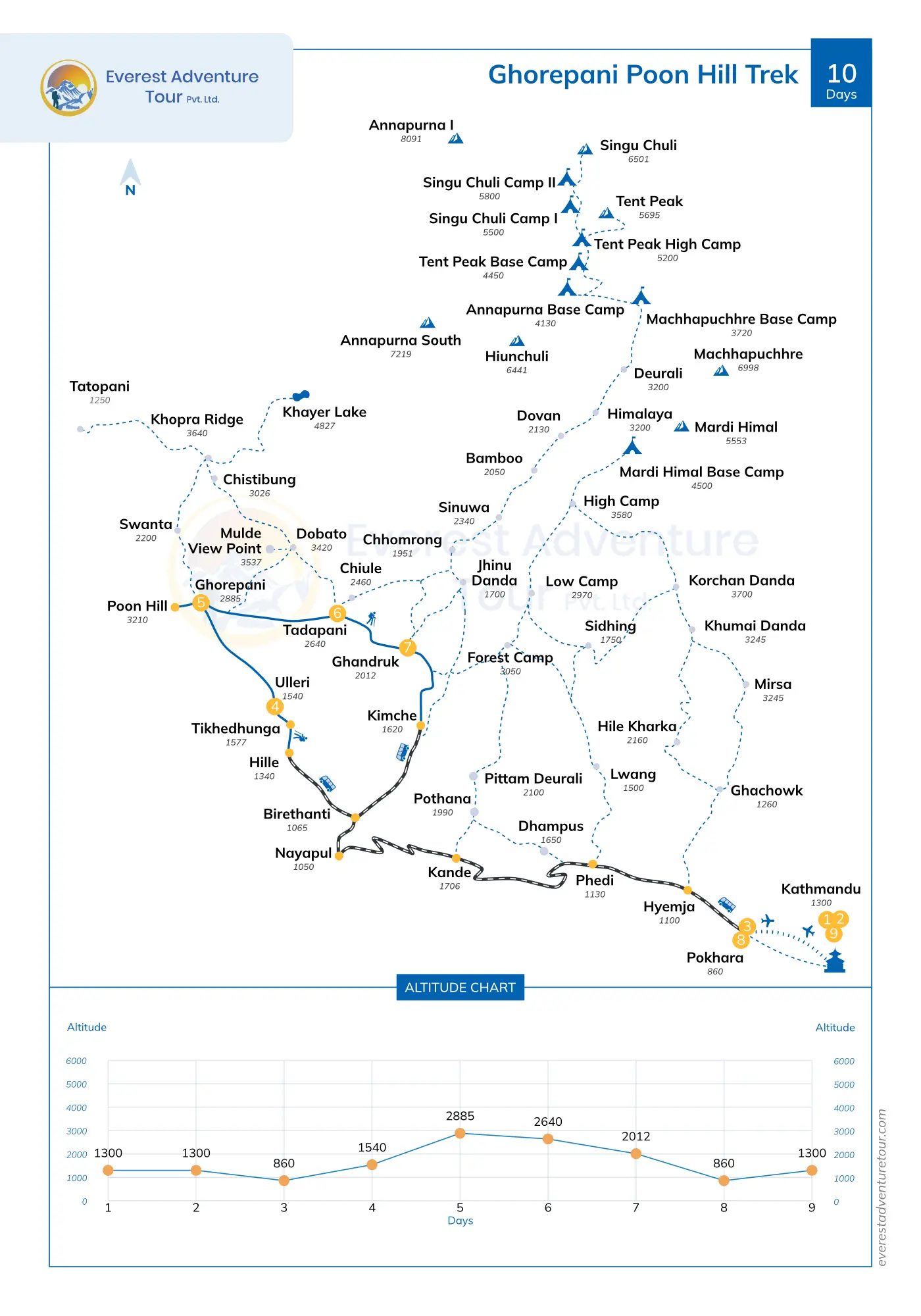
Hille: The trek typically begins with a drive from Pokhara to Hille, a quaint village situated at 1,340 meters. From here, the trail winds through terraced fields and rural settlements, giving trekkers a chance to see local agricultural practices and interact with welcoming villagers. Hille serves as the gateway to the lush hills and forests that lie ahead.
Ulleri: After a moderate 6-hour trek from Hille, you reach Ulleri at 2,070 meters. Ulleri is famous for its long stone staircase—over 3,000 steps—that challenges trekkers but rewards them with breathtaking views. The village is surrounded by dense forests of rhododendron and oak, especially stunning during spring bloom.
Ghorepani: At 2,885 meters, Ghorepani is the heart of this trek. It is a bustling teahouse village that serves as the base for the famous sunrise hike to Poon Hill. Ghorepani’s location offers incredible panoramic views of Annapurna South, Annapurna I, and Dhaulagiri ranges, setting the tone for the adventure.
Poon Hill: The highlight of the trek, Poon Hill stands at 3,210 meters. Early morning treks to this vantage point offer mesmerizing 360-degree views of the Himalayas, making it one of the most sought-after sunrise viewpoints in Nepal. The mountain panorama includes Mt. Dhaulagiri, Mt. Annapurna, and Mt. Manaslu.
Tadapani and Ghandruk: On the descent, trekkers visit Tadapani (2,640 m), surrounded by lush forests, and Ghandruk (2,012 m), a culturally significant Gurung village known for its traditional architecture and hospitality. Ghandruk is also a major gateway for extended Annapurna treks, enriching your experience with authentic mountain culture.
Best Season for Ghorepani Poon Hill Trek
Choosing the right season for the Ghorepani Poon Hill Trek greatly enhances the experience, allowing trekkers to enjoy clear skies, pleasant weather, and vibrant natural scenery.
Autumn (September to November): This is the most popular and arguably the best time for the trek. Post-monsoon weather brings clear skies, moderate temperatures, and excellent visibility of the mountain ranges. Rhododendron forests are lush and the air crisp, making sunrise views from Poon Hill especially spectacular.
Spring (March to May): Spring is another favored season, marked by blooming rhododendrons that paint the hillsides in shades of red and pink. Temperatures are warmer, and the weather stable, making it comfortable for trekking. This season offers a perfect balance of floral beauty and mountain views.
Winter (December to February): While the trek is doable in winter, trekkers should be prepared for cold temperatures, especially at higher altitudes. The skies are usually clear, providing great mountain visibility, but early mornings and nights can be very chilly.
Monsoon (June to August): The monsoon season is generally avoided due to heavy rains, slippery trails, and poor visibility. However, if you enjoy solitude and lush green landscapes with fewer tourists, this time can also offer a unique experience, though trekking conditions can be challenging.
Ghorepani Poon Hill Trekking Difficulty Level
The Ghorepani Poon Hill Trek is considered a moderate trek, accessible to a wide range of trekkers, including beginners, families, and seasoned hikers looking for a short but rewarding adventure.
Elevation Gain and Terrain: The trek starts from around 1,300 meters and climbs to Poon Hill at 3,210 meters. The elevation gain is gradual but includes some steep stone staircases, particularly around Ulleri and Ghorepani. The trail consists mainly of well-maintained dirt paths and stone steps, making navigation relatively straightforward.
Physical Demands: While no technical climbing skills are required, trekkers should be prepared for 4 to 6 hours of walking daily, sometimes on uneven and rocky terrain. The altitude is moderate, but acclimatization is important to avoid altitude sickness, especially when ascending to Poon Hill.
Suitable for Beginners: Due to its moderate difficulty, the trek is an excellent choice for those new to trekking or with limited time. The presence of teahouses and lodges along the route ensures comfortable overnight stays and easy access to food and rest.
Fitness Requirements: Basic fitness is recommended. Regular walking or light hiking before the trip can help build stamina and prepare you for the trek. The mix of uphill climbs and downhill sections offers a balanced physical challenge.
Support from Everest Adventure Tour: Our experienced guides from Everest Adventure Tour provide support throughout, ensuring safe pacing, acclimatization advice, and assistance with logistics, making the trek an enjoyable and secure experience for all participants.
Food and Accommodation for Ghorepani Poon Hill Trek
During the Ghorepani Poon Hill Trek, trekkers experience a delightful combination of traditional Nepali hospitality and simple mountain comforts. The trail is dotted with teahouses and lodges that cater to the needs of trekkers, providing a cozy place to rest and replenish after a day of hiking.
Food: The teahouses offer a variety of meals, ranging from local Nepali dishes such as dal bhat (lentil soup with rice), momos (dumplings), and vegetable curries, to more familiar western-style options like pasta, fried rice, and omelets. The availability of hot drinks such as tea, coffee, and hot chocolate is a comfort during chilly mornings and evenings. Although meals are hearty and nutritious, it is advisable to bring some personal snacks or energy bars for extra fuel on the trail.
Accommodation: Accommodation along the route is basic but comfortable, typically consisting of shared rooms with simple beds and warm blankets. Facilities vary between villages but usually include communal dining areas and shared bathroom facilities. At popular stops like Ghorepani and Tadapani, lodges tend to be more developed, offering better amenities. Electricity is generally limited to evenings, so bringing a headlamp or flashlight is useful.
Tips for Comfort: Carrying a sleeping bag liner is recommended to ensure hygiene and warmth. Booking accommodation through a reliable trekking company like Everest Adventure Tour ensures that you stay in reputable, clean lodges that prioritize guest comfort and safety.
Network and Communication for Ghorepani Poon Hill Trek
Staying connected during the Ghorepani Poon Hill Trek is possible but can vary depending on the location and service providers. Most trekking areas have gradually improved their network infrastructure, but it’s important to manage expectations.
Mobile Network: Major Nepali telecom providers such as Ncell and Nepal Telecom cover most of the trail, including villages like Ulleri, Ghorepani, and Ghandruk. While network signals are generally reliable in larger villages, connectivity may weaken or be intermittent in more remote sections of the trek. It’s wise to keep phones on airplane mode when not in use to conserve battery.
Internet Access: Some teahouses offer Wi-Fi, typically in the evenings when electricity is available. However, the connection speed is usually slow and may not support high-bandwidth activities like video calls or streaming. Satellite phones can be rented for those who require more reliable communication in emergencies.
Emergency Communication: Everest Adventure Tour equips our guides with communication devices to maintain contact with the base camp and assist in emergencies. We prioritize your safety by ensuring prompt access to help if needed.
Ghorepani Poon Hill Trekking Transportation
Transportation logistics for the Ghorepani Poon Hill Trek are well-organized to provide a smooth and comfortable journey before and after trekking.
Kathmandu to Pokhara: The adventure begins with a scenic 30-minute flight from Kathmandu to Pokhara, offering stunning aerial views of the Himalayas and lush valleys. Flights are frequent and provide the quickest access to the trekking region.
Pokhara to Hille: From Pokhara, trekkers travel by road to Hille (approximately 3-4 hours). This drive passes through rural landscapes and small villages, providing a glimpse of local life outside the city. Roads can be winding but are generally in good condition.
Trail Transportation: The trekking portion is entirely on foot, following well-marked trails. Porters and pack animals are available for hire to assist with heavy luggage, ensuring trekkers can enjoy the journey without being overburdened.
Return Transport: After completing the trek, trekkers drive back from Kimche to Pokhara before flying back to Kathmandu. These transfers are coordinated by Everest Adventure Tour to ensure timely and comfortable movements.
Ghorepani Poon Hill Trekking Permits
Permits are essential for trekking in the Annapurna region and are required to ensure sustainable tourism and local community development.
Annapurna Conservation Area Permit (ACAP): This permit is mandatory for trekking in the Ghorepani Poon Hill area. It is issued by the Nepal government and helps fund conservation and community projects. The permit is usually obtained in Pokhara or Kathmandu and must be carried during the trek for inspection.
Trekkers’ Information Management System (TIMS) Card: The TIMS card is an additional permit required for trekkers. It helps track trekking activity for safety and rescue operations. TIMS can be acquired alongside ACAP or at the Nepal Tourism Board offices.
Permit Process: Everest Adventure Tour facilitates all permit arrangements before the trek to avoid delays. Carrying copies of your permits during the trek is advised, as checkpoints regularly verify permits.
Fees: Permit fees contribute to park conservation and support local economies. Fees vary but are reasonable, reflecting Nepal’s commitment to preserving its natural heritage.
Why Choose Ghorepani Poon Hill Trek?
The Ghorepani Poon Hill Trek stands out as a premier trekking experience for those seeking breathtaking mountain scenery combined with cultural richness, making it a perfect choice for a wide range of trekkers.
Accessible and Moderate: It offers a manageable trekking experience without requiring technical skills or extreme fitness, ideal for beginners and those short on time but eager to explore the Himalayas.
Spectacular Views: The trek’s crown jewel, Poon Hill, provides arguably some of the best sunrise mountain views in Nepal. The panoramic vistas include iconic peaks such as Annapurna, Dhaulagiri, and Manaslu, ensuring an unforgettable visual experience.
Cultural Immersion: Trekking through traditional villages like Ghorepani and Ghandruk, you witness a harmonious blend of Hindu and Buddhist cultures, age-old traditions, and warm local hospitality.
Diverse Landscapes: The journey transitions from warm, green lowlands to cool alpine forests, rhododendron blooms, and rugged mountain terrain, offering varied ecosystems within a compact itinerary.
Trusted Company Support: With Everest Adventure Tour, you benefit from experienced guides, well-planned logistics, and dedicated support ensuring your trek is safe, comfortable, and culturally enriching.
Important Note
Trip Itinerary

Max. altitude

Accommodation

Meals
Max. altitude
Accommodation
Meals
Max. altitude
Accommodation
Meals
Max. altitude
Accommodation
Meals
Max. altitude
Accommodation
Meals
Max. altitude
Accommodation
Meals
Max. altitude
Accommodation
Meals
Max. altitude
Accommodation
Meals
Max. altitude
Accommodation
Meals
Max. altitude
Accommodation
Meals
Route Map
Includes
- All Arrival and Departure Transfer from airport to hotel and vice-versa, vehicles according to group size.
- Three Star hotels in Kathmandu & Pokhara on bed and breakfast basis only.
- Transportation on start of trekking and after trek to and from Pokhara. Includes domestic airfare Kathmandu-Pokhara-Kathmandu.
- Full board trekking includes twin sharing accommodation on best available local lodges, includes Breakfast, lunch, dinner with afternoon tea / snacks.
- Service of guide, trekking staff as per size of a group with porters.
- Wages, meals, medical allowance of guides, trekking staff and porters.
- Applicable Special Trekking Permits TIMS (Trekking Information Management Systems). Includes ACAP (Annapurna Conservation Area Project) Entrance Fees.
- Comprehensive Medical Kit carried by our guide if required for minor wounds and sickness.
- Sightseeing tour around Kathmandu valley as per the itinerary.
- Welcome or Farewell dinner in Kathmandu.
Doesn't Include
- Nepal Visa, Personal Medical & Travel Insurance.?
- Expenses of personal nature, meals in Kathmandu and gratitude or tipping? for trekking staff, drivers, porters and guide, including extra snacks and refreshments.?
- Personal trekking gear, including sleeping bags and down jackets (if it is not included on the trip cost).?
- Emergency Evacuation if required by any means of transportation, including? Helicopter Service.?
- Personal medical kit, as advised by you doctors.?
- Early return from the trek due to personal domestic or medical reasons, ?no refund will be entertained on breaking the journey.
- Excellent customer service. Our travel experts are ready to help you 24/7.
- Best price guaranteed.
- No credit card or booking fees.
- 100% financial protection.
- Environmentally-friendly tours.
Equipment List
- Thermal underwear (top and bottom)
- Moisture-wicking long-sleeved t-shirts
- Moisture-wicking underwear
- Fleece jacket or pullover
- Insulated down or synthetic jacket (lightweight and warm)
- Waterproof, windproof jacket (Gore-Tex or similar)
- Waterproof, windproof pants
- Trekking pants (convertible preferred)
- Warm beanie or wool hat
- Sun hat or baseball cap
- Neck gaiter, buff, or scarf
- Waterproof trousers (for rain and snow)
- Lightweight inner gloves (thermal or liner gloves)
- Insulated outer gloves or mittens (waterproof)
- Waterproof, broken-in hiking boots with ankle support
- Comfortable camp shoes or sandals (for evenings)
- Trekking socks (wool or synthetic, several pairs)
- Gaiters (optional, for snow and mud)
- Trekking backpack (30-40 liters) with rain cover
- Daypack (optional, for short hikes)
- Sleeping bag (rated to at least -10°C / 14°F)
- Insulated sleeping pad or foam mattress
- Adjustable trekking poles (with rubber tips)
- Insulated water bottles or hydration bladder (2-liter capacity recommended)
- Sunglasses with UV protection
- Headlamp with extra batteries
- Power bank and chargers (for electronics)
- Camera and extra batteries/memory cards
- Travel-size toiletries (toothbrush, toothpaste, biodegradable soap)
- Quick-dry towel
- Wet wipes and hand sanitizer
- Sunscreen (high SPF) and lip balm with SPF
- Personal first aid kit (bandages, blister pads, antiseptic, medication)
- Medications for altitude sickness (Diamox if prescribed)
- Pain relievers, anti-diarrheal, antihistamines
- Earplugs (for noisy lodges)
- Notebook and pen
- Portable solar charger (optional)
- Plastic zip-lock bags (to keep gear dry)
- Lightweight stuff sacks or packing cubes
- Snacks (energy bars, nuts, chocolates)
- Reusable water bottle or hydration system
- Small knife or multi-tool
- Passport-size photos (for permits if needed)
Frequently Asked Questions
A moderate adventure as well a short trek, all age group can enjoy the walk to Ghorepani and Poon Hill. Where altitude does not make a difference, the only tough is climb uphill on first day to Ulleri village. Including hike up to Poon Hill and then to Deurali on return journey. But taking slow and steady with enough short rest can overcome the steep and hard section of the treks. Rest of walk is more downhill on the way back to Pokhara. Families with young children and elderly people of 75 to 80 years of age can join. All should be in normal physical shape and good health, if someone has any medical history can take advice from your doctors before signing for the treks.
?Trekkers will be surprised to find good food menu of varieties, from Tibetan, Nepali, Indian and Chinese to Continental. Includes long list of snacks and drinks for the customer delights in most lodges on treks.
The lodge accommodation are nice and lovely according to the choices of the trekkers. From budget, standard to luxury accommodation at Ghandruk village, either attached or non-attached bath and toilets. But in Ulleri, Ghorepani and Tadapani the lodges are simple and clean with nice rooms with large and warm dining.
One of the most visited trekking destinations than all areas of Nepal Himalayas, due to its moderate walking trails. As well easy accessibility for drive up to Hille or Ulleri village, and for lovely views of surrounding beautiful scenery.
The Poon Hill an amazing scenic hill top that attracts thousands of visitors from across the world at every good seasons.
All lodges have hydro-power to run electricity, or by solar power, where trekkers can charge their electronic items and gadgets. A fee is charged per hour for each items, as for internet and Wi-Fi, have connection. Depending upon the areas in deep gorge and valley, as well weather wise, can be disturbing with bad receptions. The best place is Ghorepani and Ghandruk, other places works well with local SIM. Which can be bought in Kathmandu at reasonable cost.
Spring season from March to May. The whole areas of Ghorepani till Tadapani will be bright and lively with wildflowers in seasonal bloom. The surrounding forest of Ghorepani is listed as the world’s natural rhododendron garden. Trekkers can observe the wildflowers of all colors and different species. Especially the rhododendron flowers of great variation from tall trees to short bush.
Truly an enchanting place to experience during the spring time of March to May when the hills are alive and bright with wildflowers.
The trek is classified as moderate, requiring good basic fitness and stamina. Daily walks range from 4 to 6 hours on mixed terrain with some steep sections, particularly the stone staircases near Ulleri and Ghorepani. Everest Adventure Tour encourages trekkers to prepare physically by walking regularly before the trip and provides guidance to maintain a comfortable pace during the trek.
Yes, Everest Adventure Tour offers professional guides and porters to assist trekkers, which can greatly enhance the experience by easing the load and providing cultural insights. Hiring porters is highly recommended for comfort and safety, especially for those with limited trekking experience or carrying heavy backpacks.
Altitude sickness can affect anyone regardless of experience. Everest Adventure Tour’s experienced guides are trained to recognize early symptoms and provide immediate assistance, including advising rest days, ensuring proper hydration, and arranging rapid descent if needed. We prioritize safety and carry oxygen and first-aid kits to handle emergencies promptly during the trek.
Two main permits are required: the Annapurna Conservation Area Permit (ACAP) and the Trekkers’ Information Management System (TIMS) card. These permits help protect the environment and ensure trekkers’ safety. Everest Adventure Tour arranges all permits on behalf of trekkers, simplifying the process and ensuring compliance with Nepalese regulations.
Medical facilities are limited along the Ghorepani Poon Hill route, but basic first aid is available at teahouses, and Everest Adventure Tour guides carry comprehensive first-aid kits. In case of serious illness or injury, evacuation can be arranged to Pokhara or Kathmandu hospitals. Our team is trained to manage emergencies and coordinate swift medical responses if required.