

Hotel in Kathmandu and Tea house / lodges during the trek
Breakfast in Kathmandu and all meals during the trek
Highlights
- Trek to the South Base Camp of Kanchenjunga, the world’s third-highest peak (8,586 m).
- Panoramic views of Kanchenjunga, Jannu, Pandim, and other Himalayan peaks
- Scenic landscapes: rivers, forests, alpine meadows, and high-altitude valleys.
- Cultural encounters with Limbu, Sherpa, and Rai communities.
- Visit to Oktang viewpoint for spectacular mountain vistas.
- Immersive experience in traditional tea houses and local villages.
- Blooming rhododendron forests in spring and clear skies in autumn.
- Opportunity to experience pristine Himalayan wilderness and biodiversity.
Overview
The Kanchenjunga South Base Camp Trek, offered by Everest Adventure Tour, is one of Nepal's most remote and spectacular trekking experiences. Unlike the more crowded Everest or Annapurna regions, this trek takes you through untouched trails, traditional villages, lush rhododendron forests, and dramatic mountain landscapes. Trekking to the South Base Camp of Kanchenjunga, the third highest peak in the world at 8,586 meters, provides trekkers with breathtaking views of snow-capped peaks, glacial valleys, and alpine meadows. This trek is perfect for adventure enthusiasts seeking solitude, cultural encounters, and stunning Himalayan panoramas.
The journey begins in Kathmandu, where trekkers experience a rich cultural tour of UNESCO World Heritage Sites before flying to Bhadrapur. From there, a scenic drive through eastern Nepal introduces travelers to the diverse landscapes, from lowland jungles to the rolling hills of Taplejung. The trekking portion starts in Yasang, gradually ascending through Tortong, Cheram, and Ramche, with opportunities to witness traditional Limbu and Sherpa villages. The trek also includes a visit to the Oktang viewpoint, offering panoramic views of Kanchenjunga’s main peaks.
Highlights of the trek include:
- Views of Kanchenjunga, Jannu, Pandim, and other Himalayan peaks.
- Remote, off-the-beaten-path trails with minimal crowds.
- Immersive cultural experiences in local villages.
- Scenic landscapes including rivers, forests, and high-altitude passes.
Best Season for Kanchenjunga South Base Camp Trek
The best times to undertake the Kanchenjunga South Base Camp Trek are spring (March to May) and autumn (late September to November). These seasons offer the clearest skies, making mountain views spectacular and photography ideal. During spring, rhododendron forests burst into vibrant colors, while autumn provides crisp air and stable weather conditions. Summer, due to the monsoon (June to August), brings heavy rainfall, slippery trails, and leeches, making trekking more challenging. Winter (December to February) is cold and sometimes inaccessible due to snow at higher elevations, but it may appeal to trekkers seeking solitude.
Choosing the right season is crucial to fully enjoy this remote region. Everest Adventure Tour ensures that your trek aligns with the optimal season to enhance safety, comfort, and the overall experience. Proper planning during the right season allows trekkers to witness pristine mountain vistas, abundant wildlife, and flourishing alpine flora without encountering crowded trails.
Key seasonal highlights:
- Spring (March–May): Blooming rhododendrons, moderate temperatures.
- Autumn (September–November): Clear skies, ideal for photography.
- Summer (June–August): Risk of rain, slippery paths, and leeches.
- Winter (December–February): Snow-covered trails, minimal crowds, cold conditions.
Kanchenjunga South Base Camp Trekking Difficulty and Transportation
The Kanchenjunga South Base Camp Trek is categorized as moderate to challenging, suitable for trekkers with a good level of fitness and some prior trekking experience. The trek combines long walking days, steep ascents, and occasional high-altitude challenges. The highest point, Ramche (4,580 m), and other high passes require proper acclimatization to avoid altitude sickness. Unlike popular trekking regions, trails are less developed, so trekkers must be prepared for uneven paths, suspension bridges, and remote areas.
Transportation to the trailhead is convenient yet adventurous. After sightseeing in Kathmandu, trekkers fly to Bhadrapur, followed by scenic drives through eastern Nepal to reach Yasang, the starting point of the trek. Road travel offers glimpses of rural life, tea gardens, and dense forests. Everest Adventure Tour ensures safe and comfortable travel arrangements with experienced drivers familiar with mountain roads.
Difficulty and transportation highlights:
- Moderate to challenging trek with long daily hikes (3–8 hours).
- Remote trails with limited infrastructure.
- High-altitude trekking with acclimatization needed.
- Transportation by flight (Kathmandu to Bhadrapur) and local drives to trailhead.
Food and Accommodation for Kanchenjunga South Base Camp Trek
During the Kanchenjunga South Base Camp Trek, food and accommodation reflect the region’s remote and traditional Himalayan lifestyle. Trekkers typically stay in tea houses and lodges, offering simple rooms with basic amenities. In higher villages, facilities may be rustic, with shared bathrooms and limited electricity, but they provide a warm, hospitable environment. Staying in these lodges allows trekkers to experience local culture firsthand and interact with villagers.
Food on the trek is a mix of Nepali, Tibetan, and local cuisine. Staples include rice, lentils (dal), noodles, momos (dumplings), and fresh vegetables. Tea houses provide hot meals and beverages, essential for energy during long trekking days. Everest Adventure Tour emphasizes hygiene and balanced nutrition, ensuring trekkers are well-fueled and comfortable. High-altitude dining is simple but satisfying, and trekkers can enjoy freshly brewed butter tea and local specialties in small villages.
Food and accommodation highlights:
- Tea houses and lodges with basic facilities.
- Local and Nepali cuisine: dal bhat, noodles, momos.
- Interaction with villagers and cultural immersion.
- Warm hospitality despite remote locations.
Kanchenjunga South Base Camp Trekking Permits
Trekking to Kanchenjunga South Base Camp requires special permits due to the area’s protected status and restricted access. Trekkers must obtain the Kanchenjunga Conservation Area Permit (KCAP) and the Trekkers’ Information Management System (TIMS) card. These permits help conserve the fragile Himalayan ecosystem and support local communities. Permits can only be arranged through registered trekking agencies, such as Everest Adventure Tour, ensuring all legal and logistical requirements are met smoothly.
The Kanchenjunga region is less commercialized than other trekking areas, so permits are crucial for controlled access and environmental protection. These regulations help maintain the pristine beauty of the landscape, protect wildlife, and preserve the local culture. Everest Adventure Tour handles all documentation, allowing trekkers to focus on the journey without administrative stress.
Permit highlights:
- Kanchenjunga Conservation Area Permit (KCAP) for protected regions.
- TIMS card for all trekkers.
- Obtained through registered trekking agencies.
- Supports environmental conservation and local communities.
Why Choose Kanchenjunga South Base Camp Trek
Choosing the Kanchenjunga South Base Camp Trek with Everest Adventure Tour promises an unparalleled adventure in one of Nepal’s most pristine and remote regions. Unlike popular trekking destinations, Kanchenjunga offers solitude, unspoiled trails, and a deep connection with nature and local culture. The trek combines breathtaking mountain vistas, rich biodiversity, and encounters with indigenous communities. Every day brings a new experience, from crossing suspension bridges over rushing rivers to walking through rhododendron forests and high-altitude meadows.
Everest Adventure Tour ensures a safe, well-organized, and culturally immersive trekking experience. Experienced guides, porters, and support staff accompany every group, providing expertise, safety, and local knowledge. The company’s commitment to sustainable tourism ensures minimal environmental impact while supporting local livelihoods. This trek is ideal for adventurers seeking a challenging yet rewarding Himalayan journey that combines natural beauty, cultural exploration, and personal achievement.
Reasons to choose this trek:
- Remote, off-the-beaten-path trekking experience.
- Panoramic views of Kanchenjunga and surrounding peaks.
- Cultural encounters with Limbu and Sherpa communities.
- Professionally guided and well-supported by Everest Adventure Tour.
- Opportunity for personal challenge, solitude, and adventure.
Important Note
Trip Itinerary
Today is dedicated to exploring the cultural and historical gems of the Kathmandu Valley. You will visit UNESCO World Heritage Sites such as the majestic Pashupatinath Temple, the serene Boudhanath Stupa, and the ancient Patan Durbar Square. Our guide will share fascinating stories and historical insights about Nepalese architecture, culture, and religion. This day allows you to immerse yourself in Nepal’s rich traditions while preparing mentally for the trek. In the evening, return to the hotel for a briefing on trekking tips and overnight stay in Kathmandu.
Early in the morning, we fly from Kathmandu to Bhadrapur, a gateway to the Kanchenjunga region. From Bhadrapur Airport, we take a scenic drive to Phikkal Bazaar, passing through lush farmland, rivers, and small villages. The drive offers an excellent opportunity to observe rural life in eastern Nepal. Upon arrival in Phikkal, we settle into local accommodation. You can enjoy the surrounding natural beauty and prepare for the long trek ahead. The evening is spent relaxing, enjoying the fresh mountain air, and reviewing the trekking plan for the coming days.
Today’s journey takes us to Taplejung, a remote district at the foothills of the Kanchenjunga. The drive is long but incredibly scenic, winding through terraced fields, rivers, and dense forests, with occasional views of distant Himalayan peaks. We stop at small villages along the way to experience local culture and sample traditional Nepali food. Taplejung is a quaint town, providing the perfect gateway to the trek. Once we arrive, we check into our lodge or guesthouse and rest, preparing for the first day of trekking tomorrow.
We start the day with a drive to Yasang, which serves as the starting point of the trek. The road winds through dense forests and remote settlements, offering glimpses of rural Himalayan life. From Yasang, we begin a gentle hike to acclimatize, passing through charming villages and rhododendron forests. The peaceful surroundings and panoramic views of distant snow-capped peaks provide a perfect introduction to the Kanchenjunga region. Upon reaching our lodge, we settle in for the night, enjoying the tranquility of the mountains and the anticipation of the challenging trek ahead.
The trek to Tortong is moderately challenging but immensely rewarding. We pass through dense rhododendron forests, cascading waterfalls, and terraced fields while ascending steadily. Along the way, we encounter local communities whose warm hospitality offers a glimpse into traditional Himalayan life. The surrounding peaks gradually come into view, growing more impressive with every step. Reaching Tortong, we are greeted by spectacular panoramic views of Kanchenjunga and neighboring mountains. The lodge provides a cozy retreat after the day’s effort, and the evening offers a chance to relax under the starlit sky.
Today’s trek ascends further into the high Himalayas as we make our way to Cheram. The trail becomes steeper, with sections of rugged terrain, but the journey is filled with rewarding vistas of glacial streams, alpine meadows, and towering peaks. Cheram is a charming village nestled amidst breathtaking scenery, and we spend the evening acclimatizing and enjoying the serene surroundings. The crisp mountain air and panoramic views make it a perfect spot to rest before the more strenuous days ahead. The evening is spent enjoying warm meals and preparing for the next day’s adventure.
The trek to Ramche is a shorter but higher-altitude hike, allowing for proper acclimatization. The trail passes through alpine landscapes, with sparse vegetation and rugged terrain. As we ascend, the views of Kanchenjunga’s South and Central peaks dominate the horizon, creating a surreal experience. Ramche is a small settlement offering basic but comfortable lodges. The evening at this altitude provides a chance to rest, breathe in the crisp mountain air, and enjoy a spectacular sunset over the surrounding peaks. This stop is crucial for acclimatization before the summit viewpoint trek.
Today we hike to the famous Oktang Viewpoint for an unforgettable view of Kanchenjunga’s massive south face. The hike involves ascending steep trails, but every step is rewarded with breathtaking scenery of glaciers, snow-capped peaks, and deep valleys. After spending ample time capturing photographs and soaking in the majestic landscape, we descend back to Cheram. The return trek is an opportunity to reflect on the beauty of the high Himalayas and the effort it took to reach such a remarkable vantage point. Evening at Cheram is spent enjoying rest and hearty meals.
Descending to New Jhoreni, we traverse mixed forests, past small streams, and charming villages. The trek today is longer, requiring 7–8 hours of hiking, but it offers varied scenery with glimpses of terraced farmlands, rhododendron forests, and distant peaks. Reaching New Jhoreni, we find comfortable lodges and a warm welcome from locals. The descent also gives a sense of accomplishment as we move closer to the lower valleys. Evening is spent relaxing, sharing trekking stories with fellow hikers, and preparing for the continued journey down to Yamphudin.
The trail today descends further through verdant forests and farmland, passing through small villages where locals greet trekkers warmly. The hike provides a chance to observe rural life in eastern Nepal, with children playing along the path and farmers tending to their fields. Reaching Yamphudin, we experience a mix of relief and satisfaction after the high-altitude trek. The village offers a tranquil atmosphere and a chance to relax in a more comfortable lodge. Evening is spent enjoying the natural beauty, reflecting on the trek’s highlights, and preparing for the long journey back to civilization.
Today we take a long but scenic drive from Yamphudin to Birtamod or Bhadrapur. The route passes through picturesque landscapes, including rivers, forests, and bustling local markets. It’s a chance to witness the changing topography from high mountains to lowland Terai. Despite the long journey of approximately 12 hours, the experience is enriching as we see the diversity of eastern Nepal. Upon arrival, we check into a hotel, enjoy a well-earned rest, and share stories from the trek over a celebratory meal, reflecting on the adventure’s successes.
After breakfast, we board a flight from Bhadrapur back to Kathmandu, returning to the bustling capital after an unforgettable mountain adventure. Upon arrival, there is time for last-minute shopping, souvenir hunting, or a relaxing spa treatment to soothe tired muscles. In the evening, Everest Adventure Tour organizes a farewell dinner where trekkers and guides celebrate the completion of the Kanchenjunga South Base Camp Trek. It’s a wonderful opportunity to relive memories, share photographs, and bond over the shared adventure. Overnight stay is at a comfortable hotel in Kathmandu.
After breakfast, you will be transferred to Tribhuvan International Airport for your onward flight. This marks the end of your remarkable journey through the Kanchenjunga region. As you leave Nepal, you carry back memories of stunning landscapes, friendly locals, and the satisfaction of conquering one of the world’s most remote trekking routes. Everest Adventure Tour extends warm wishes for your safe travels and hopes to welcome you back for another Himalayan adventure in the future.
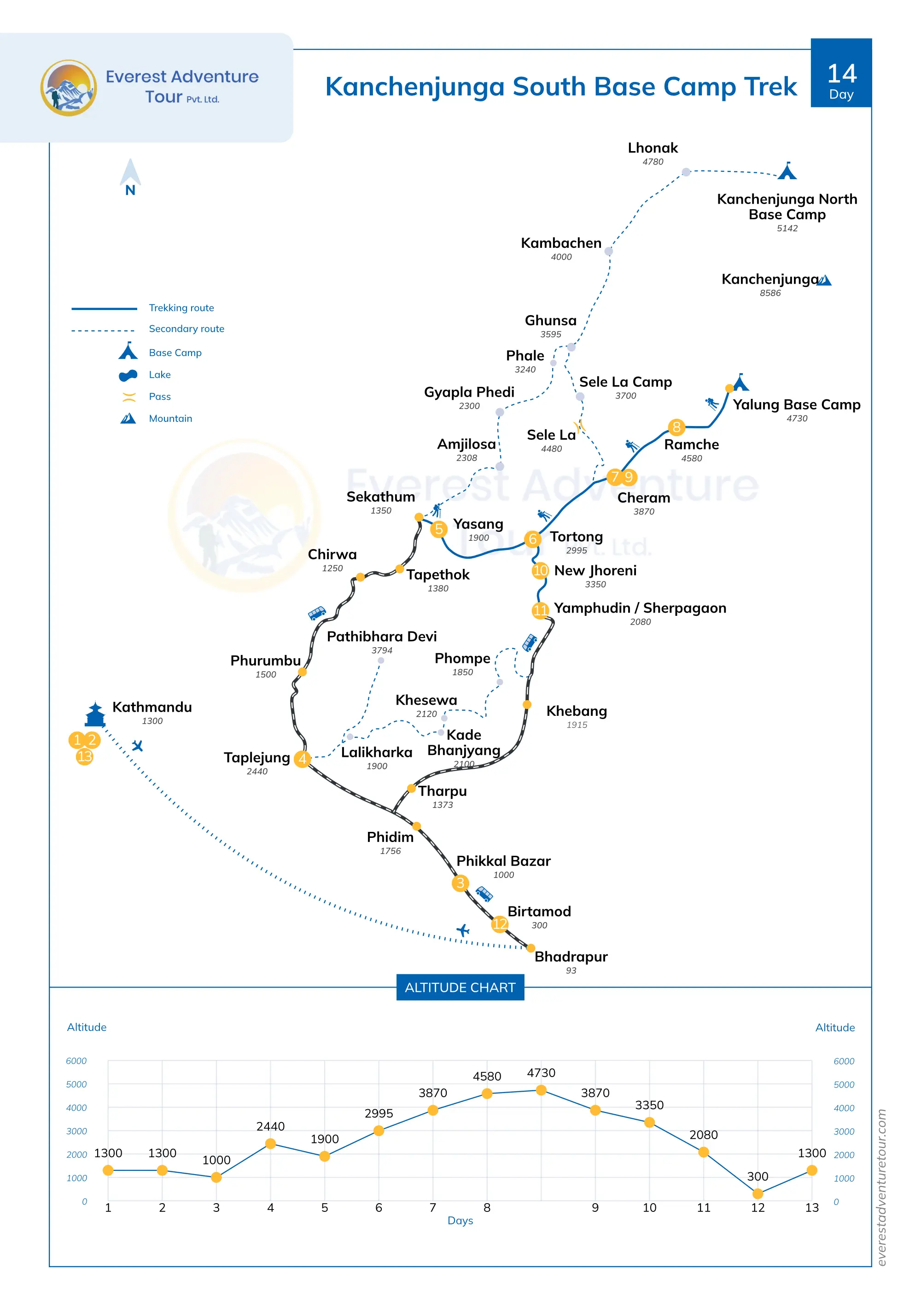
Route Map
Includes
- Airport pick-up and drop in Kathmandu
- Domestic flight and all around transportation as per Itinerary
- Hotel in Kathmandu and Tea house / lodges during the trek
- Breakfast in Kathmandu and Full-board meals during trekking (breakfast, lunch, dinner)
- Experienced English-speaking trekking guide and porters
- Trekking permits, national park fees, and TIMS card
- Welcome and farewell dinner in Kathmandu
- First-aid kit and emergency support
Doesn't Include
- International airfare to/from Nepal
- Travel insurance (mandatory)
- Personal expenses (snacks, drinks, laundry)
- Tips for guides and porters
- Beverages (alcohol, soft drinks, bottled water)
- Optional sightseeing or activities not mentioned in itinerary
- Visa fees for Nepal
- Excellent customer service. Our travel experts are ready to help you 24/7.
- Best price guaranteed.
- No credit card or booking fees.
- 100% financial protection.
- Environmentally-friendly tours.
Frequently Asked Questions
The ideal time for this trek is during the pre-monsoon (March to May) and post-monsoon (late September to November) seasons. During these months, the weather is relatively stable, with clear skies and pleasant temperatures. Snowfall in the higher regions can make the trail challenging in winter, while the monsoon season (June to August) brings heavy rain, landslides, and leeches, making trekking unsafe. Everest Adventure Tour ensures trekkers get the best seasonal guidance before departure.
This trek is categorized as moderate to strenuous due to long hiking days, steep ascents, and high altitudes reaching over 4,500 meters. Previous trekking experience is recommended but not mandatory. Proper acclimatization, as incorporated in our itinerary, ensures safety against altitude sickness. Everest Adventure Tour provides professional guides who monitor your pace and health throughout the journey.
Accommodations vary from comfortable hotels in cities like Kathmandu, Taplejung, and Birtamod, to teahouses and lodges along the trail. While teahouses in remote areas are basic, they provide meals, warm beds, and a friendly environment. Everest Adventure Tour carefully selects lodges that prioritize safety, hygiene, and comfort for trekkers.
Most lodges and teahouses provide simple but nutritious meals, including local Nepali cuisine such as dal bhat, noodles, soups, and rice dishes. Breakfast, lunch, and dinner are generally included in our trekking packages, and vegetarian options are available upon request. Everest Adventure Tour ensures meals are balanced to support energy levels during long trekking days.
Yes, altitude sickness can be a risk, especially at elevations above 4,000 meters. Our itinerary is designed with gradual ascents and acclimatization days to reduce risks. Guides from Everest Adventure Tour are trained to recognize symptoms, provide advice, and take necessary actions such as descending to lower altitudes if needed.
While no technical climbing skills are required, trekkers should have a good level of fitness, including stamina for hiking 4–8 hours daily over uneven terrain. Regular walking, jogging, or stair climbing before the trek can help. Everest Adventure Tour encourages physical preparation and provides a detailed fitness guide before departure.
Essential trekking gear includes waterproof hiking boots, warm layers, down jackets, gloves, trekking poles, and sleeping bags. During Everest Adventure Tour’s pre-departure briefing, we provide a complete packing list tailored to the season and altitude, ensuring trekkers are well-prepared for changing mountain conditions.
Yes, the trek passes through remote villages inhabited by Limbu, Rai, and Sherpa communities. Trekkers can experience local hospitality, traditional foods, festivals (depending on the season), and ancient monasteries. Everest Adventure Tour emphasizes responsible tourism and cultural respect, helping trekkers engage meaningfully with local communities.
Safety is a top priority for Everest Adventure Tour. Our experienced guides, porters, and well-planned itinerary ensure safe routes, regular health monitoring, and emergency evacuation plans if needed. While trekking in the Himalayas involves natural risks, we minimize these through preparation, communication devices, and careful monitoring of weather conditions.
The package typically includes airport transfers, domestic flights (Kathmandu–Bhadrapur–Kathmandu), accommodation, meals during trekking, experienced guides, porters, trekking permits, and TIMS cards. Everest Adventure Tour also provides 24/7 support before and during the trek, ensuring a seamless and memorable trekking experience.
Yes, motivated beginners with good fitness can undertake this trek, though prior trekking experience is advantageous. Everest Adventure Tour ensures gradual acclimatization, a paced itinerary, and professional guidance to help first-time trekkers safely enjoy the Himalayan adventure.