

- 1 - 1 Person US$ 2,799
- 2 - 5 Person US$ 2,699
- 6 - 12 Person US$ 2,599
- 13 - 20 Person US$ 2,499
Hotel in Kathmandu and Tea House / Lodge / Camp during the trek
Breakfast in Kathmandu and all meals during the trek
Highlights
- Scenic and cultural walks around the beautiful Khumbu and Everest high region.
- Explore traditional Sherpa villages rich with Buddhist heritage and prayer flags.
- Experience the vibrant local culture, monasteries, and Himalayan lifestyle.
- Exciting trails from lush green forests to alpine terrain and glacial landscapes.
- Enjoy the classic trek to Everest Base Camp and climb Kala Patthar for epic Everest views.
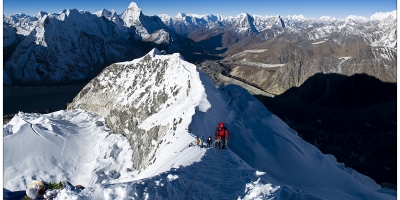
- Breathtaking sunrise and panoramic views from the summit of Lobuche East (6,119m).
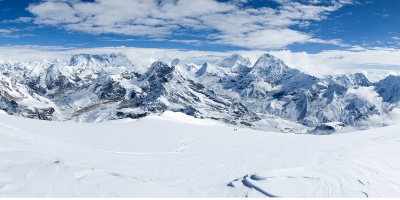
- Summit views of Mt. Everest, Lhotse, Nuptse, Makalu, Ama Dablam, and more.
- Trek through Sagarmatha National Park, a UNESCO World Heritage Site.
- Encounter unique Himalayan wildlife like musk deer, Himalayan tahr, and pheasants.
- Stunning aerial views on the scenic flight between Kathmandu (or Ramechhap) and Lukla.
Overview
An adventure on top of the stunning and technical summit of Lobuche East Peak with Everest Adventure Tour
Lobuche East Peak Climbing with Everest Adventure Tour is a thrilling mountaineering expedition in the majestic Khumbu region, home to Everest and some of the most iconic Himalayan peaks. This 19-day journey blends high-altitude trekking with technical alpine climbing, culminating at Lobuche East Peak’s summit (6,119 m / 20,070 ft). Ideal for experienced trekkers seeking their first Himalayan climbing experience, this climb offers spectacular views, cultural immersion, and personal challenge wrapped into one unforgettable Himalayan adventure.
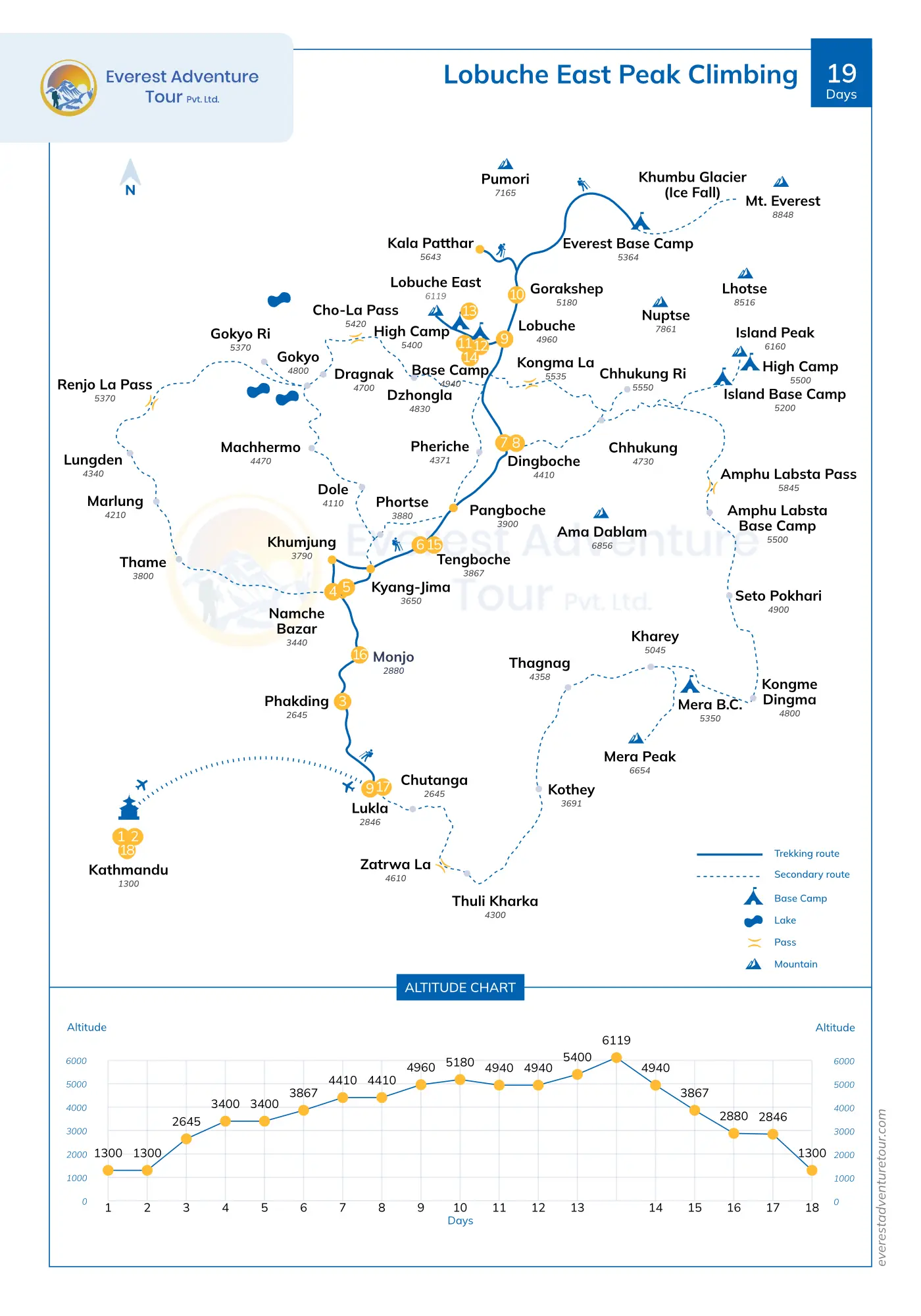
The expedition begins in the vibrant city of Kathmandu, followed by a scenic flight to Lukla, known as the gateway to Everest. From Lukla, the route follows the famous Everest Base Camp trail, passing through lush valleys, suspension bridges, and authentic Sherpa villages such as Phakding, Namche Bazaar, Tengboche, and Dingboche. The trail winds through the heart of Sagarmatha National Park, a UNESCO World Heritage Site rich in Himalayan flora and fauna. Along the way, trekkers witness awe-inspiring views of towering peaks like Mt. Everest, Lhotse, Ama Dablam, and Nuptse.
Acclimatization is carefully planned into the itinerary, with rest days in Namche Bazaar and Dingboche. These stops are not only essential for health and altitude adjustment but also offer cultural experiences with local monasteries, yak pastures, and panoramic day hikes. The trail eventually leads to Everest Base Camp (5,364 m), a legendary destination in itself, and the iconic viewpoint of Kala Patthar (5,643 m), providing one of the best close-up views of Mt. Everest.
After completing the EBC trek, the adventure takes a more technical turn as climbers head toward the Lobuche East Base Camp (4,940 m), followed by a rest and training day. Under the guidance of Everest Adventure Tour’s certified climbing guides, participants learn essential mountaineering skills, including the use of fixed ropes, crampons, and ice axe techniques. The climb to High Camp (5,400 m) and eventually to the summit of Lobuche East Peak is physically demanding and classified as TD (Technical Difficult) on the Alpine Grading system. However, with expert leadership and proper gear, the summit is achievable for fit and determined climbers.
Reaching the summit of Lobuche East is a truly rewarding experience—offering a 360-degree Himalayan panorama including peaks such as Mt. Everest, Lhotse, Nuptse, Pumori, Makalu, and Cho Oyu. Standing at over 6,000 meters, climbers are rewarded not just with breathtaking views, but with the satisfaction of completing a high-altitude, technical Himalayan climb. After a safe descent, the team retraces their steps back through Tengboche, Monjo, and finally to Lukla, where the adventure concludes with a celebratory flight back to Kathmandu.
Throughout the journey, Everest Adventure Tour ensures the highest standards of safety, logistics, and personalized service. From trekking permits and domestic flights to high-altitude support and climbing gear management, every aspect is handled by seasoned professionals. Whether you're an experienced trekker seeking to push your limits or a mountaineering enthusiast looking for a new challenge, Lobuche East Peak Climbing offers a perfect combination of adventure, scenery, and achievement in the world’s most iconic mountain region.
Major Places for Lobuche East Peak Climbing
The journey to Lobuche East Peak (6,119m / 20,070ft) covers some of the most iconic and culturally rich destinations in the Everest region (Khumbu). Starting from Kathmandu, the capital city of Nepal, climbers are introduced to the rich history, art, and architecture of the country through guided tours and preparation. A short scenic flight then takes you to Lukla (2,846m), the gateway to the Everest region. From here, the trekking journey begins, gradually ascending through traditional Sherpa settlements and rhododendron forests.
Namche Bazaar (3,440m) is a major highlight and the main trade center of Khumbu. Known as the “Sherpa Capital,” it offers acclimatization hikes and stunning views of Mount Everest, Ama Dablam, and Thamserku. As the trek progresses, Tengboche Monastery (3,867m) offers a spiritual experience along with panoramic Himalayan views. Dingboche (4,410m) is another acclimatization stop, beautifully set in the Imjatse Valley. The journey continues to Lobuche and Gorakshep, before heading to Everest Base Camp and Kala Patthar—both critical for altitude conditioning before the climb.
Key places for the climb:
- Kathmandu – Cultural hub and starting point.
- Lukla – Gateway to the Khumbu region.
- Namche Bazaar – Acclimatization and rest.
- Tengboche – Famous monastery with views.
- Dingboche – Scenic and important for acclimatization.
- Lobuche and Gorakshep – Gateway to EBC and Kala Patthar.
- Lobuche Peak Base Camp & High Camp – Technical climbing zone.
With Everest Adventure Tour, each destination is strategically chosen for acclimatization, cultural immersion, and breathtaking scenery, preparing climbers for a safe and successful summit attempt.
Best Season for Lobuche East Peak Climbing
The ideal time for Lobuche East Peak Climbing is during the two main Himalayan climbing seasons: spring (March to May) and autumn (late September to November). These windows offer the best weather conditions, clearer skies, moderate temperatures, and minimal precipitation—key factors for both trekking and peak climbing.
Spring Season (March to May):
- Spring is one of the best times for climbing in Nepal. The temperature is mild, and the trails come alive with blooming rhododendron forests. Visibility is excellent, providing unobstructed views of Everest and surrounding peaks. Snow conditions on Lobuche East are generally stable, and the days are longer, giving climbers a larger window for summit attempts.
Autumn Season (Late September to November):
- Autumn follows the monsoon and is considered the most reliable season for Himalayan expeditions. The air is crisp, skies are deep blue, and the trails are dry and safe. This period is also popular due to the festive atmosphere in Nepal, with celebrations like Dashain and Tihar adding cultural flavor to the adventure.
Best climbing months:
- Spring: March, April, May
- Autumn: Late September, October, November
Everest Adventure Tour organizes expeditions during these peak seasons to maximize safety and summit success. Their team closely monitors weather patterns and maintains flexibility in the itinerary to adapt to any changes, ensuring a well-timed and well-managed climb.
Lobuche East Peak Climbing Difficulty
Lobuche East Peak is one of Nepal’s most technically challenging trekking peaks, classified as “Technical Difficult” (TD) in the French Alpine Grading System. While not a full-scale expedition peak like Everest or Ama Dablam, Lobuche East requires solid physical fitness, basic climbing skills, and prior high-altitude trekking experience.
Altitude and Terrain:
Climbers will ascend to 6,119m (20,070ft), which involves dealing with thin air, low oxygen levels, and steep elevation gains. The route includes snow-covered ridges, icy slopes, and exposed sections that demand the use of fixed ropes, ice axe, crampons, and harness. Most of the technical climbing begins from High Camp (5,400m), and the summit day can take 8–10 hours, including descent.
Physical & Technical Requirements:
Although prior mountaineering experience is not mandatory, having basic rope and ice climbing knowledge is highly recommended. Everest Adventure Tour provides a full day of climbing training at Base Camp to ensure participants are well-prepared. The biggest challenge for most climbers is the altitude and cold, combined with steep technical sections that require both mental resilience and physical endurance.
Difficulty highlights:
- High-altitude exposure (above 5,000m for multiple days)
- Technical climbing sections requiring ropes and gear
- Cold temperatures and wind conditions
- Remote terrain with limited emergency access
Climbers with good preparation, a strong mindset, and proper guidance from Everest Adventure Tour’s professional climbing team can safely and successfully reach the summit.
Food and Accommodation for Lobuche East Peak Climbing
One of the strengths of climbing with Everest Adventure Tour is the well-organized logistics that ensure proper food and accommodation throughout the journey. From the city comforts of Kathmandu to remote mountain lodges and high-altitude camps, climbers are well taken care of every step of the way.
Accommodation:
During the trek, climbers stay in locally run tea houses or lodges, which offer twin-sharing rooms with warm blankets and clean bedding. In places like Namche, Dingboche, and Lukla, upgraded lodges are available with attached bathrooms and additional amenities. As the altitude increases, facilities become more basic, but Everest Adventure Tour ensures the best available lodging at each stop. At Base Camp and High Camp, tents are provided with thick mattresses, warm sleeping bags, and dining arrangements inside a large mess tent.
Meals:
Climbers enjoy three freshly prepared meals a day during the trek and climb. Food includes local staples like dal bhat (lentil soup with rice), vegetable curry, momos (dumplings), as well as continental options like pasta, pancakes, soups, and fried rice. Hot drinks such as tea, coffee, and hot lemon are served regularly to keep you hydrated. At high camps, meals are simplified but still energy-rich and designed for cold-weather nutrition.
Food and accommodation highlights:
- Tea houses with warm bedding and local hospitality
- Nutritious meals tailored for high-altitude trekking
- Hot drinks and snacks at each stop
- Tent accommodation with full support at base and high camps
Everest Adventure Tour ensures hygienic food preparation, clean water (boiled or filtered), and responsive staff to accommodate dietary needs. Their logistical support plays a vital role in the comfort, morale, and overall success of the expedition.
Network and Communication for Lobuche East Peak Climbing
Staying connected during the Lobuche East Peak Climbing expedition can be both a challenge and a concern, especially in remote high-altitude environments. However, thanks to growing infrastructure in the Everest region, there are now several communication options available throughout most parts of the trek. Everest Adventure Tour ensures climbers stay informed and connected as much as possible, especially for safety and coordination.
In lower elevations such as Kathmandu, Lukla, Phakding, Namche Bazaar, and even Dingboche, there is decent mobile network coverage, primarily from Nepal Telecom (NTC) and Ncell. In Namche, many tea houses also offer Wi-Fi services (Everest Link or private providers) for a small fee. As you ascend beyond Dingboche toward Lobuche, Gorakshep, and Base Camp, connectivity becomes limited but is still available at a premium. Everest Link cards (data scratch cards) can be purchased and used in many tea houses along the route. At high camps and remote areas, mobile signal is often unavailable, and communication is primarily maintained through satellite phones or radio systems carried by the guide team.
Communication essentials:
- Mobile Network Coverage: Available in lower regions (NTC & Ncell).
- Wi-Fi Access: Everest Link available in tea houses at extra cost.
- Satellite Phones/Walkie-talkies: Used by Everest Adventure Tour’s guides above base camp.
- Internet Speed: Slow and weather-dependent at higher altitudes.
- Electric Charging: Available at most lodges (often solar-powered or pay-per-charge).
With safety as a top priority, Everest Adventure Tour ensures real-time communication between guides, staff, and base teams—keeping climbers informed and supported throughout the expedition, even in challenging conditions.
Lobuche East Peak Climbing Transportation
Transportation logistics are a critical part of the Lobuche East Peak Climbing experience. Given the remote and rugged terrain of the Khumbu region, Everest Adventure Tour provides well-coordinated and reliable transportation from the start of the journey in Kathmandu to the remote base camp of Lobuche East Peak. Each step is planned to optimize acclimatization and reduce logistical hassle for the climbers.
The journey begins with a scenic and adventurous flight from Kathmandu to Lukla. The flight is about 30–35 minutes and offers stunning views of the Himalayan range. The Lukla Airport (Tenzing-Hillary Airport) is considered one of the most iconic airstrips in the world. Depending on weather or seasonal changes, Everest Adventure Tour may also organize flights from Ramechhap (Manthali) as an alternative. From Lukla onwards, the entire expedition is on foot, using well-established trekking trails and suspension bridges. Porters and yaks are used to carry gear, tents, and food supplies.
Transport logistics overview:
- Kathmandu Arrival: Airport pick-up in private vehicles.
- Domestic Flights: Kathmandu (or Ramechhap) to Lukla and return.
- Trekking Route: On foot from Lukla through Sherpa villages to base camp.
- Porter Support: For personal bags and group equipment.
- Emergency Evacuation: Helicopter evacuation arranged in case of emergencies.
Everest Adventure Tour ensures all flights are pre-booked and monitored for weather changes. Emergency back-up plans, including helicopter evacuations, are kept on standby to prioritize climbers’ safety and timely movement in unforeseen circumstances.
Lobuche East Peak Climbing Permits
Climbing Lobuche East Peak requires several official permits, each issued by relevant governing bodies in Nepal. These permits are essential for legal trekking and mountaineering in the Sagarmatha National Park and Nepal Mountaineering Association (NMA) territories. Everest Adventure Tour handles the entire permit process on your behalf, ensuring compliance with all regulations and timely acquisition.
The first required document is the Sagarmatha National Park Entry Permit, which grants access to the protected area of the Everest region. In addition, travelers need a Khumbu Pasang Lhamu Rural Municipality Permit, implemented by the local government for tourism management. For the climb itself, a Lobuche East Peak Climbing Permit must be obtained through the Nepal Mountaineering Association (NMA). This is a regulated trekking peak, and the fee varies depending on the season.
Required permits:
- Sagarmatha National Park Entry Permit (Approx. USD 30)
- Khumbu Rural Municipality Permit (Approx. USD 20)
Lobuche East Climbing Permit from NMA
- Spring (March–May): USD 250
- Autumn (Sept–Nov): USD 125
- Winter/Summer: USD 70
Everest Adventure Tour includes all permits in their expedition package and ensures every document is arranged in advance. This allows climbers to focus on their adventure while the company takes care of the bureaucratic requirements with accuracy and efficiency.
Why Choose Lobuche East Peak Climbing
Choosing to climb Lobuche East Peak is about more than reaching a high summit—it's about experiencing the very best of the Himalayas. This peak is one of the most popular trekking peaks in Nepal, offering a perfect blend of technical challenge, alpine scenery, and cultural immersion. With its proximity to Everest Base Camp, it also allows climbers to combine two iconic Himalayan experiences in one expedition.
The Lobuche East summit (6,119m / 20,070ft) provides climbers with breathtaking panoramic views of the Everest range, including Lhotse, Nuptse, Ama Dablam, Makalu, and Pumori. The route is technical enough to be rewarding, but accessible for climbers with good trekking experience and basic mountaineering knowledge. With proper training and acclimatization (which the itinerary provides), even first-time climbers can succeed under the guidance of experienced leaders.
Why Lobuche East?
- Ideal for first-time Himalayan climbers
- Includes Everest Base Camp and Kala Patthar
- Stunning summit views of the Everest range
- Great acclimatization route for 6,000m+ climbs
- Technically engaging yet achievable
Climbing with Everest Adventure Tour adds another layer of value. Their expert guides, high safety standards, detailed logistics, and personalized support system ensure climbers are well-prepared, well-fed, and well-cared-for at every stage. With an emphasis on responsible tourism and customer satisfaction, they are one of the most trusted names for climbing expeditions in Nepal.
Important Note
Trip Itinerary
Route Map
Includes
- All Arrival and Departure Transfer from airport to hotel and vice-versa, vehicles according to group size.
- Three Star hotels in Kathmandu on bed and breakfast basis only.
- Domestic airfare from Kathmandu-Lukla-Kathmandu.
- Full board trekking includes twin sharing accommodation on best available local lodges, includes Breakfast, lunch, dinner with afternoon tea / snacks.
- Tented Camping for few overnights on climb with full support of camping cook, kitchen staff and climbing guide.
- Service of climbing guide, trekking staff as per size of a group with porters.
- Wages, meals, medical allowance of guides, trekking staff and porters.
- Applicable Peak Climbing Permits, includes Sagarmatha National Park Entrance Fees.
- Comprehensive Medical Kit carried by our guide if required for minor wounds and sickness.
- Sightseeing tour around Kathmandu valley as per the itinerary.
- Welcome or Farewell dinner in Kathmandu.
Doesn't Include
- Nepal Visa, Personal Medical & Travel Insurance.?
- Expenses of personal nature, meals in Kathmandu and gratitude or tipping for trekking staff, drivers, porters and guide, including extra snacks and refreshments.?
- Personal trekking / climbing gear, including sleeping bags and down jackets (if it is not included on the trip cost).?
- Emergency Evacuation if required by any means of transportation, including Helicopter Service.?
- Personal medical kit, as advised by you doctors.?
- Early return from the trek due to personal domestic or medical reasons, no refund will be entertained on breaking the journey.
- Excellent customer service. Our travel experts are ready to help you 24/7.
- Best price guaranteed.
- No credit card or booking fees.
- 100% financial protection.
- Environmentally-friendly tours.
Equipment List
- Thermal underwear (top and bottom)
- Moisture-wicking long-sleeved t-shirts
- Moisture-wicking underwear
- Fleece jacket or pullover
- Insulated down or synthetic jacket (lightweight and warm)
- Waterproof, windproof jacket (Gore-Tex or similar)
- Waterproof, windproof pants
- Trekking pants (convertible preferred)
- Warm beanie or wool hat
- Sun hat or baseball cap
- Neck gaiter, buff, or scarf
- Waterproof trousers (for rain and snow)
- Lightweight inner gloves (thermal or liner gloves)
- Insulated outer gloves or mittens (waterproof)
- Waterproof, broken-in hiking boots with ankle support
- Comfortable camp shoes or sandals (for evenings)
- Trekking socks (wool or synthetic, several pairs)
- Gaiters (optional, for snow and mud)
- Trekking backpack (30-40 liters) with rain cover
- Daypack (optional, for short hikes)
- Sleeping bag (rated to at least -10°C / 14°F)
- Insulated sleeping pad or foam mattress
- Adjustable trekking poles (with rubber tips)
- Insulated water bottles or hydration bladder (2-liter capacity recommended)
- Sunglasses with UV protection
- Headlamp with extra batteries
- Power bank and chargers (for electronics)
- Camera and extra batteries/memory cards
- Travel-size toiletries (toothbrush, toothpaste, biodegradable soap)
- Quick-dry towel
- Wet wipes and hand sanitizer
- Sunscreen (high SPF) and lip balm with SPF
- Personal first aid kit (bandages, blister pads, antiseptic, medication)
- Medications for altitude sickness (Diamox if prescribed)
- Pain relievers, anti-diarrheal, antihistamines
- Earplugs (for noisy lodges)
- Notebook and pen
- Portable solar charger (optional)
- Plastic zip-lock bags (to keep gear dry)
- Lightweight stuff sacks or packing cubes
- Snacks (energy bars, nuts, chocolates)
- Reusable water bottle or hydration system
- Small knife or multi-tool
- Passport-size photos (for permits if needed)
Frequently Asked Questions
Accommodation during the Lobuche East Peak Climbing depends on the type of package and budget agreed upon with Everest Adventure Tour. Generally, the standard itinerary includes stays in normal tea houses or standard lodges, which offer clean and comfortable rooms with shared or attached bathrooms depending on the location. However, if clients prefer luxury accommodations (where available, especially in places like Namche Bazaar), the company can arrange upgraded stays. Luxury lodges come with additional services such as hot showers, better room heating, and gourmet meals. Keep in mind that higher in the mountains, especially above Dingboche, luxury options become limited due to the remote location and high altitude. Costs may increase slightly based on the upgrade, but Everest Adventure Tour ensures every client gets quality lodging suited to their preferences.
Trekkers often find the food surprisingly varied and satisfying along the trail to Lobuche Peak. Everest Adventure Tour ensures that meals include local, Asian, and Western dishes, ranging from dal bhat, Tibetan noodles, momos, and fried rice to pizza, pasta, pancakes, and more. Most tea houses have extensive menus and offer warm, hearty meals with tea and coffee. Accommodation varies from basic to standard lodges, some with private bathrooms in lower elevations. However, in high-altitude villages like Dingboche, Lobuche, and Gorakshep, rooms have shared toilets, as plumbing systems often freeze due to sub-zero temperatures. Once you move to Lobuche Peak Base Camp and High Camp, accommodation shifts to tented camping. All camping gear is provided by the company, and food is prepared by the expedition cook team—simple but nutritious meals to fuel your climb.
For safety and peace of mind, Everest Adventure Tour requires all participants to carry comprehensive travel and medical insurance before joining the Lobuche East Peak expedition. Your insurance must cover high-altitude trekking and mountaineering up to 6,500 meters, including emergency helicopter evacuation, hospitalization, trip cancellations, and delays due to flight disruptions or natural disasters like avalanches or landslides. Without proper insurance, trekkers may face delays in rescue or limited treatment options in case of altitude sickness or injury. It’s recommended to purchase insurance from international providers who specialize in adventure travel. Always send a copy of your insurance to the company before your arrival.
Climbing Lobuche East Peak is a high-altitude adventure that demands physical fitness and mental endurance. As a guideline, Everest Adventure Tour accepts climbers aged 16 to 70 years old, with flexibility depending on medical fitness. Young climbers (ages 16–18) must be accompanied by a guardian and require parental consent. Older climbers over 60 should provide a medical certificate confirming their ability to perform at high altitudes. Even those with minor health conditions can participate with proper medical clearance. The trek is not about speed, but endurance, and the company ensures proper acclimatization and rest days to support climbers of varying ages and abilities.
The best seasons for Lobuche East Peak Climbing are during spring (March to May) and autumn (September to November). These months offer the most stable weather, clear skies, and ideal climbing conditions. Spring is particularly beautiful with blooming rhododendrons and warmer daytime temperatures. Autumn brings excellent visibility and crisp mountain air—perfect for panoramic views. Climbing during winter (December to February) is possible but involves extremely cold temperatures, frozen trails, and shorter daylight hours. While some experienced climbers enjoy the solitude of winter climbs, it’s not recommended for first-timers. Everest Adventure Tour organizes expeditions primarily during spring and autumn to ensure the best chances of a successful summit.
Lobuche East Peak is categorized as a “Trekking Peak”, but it involves technical sections near the summit, making it more challenging than standard treks. The climb includes steep ice and snow sections, often requiring crampons, harnesses, ice axes, and the use of fixed ropes. The summit push is long and physically demanding, with altitude being a major factor. However, with proper training, acclimatization, and guidance from Everest Adventure Tour’s professional climbing Sherpa guides, most fit and motivated trekkers can succeed. A pre-climb training session is provided at base camp to teach rope techniques and gear handling.
Prior climbing experience is helpful but not mandatory for Lobuche East Peak. This peak is suitable for trekkers who are physically fit and have experience with multi-day trekking and basic knowledge of using climbing equipment. Everest Adventure Tour provides hands-on training at base camp, where climbers learn to use fixed ropes, carabiners, ascenders, and other essential gear. However, having done treks above 4,000 meters or having attempted previous trekking peaks like Island Peak or Mera Peak can boost your confidence and performance. Strong mental determination and proper physical preparation are more important than technical expertise.
Lobuche East Peak Climbing demands good cardiovascular endurance, core strength, and mental resilience. Preparing at least 2–3 months in advance is recommended. Activities like hiking with a backpack, running, cycling, stair climbing, or strength training will help build stamina and leg strength. Training at high altitude (if possible) or using altitude simulation masks can be an added advantage. Everest Adventure Tour recommends trekkers consult with a personal trainer and follow a routine designed for high-altitude adventures. The key is to maintain consistency and gradually increase intensity. Remember, the climb is not a race—it’s about endurance and smart acclimatization.
Everest Adventure Tour provides essential group climbing equipment including fixed ropes, snow bars, ice screws, tents, kitchen gear, and safety equipment. Climbers are required to bring personal gear such as mountaineering boots, crampons, harness, helmet, headlamp, down jacket, sleeping bag, and gloves. A detailed gear checklist is provided upon booking. If you don’t own some of the gear, most of it can be rented or bought in Kathmandu before the trip. It’s crucial to ensure everything fits properly and is tested prior to departure to avoid discomfort or safety issues during the climb.
Everest Adventure Tour is a locally operated, experienced expedition company with a strong reputation for safety, professionalism, and client satisfaction. Their team consists of certified climbing Sherpas, many of whom have summited Everest and other 8,000-meter peaks. The company offers custom itineraries, comprehensive acclimatization plans, pre-climb training, and full logistic support. What sets them apart is their personalized service, attention to detail, and commitment to responsible tourism. Whether you’re a first-time climber or an experienced adventurer, Everest Adventure Tour ensures that your Lobuche East Peak Climbing experience is safe, enjoyable, and truly unforgettable.