

- 1 - 1 Person US$ 2,800
- 2 - 5 Person US$ 2,650
- 6 - 9 Person US$ 2,600
- 10 - 15 Person US$ 2,550
- 16 - 20 Person US$ 2,500
Hotel in Kathmandu and Tea House / Lodge / Camp during the trek
Breakfast in Kathmandu and all meals during the trek
Highlights
- Walk into sheer mountain wilderness in one of the least-trekked regions of Khumbu
- Journey through dense rhododendron and pine forests to barren glacial terrain
- Explore an off-the-beaten-path route to Mera Peak (6,654m) – Nepal’s highest trekking peak
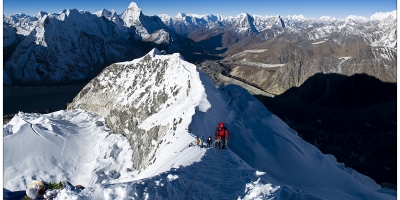
- Experience the thrill of standing on the summit, surrounded by towering Himalayan giants
- Adventure around the quiet, serene Hinku Valley, far from maddening civilization
- Enjoy panoramic views of five 8,000m peaks: Everest, Lhotse, Makalu, Cho Oyu & Kanchenjunga
- Cross the dramatic Zatwar-La Pass with views of both Hinku Valley and Dudh Koshi
- Immerse in Sherpa culture and traditions in highland villages like Thangnag and Khare
- Capture dramatic landscape photography across changing terrains and light conditions
- Taste traditional Nepali meals and warm hospitality in one of Nepal’s wildest regions
Overview
‘An adventure around the hidden valley of Hinku to Mera Peak summit’
Mera Peak Climb with Everest Adventure Tour offers one of the finest alpine trekking and climbing experiences in the Himalayas of Nepal. Rising to 6,654 meters (21,825 feet), Mera Peak is the highest permitted trekking peak in the country, listed under the ‘B group’ category by the Nepal Mountaineering Association (NMA). Situated southeast of Mount Everest, it lies in the remote and less-trodden Hinku Valley, surrounded by a dramatic amphitheater of snow-capped Himalayan giants. This awe-inspiring journey blends adventurous trekking through pristine forested trails with high-altitude mountaineering, making it a dream expedition for passionate trekkers and climbers alike.
The trip begins in Kathmandu with a cultural introduction to Nepal’s vibrant history and architecture. After a short and scenic flight to Lukla, the gateway to Everest, the trek begins in earnest. Unlike the classic Everest Base Camp route, the path to Mera Peak veers away from the crowds and enters the serene wilderness of the Hinku Valley. This region remains untouched by modern development, featuring only sparse, seasonal settlements. Over the course of several days, trekkers gradually gain altitude while passing through beautiful rhododendron forests, alpine meadows, glacial streams, and high mountain passes such as the Zatwar-La. The trail is designed with ample acclimatization time to prepare for the demanding climb.
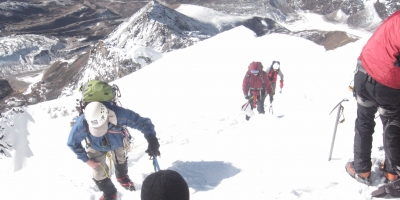
Once at Khare (5,045m), the base of Mera Peak, climbers undergo pre-climb training and equipment checks led by Everest Adventure Tour’s experienced guides. These vital days help ensure safety and success. Although technically categorized as a non-technical climb, the summit push from Mera High Camp (5,780m) requires the use of basic alpine gear such as crampons, harnesses, ropes, and ice axes. Due to climate shifts, the glacier conditions on Mera have become more dynamic in recent years, with deep crevices and steeper inclines requiring careful navigation. Nevertheless, with the proper guidance and steady acclimatization, the ascent remains accessible to fit and determined trekkers.
Reaching the summit of Mera Peak is an unforgettable moment. From this vantage point, climbers are treated to one of the best panoramic views in the entire Himalayas, including five of the world’s highest mountains—Everest (8,848m), Lhotse (8,516m), Cho Oyu (8,188m), Makalu (8,481m), and Kanchenjunga (8,586m). The sense of achievement, paired with the raw beauty of the surrounding landscapes, makes the effort entirely worthwhile. After a safe descent to Khare, the return journey retraces the scenic trail, descending through high alpine landscapes, forested hills, and peaceful valleys before flying back to Kathmandu. With a blend of natural splendor, cultural richness, and mountaineering challenge, the Mera Peak Climb with Everest Adventure Tour promises an epic and transformative Himalayan experience.
Major Places for Mera Peak Climbing
Mera Peak Climbing with Everest Adventure Tour offers a remarkable journey through some of the most scenic and culturally rich locations in Nepal’s remote Himalayan region. Starting from Kathmandu, Nepal’s capital, the trip begins with exploration of ancient heritage sites like Pashupatinath, Boudhanath, and Kathmandu Durbar Square. These UNESCO World Heritage Sites offer insight into Nepal’s religious diversity, history, and artistic brilliance before the mountain journey begins.
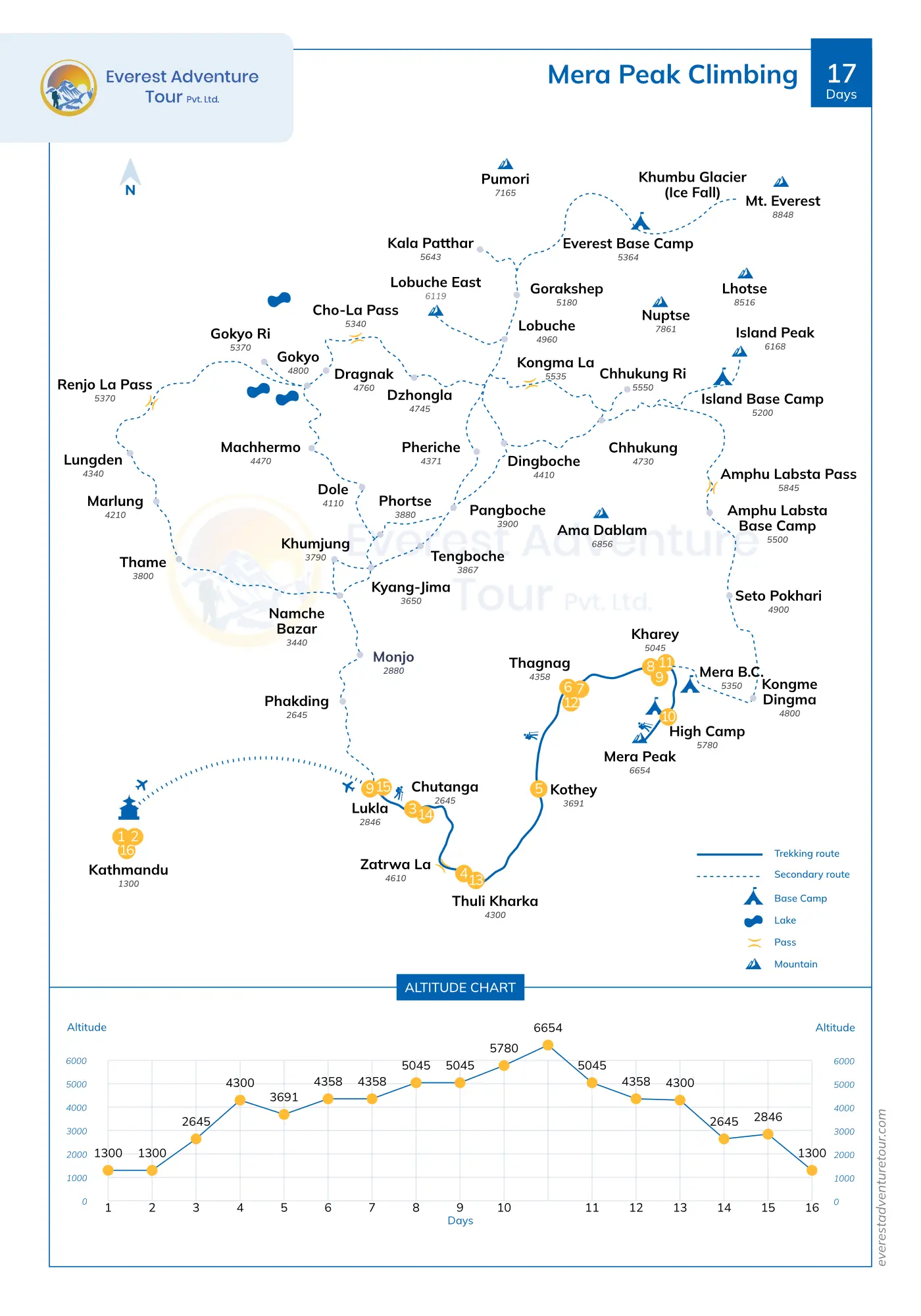
The actual trekking adventure starts in Lukla (2,846 m)—a gateway to the Everest region—after a scenic mountain flight. From here, the trail veers off from the busier Everest Base Camp route and enters the peaceful Hinku Valley. This lesser-known region is home to a variety of beautiful places including Chutanga, Thuli-Kharka, Kothe, Thangnag, and finally Khare, the base camp of Mera Peak. The climb then continues to Mera High Camp (5,780 m), situated beneath glaciers and snow domes, before pushing towards the summit of Mera Peak (6,654 m)—the highest trekking peak in Nepal.
Each place along the way has its own character—forests in Chutanga, mountain vistas in Thuli-Kharka, glacial rivers near Kothe, and striking alpine landscapes at Khare. From the summit, climbers are rewarded with a breathtaking 360-degree view of Himalayan giants like Everest, Lhotse, Makalu, Cho Oyu, and Kanchenjunga.
Key Major Places:
- Kathmandu – Cultural and historical hub
- Lukla – Gateway to Everest region
- Chutanga – Forested starting point for altitude gain
- Thuli-Kharka – Scenic ridge offering high mountain views
- Kothe – Remote riverside village
- Thangnag – Glacial valley settlement
- Khare – Mera Peak Base Camp
- Mera High Camp & Summit – The ultimate destination
Best Season for Mera Peak Climbing
The best seasons for Mera Peak Climbing are spring (March to May) and autumn (mid-September to early December). These periods offer the most favorable conditions in terms of weather, temperature, and visibility. As a high-altitude climb reaching over 6,600 meters, choosing the right season is crucial for a successful summit and safe return.
Spring brings clear skies, mild temperatures, and vibrant landscapes. The forests around Chutanga and Thuli-Kharka bloom with colorful rhododendrons and wildflowers, while snow conditions at higher altitudes remain relatively stable. Spring is also the pre-monsoon season, making it ideal for photography and extended views of peaks like Everest, Lhotse, and Makalu.
Autumn, on the other hand, follows the monsoon and features crisp, dry air, ensuring excellent visibility of the mountains and safe trekking conditions. The days are usually sunny, and nights are cold but manageable. This season also sees fewer chances of flight cancellations to/from Lukla due to stable weather.
Climbing in winter (December to February) or monsoon (June to August) is not recommended. Winter brings extreme cold, especially at Mera High Camp, with risks of frostbite and icy trails. The monsoon season brings heavy rain, landslides, and cloud cover, making both trekking and flying unsafe.
Best Season Highlights:
- Spring (Mar–May): Blooming rhododendrons, steady snow, great visibility
- Autumn (Sep–Nov): Clear skies, crisp air, minimal rainfall
- Avoid Winter & Monsoon: Harsh conditions and poor trail safety
Mera Peak Climbing Difficulty
Mera Peak Climbing is considered a moderate to challenging expedition, depending on prior experience, physical fitness, and weather conditions. Although technically less demanding than other Himalayan peaks, the high altitude and extended duration of the trek require serious preparation. With Everest Adventure Tour, climbers receive professional guidance, structured acclimatization, and proper safety measures, increasing their chances of success.
The approach to Mera Peak does not involve vertical ice climbing or technical rock sections. Instead, the route is a high-altitude snow walk, but it still requires the use of mountaineering equipment such as crampons, harnesses, ropes, ice axe, and helmet. The most physically demanding part is the summit day, which can take 8–10 hours of climbing and descending in thin air, freezing temperatures, and possibly windy conditions. Glacial movement and crevasses also add to the risk level.
The real challenge of Mera lies in altitude acclimatization, not technical climbing. The route exceeds 5,000 meters for multiple days, with the summit sitting at 6,654 meters (21,825 ft). Altitude sickness, fatigue, and cold temperatures are the main difficulties. To address these, Everest Adventure Tour has designed the itinerary with gradual altitude gain, rest days, and emergency evacuation planning.
Difficulty Factors:
- High altitude and risk of AMS (Acute Mountain Sickness)
- Cold temperatures, especially at high camp
- Long summit day (8–10 hours)
- Glacier travel and use of technical gear
- Requires good fitness and endurance
Food and Accommodation for Mera Peak Climbing
During the Mera Peak Climbing expedition with Everest Adventure Tour, trekkers are provided with hygienic meals and comfortable accommodations along the entire route. From Kathmandu to Lukla and all the way to Khare, lodging is in local teahouses—basic but cozy lodges run by local families. These teahouses typically offer twin-sharing rooms, communal dining areas, and hearty food. While facilities become more limited with increasing altitude, warmth and hospitality remain consistent throughout the journey.
Meals are mostly nutritious Nepali and continental dishes designed to keep you energized for long treks and climbs. Common meals include dal bhat (lentils, rice, and vegetables), noodles, pasta, soups, momos (dumplings), fried rice, eggs, and potatoes. Hot drinks like ginger tea, lemon honey tea, and hot chocolate are also widely available. Everest Adventure Tour ensures food is cooked hygienically, using clean drinking water and local ingredients.
Once the group reaches Khare and begins the climbing phase, accommodation switches to tented camping for the nights at Mera High Camp and possibly during summit attempts, depending on conditions. The company provides quality mountaineering tents, sleeping bags, insulated mats, and all meals prepared by an experienced camp cook. Although this part is more rugged, Everest Adventure Tour prioritizes safety, warmth, and nourishment even in extreme conditions.
Food & Accommodation Overview:
- Teahouses: Comfortable, warm, and locally operated up to Khare
- Meals: Dal bhat, soups, pasta, noodles, eggs, momos, etc.
- Drinks: Hot tea, coffee, and filtered water
- Camping: At Mera High Camp – quality tents and nutritious meals
- Hygiene & Nutrition: Top priority for Everest Adventure Tour
Network and Communication for Mera Peak Climbing
During the Mera Peak Climbing expedition with Everest Adventure Tour, staying connected can be a challenge due to the remote terrain and high altitude. Network and communication facilities are available in the early parts of the trek, but they become limited or non-existent as you ascend further toward Khare and beyond. In Kathmandu and Lukla, you’ll have access to 4G mobile networks, Wi-Fi, and phone services. Local SIM cards from providers like NCELL and NTC offer prepaid packages with data, but their coverage becomes unreliable in high-altitude regions.
As the trek progresses beyond Chutanga and into the Hinku Valley, the mobile signal becomes sparse and inconsistent. In some villages like Thuli-Kharka and Kothe, you might get weak signals depending on the weather and terrain. However, in higher altitude regions like Thangnag, Khare, and Mera High Camp, network coverage is typically unavailable. That said, Everest Adventure Tour guides are usually equipped with satellite phones or radio communication for emergencies, allowing for contact with base teams and helicopter rescue services if needed.
For trekkers who need to stay in touch with family or work, the best option is to communicate while in Kathmandu and Lukla or through satellite messaging devices like Garmin inReach if you bring your own. Everest Adventure Tour ensures that all safety-related communication is consistently maintained through guide coordination, so you are never truly "off the grid" in case of emergencies.
Network & Communication Highlights:
- Good signal in Kathmandu and Lukla
- Weak or no signal beyond Chutanga and Khare
- Wi-Fi available in select lower teahouses (extra cost)
- Satellite phone or radio provided by Everest Adventure Tour
- Emergency contact always maintained by guide team
Mera Peak Climbing Transportation
Transportation for Mera Peak Climbing is well-managed by Everest Adventure Tour, ensuring a smooth and stress-free transition between each stage of the journey. The expedition begins with your arrival in Kathmandu, where you are picked up from the international airport and transferred to your hotel in a private vehicle. Everest Adventure Tour arranges all in-country transportation, allowing you to focus solely on the adventure.
On Day 3, one of the most exciting parts of the journey is the scenic flight from Kathmandu to Lukla. This short 30–40-minute flight offers stunning aerial views of the Himalayan range and lands at Tenzing-Hillary Airport, known for its thrilling approach. The rest of the journey—from Lukla to Khare and back—is done on foot, as the region is not accessible by road. All gear and supplies are carried by porters and yaks, ensuring trekkers carry only a light daypack.
In case of bad weather or emergencies, helicopter evacuation is an option available at additional cost, and Everest Adventure Tour helps coordinate this if necessary. After the trek, you’ll fly back from Lukla to Kathmandu, and final transportation to your hotel or airport is included. The company takes care of airport transfers, permits, and logistics, making the transportation side seamless from start to finish.
Transportation Overview:
- Airport pickup/drop by private vehicle in Kathmandu
- Scenic domestic flight to/from Lukla (weather-dependent)
- Entire trekking route done on foot
- Porters or yaks for luggage
- Emergency helicopter rescue coordination (if needed)
Mera Peak Climbing Permits
To legally and safely climb Mera Peak, several permits are required, all of which are arranged by Everest Adventure Tour as part of the package. These permits ensure that trekkers are authorized to enter conservation zones and climb regulated peaks under the supervision of licensed guides. Without proper documentation, climbers can be subject to fines or even denied entry to the route.
The primary permit required is the Mera Peak Climbing Permit, issued by the Nepal Mountaineering Association (NMA). The cost varies by season:
- Spring (March–May): USD 250
- Autumn (Sept–Nov): USD 125
- Winter/Summer: USD 70
In addition to the climbing permit, trekkers must also obtain the Makalu Barun National Park Entry Permit, as Mera Peak lies within this protected region. This costs around NPR 3,000 (approx. USD 25). Another necessary document is the Khumbu Pasang Lhamu Rural Municipality Entry Permit, which is specific to the Solukhumbu district and costs NPR 2,000 (approx. USD 17).
Everest Adventure Tour handles all permit paperwork, payments, and checkpoint management, ensuring trekkers don’t have to worry about these administrative tasks. This also helps avoid delays at trail checkpoints and ensures compliance with all local regulations.
Required Permits for Mera Peak:
- Mera Peak Climbing Permit (NMA): Seasonal rates
- Makalu Barun National Park Permit
- Khumbu Rural Municipality Permit
- Everest Adventure Tour manages all permits for you
Why Choose Mera Peak Climbing
Mera Peak Climbing is more than just a high-altitude trek—it's an immersive Himalayan experience that combines physical challenge, natural beauty, and cultural richness. For trekkers seeking their first Himalayan summit above 6,000 meters, Mera Peak stands out as the perfect goal. With its non-technical ascent and incredible panoramic views of five 8,000-meter peaks—including Everest, Lhotse, Makalu, Cho Oyu, and Kanchenjunga—it offers a truly rewarding and unforgettable adventure.
Unlike the crowded trails of Everest Base Camp or Annapurna, Mera Peak lies in the less-traveled Hinku Valley, allowing for a peaceful and wild Himalayan journey. The route passes through diverse landscapes—from lush forests and alpine meadows to glacial moraines and high snowfields. Along the way, you’ll interact with the remote mountain communities of eastern Nepal, gaining insight into Sherpa life, Buddhist culture, and traditional mountain hospitality.
Everest Adventure Tour is known for its safety-first approach, experienced guides, and personalized service. Their well-designed itinerary allows for proper acclimatization, and their local expertise ensures smooth logistics, from transportation and permits to high-quality camping gear and meals. Whether you're a first-time climber or a seasoned trekker, Everest Adventure Tour offers an experience tailored to your abilities while maintaining high standards of support and professionalism.
Why Choose Mera Peak:
- Highest trekking peak in Nepal (6,654m)
- Stunning views of Everest, Lhotse, Makalu, and more
- Less crowded, remote wilderness experience
- Perfect mix of trekking and alpine climbing
- Professionally guided with full support by Everest Adventure Tour
Important Note
Trip Itinerary
Route Map
Includes
- All Arrival and Departure Transfer from airport to hotel and vice-versa, vehicles according to group size.
- Twin sharing room on best tourist standard hotels in Kathmandu on bed and breakfast basis only. (For single supplement at extra cost on informing Everest Adventure Tour on booking).
- Domestic airfare from Kathmandu-Lukla-Kathmandu.
- Full board trekking includes twin sharing accommodation on best available local lodges, includes Breakfast, lunch, dinner with afternoon tea / snacks.
- Tented Camping for few overnights on climb with full support of camping cook, kitchen staff and climbing guide.
- Service of climbing guide, trekking staff as per size of a group with porters.
- Wages, meals, medical allowance of guides, trekking staff and porters.
- Applicable Peak Climbing Permits, includes Sagarmatha National Park Entrance Fees.
- Comprehensive Medical Kit carried by our guide if required for minor wounds and sickness.
- Sightseeing tour around Kathmandu valley as per the itinerary.
- Welcome or Farewell dinner in Kathmandu.
Doesn't Include
- Nepal Visa, Personal Medical & Travel Insurance.?
- Expenses of personal nature, meals in Kathmandu and gratitude or tipping for trekking staff, drivers, porters and guide, including extra snacks and refreshments.?
- Personal trekking / climbing gear, including sleeping bags and down jackets (if it is not included on the trip cost).?
- Emergency Evacuation if required by any means of transportation, including Helicopter Service.?
- Personal medical kit, as advised by you doctors.?
- Early return from the trek due to personal domestic or medical reasons, no refund will be entertained on breaking the journey.
- Excellent customer service. Our travel experts are ready to help you 24/7.
- Best price guaranteed.
- No credit card or booking fees.
- 100% financial protection.
- Environmentally-friendly tours.
Equipment List
- Thermal underwear (top and bottom)
- Moisture-wicking long-sleeved t-shirts
- Moisture-wicking underwear
- Fleece jacket or pullover
- Insulated down or synthetic jacket (lightweight and warm)
- Waterproof, windproof jacket (Gore-Tex or similar)
- Waterproof, windproof pants
- Trekking pants (convertible preferred)
- Warm beanie or wool hat
- Sun hat or baseball cap
- Neck gaiter, buff, or scarf
- Waterproof trousers (for rain and snow)
- Lightweight inner gloves (thermal or liner gloves)
- Insulated outer gloves or mittens (waterproof)
- Waterproof, broken-in hiking boots with ankle support
- Comfortable camp shoes or sandals (for evenings)
- Trekking socks (wool or synthetic, several pairs)
- Gaiters (optional, for snow and mud)
- Trekking backpack (30-40 liters) with rain cover
- Daypack (optional, for short hikes)
- Sleeping bag (rated to at least -10°C / 14°F)
- Insulated sleeping pad or foam mattress
- Adjustable trekking poles (with rubber tips)
- Insulated water bottles or hydration bladder (2-liter capacity recommended)
- Sunglasses with UV protection
- Headlamp with extra batteries
- Power bank and chargers (for electronics)
- Camera and extra batteries/memory cards
- Travel-size toiletries (toothbrush, toothpaste, biodegradable soap)
- Quick-dry towel
- Wet wipes and hand sanitizer
- Sunscreen (high SPF) and lip balm with SPF
- Personal first aid kit (bandages, blister pads, antiseptic, medication)
- Medications for altitude sickness (Diamox if prescribed)
- Pain relievers, anti-diarrheal, antihistamines
- Earplugs (for noisy lodges)
- Notebook and pen
- Portable solar charger (optional)
- Plastic zip-lock bags (to keep gear dry)
- Lightweight stuff sacks or packing cubes
- Snacks (energy bars, nuts, chocolates)
- Reusable water bottle or hydration system
- Small knife or multi-tool
- Passport-size photos (for permits if needed)
Frequently Asked Questions
Mera Peak is considered one of the less technical trekking peaks in Nepal. Historically, it was graded ‘F’ (Facile, or easy), but due to new crevices formed by avalanches, the climbing route is now graded PD (Peu Difficile, or slightly difficult). While the climb is mostly straightforward, there are a few technical sections, particularly on steep snowy slopes near the summit. The biggest challenge is the long, strenuous ascent requiring good fitness and acclimatization. With proper preparation, it is suitable even for first-time climbers aiming for a Himalayan peak.
Accommodation on the Mera Peak route is basic but comfortable considering the remote location. The lodges offer small rooms or dormitory-style sleeping arrangements, often with shared bathrooms. As this route goes through the less-frequented Hinku Valley, trekkers should expect minimal luxury but warm hospitality. Food served is simple and nutritious, mainly Nepali staples like Dal Bhat (rice and lentils), vegetable curries, and Tibetan dishes such as noodles and momo dumplings. During the summit climb, overnight stays are in spacious tents with meals prepared by the kitchen team.
Because Mera Peak climbing involves high altitude, it is crucial to have comprehensive travel and medical insurance. Everest Adventure Tour requires all clients to carry insurance that covers emergency evacuation, including helicopter rescue, and medical expenses for altitude sickness or other injuries. The insurance should also cover trip delays or cancellations caused by weather or natural events like landslides. Without proper insurance, you risk significant financial loss if unexpected problems arise during the trek or climb.
Mera Peak climbing is open to a wide age range, but for safety reasons, Everest Adventure Tour recommends a minimum age of 16 years, and minors must be accompanied by a parent or guardian. The maximum age generally accepted is around 70, provided the individual is in good physical condition and has no serious health issues. Anyone with pre-existing medical conditions should consult a doctor before booking. Good fitness and proper acclimatization are more important than age for safely completing the climb.
Most lodges and teahouses from Lukla onwards have access to electricity, primarily through solar or small hydro-power systems. Trekkers can usually charge phones, cameras, and other devices, but there is often a small fee charged per hour or per item. Wi-Fi availability varies greatly—while Lukla and larger settlements have decent connectivity, higher and more remote areas like Khare and Mera High Camp may have limited or no internet access. Weather and terrain can affect signal strength, so plan accordingly.
To climb Mera Peak legally, trekkers must obtain several permits. The main climbing permit comes from the Nepal Mountaineering Association (NMA), which Everest Adventure Tour arranges on your behalf. Additionally, permits for the Makalu Barun National Park and the Khumbu Pasang Lhamu Rural Municipality are required. These permits regulate conservation efforts and maintain safety standards. Everest Adventure Tour handles all permit processing, so clients don’t have to worry about paperwork or checkpoint formalities.
The best time to climb Mera Peak is during the pre-monsoon (spring: March to May) and post-monsoon (autumn: September to November) seasons. These periods offer the clearest skies, stable weather, and moderate temperatures, ideal for both trekking and climbing. Spring rewards trekkers with blooming rhododendrons, while autumn provides crisp air and spectacular mountain views. Winter is colder and riskier due to heavy snow, while the monsoon season brings heavy rain, landslides, and poor visibility, making it less suitable.
A good level of physical fitness is essential for successfully climbing Mera Peak. While the climb is non-technical, it involves long days of trekking at high altitude with significant elevation gain. Cardiovascular endurance, leg strength, and stamina are crucial. Preparation with regular hiking, jogging, and stair climbing is recommended. Everest Adventure Tour suggests climbers undergo fitness training at least 2-3 months before departure. Proper acclimatization and rest days are built into the itinerary to help your body adjust.
Mera Peak Climbing offers more than just physical adventure; it’s also a journey into the heart of Sherpa culture and Buddhist traditions. The trek passes through remote villages like Thangnag and Khare, where you can observe traditional mountain life and interact with friendly locals. Monasteries, mani walls, and prayer flags enrich the cultural landscape. Staying in teahouses and tents run by Sherpa families gives a unique opportunity to experience their warm hospitality, cuisine, and customs, making the journey both an adventure and a cultural immersion.
Safety is a top priority for Everest Adventure Tour. All expeditions include experienced Sherpa guides trained in high-altitude rescue and first aid. The team carries communication devices such as satellite phones for emergencies. Oxygen bottles and first aid kits are available. Everest Adventure Tour monitors weather conditions closely and will adjust plans to avoid risk. Emergency evacuation by helicopter is arranged if necessary. Thorough pre-climb briefings and acclimatization days help minimize altitude sickness risks.