

- 1 - 1 Person US$ 2,550
- 2 - 4 Person US$ 2,400
- 5 - 9 Person US$ 2,300
- 10 - 15 Person US$ 2,200
Hotel in Kathmandu and Tea House / Lodge / Camp during the trek
Breakfast in Kathmandu and all meals during the trek
Highlights
- Enjoy the most exciting adventure through the high scenic Khumbu valley of Mount Everest.
- Explore the remote, lesser-visited corners of the beautiful and wild Imjatse Valley.
- Trek to the iconic Everest Base Camp (5,364 m) — the world’s highest trekking destination.
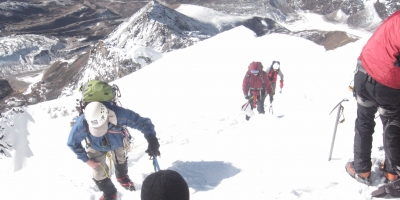
- Summit the stunning Island Peak (6,160 m) with breathtaking 360° views of the Himalayas.
- Journey from lush alpine forests to barren glaciers and dramatic high-altitude landscapes.
- Witness awe-inspiring views of Lhotse, Nuptse, Makalu, Ama Dablam, and Mount Everest.
- Visit ancient Sherpa villages, including Namche Bazaar, Pangboche, and Tengboche Monastery.
- Immerse in Buddhist culture with visits to monasteries, chortens, and prayer flag-filled trails.
- Experience both trekking and alpine climbing in one seamless and rewarding expedition.
- Climb Kalapathar (5,643 m) for the closest views of Everest at sunrise.
- Encounter Himalayan wildlife such as musk deer, snow pigeons, Himalayan tahrs, and yaks.
- Camp in the wilderness at Island Peak High Camp under the star-filled Himalayan sky.
Overview
‘An adventure with exciting trek and climb on top of the famous Island Peak’
Island Peak Climb with Everest Base Camp Trek is a once-in-a-lifetime Himalayan journey that blends two of Nepal’s greatest trekking and climbing experiences into one extraordinary itinerary. Offered by Everest Adventure Tour, this trip gives adventurers the chance to visit the world-famous Everest Base Camp (5,364 m) and then go a step further by attempting the summit of Island Peak (6,160 m), one of Nepal’s most popular trekking peaks. This climb is an excellent opportunity for those looking to gain high-altitude mountaineering experience without the technical demands of an 8,000-meter expedition.
Island Peak, locally known as Imja Tse, stands proudly in the Imjatse Valley surrounded by the towering peaks of Lhotse, Nuptse, Ama Dablam, and Baruntse. The peak was named "Island Peak" by early British climbers because it appears like an island in a sea of ice when viewed from Dingboche. While not overly technical, the climb demands a good level of physical fitness, basic climbing skills, and proper acclimatization. That’s why this itinerary has been carefully crafted to include gradual altitude gain, sufficient rest days, and a full acclimatization trek to Everest Base Camp and Kalapathar (5,643 m) before the summit attempt.
Throughout this journey, trekkers and climbers will be immersed in the raw beauty of the Khumbu region, walk through ancient Sherpa villages, visit Tengboche Monastery, and witness the grandeur of Himalayan landscapes. Whether you are standing in awe beneath Everest's southwest face at base camp or pushing your limits on the Island Peak summit, each day presents a new highlight. The satisfaction of summiting Island Peak and tracing the footsteps of legendary climbers like Tenzing Norgay and Sir Edmund Hillary makes this a truly fulfilling Himalayan experience.
Everest Adventure Tour ensures safety, quality, and personalized service throughout the trip. Our experienced guides, Sherpa climbers, and support crew are committed to making your dream of climbing a Himalayan peak both achievable and memorable. With the best logistical planning, quality equipment, and an adaptive itinerary, you’ll feel prepared and supported every step of the way—from Kathmandu to the top of Island Peak and back.
Major Places for Island Peak Climb with Everest Base Camp Trek
The Island Peak Climb with Everest Base Camp Trek offers an immersive experience through the most iconic and picturesque regions of the Himalayas. The journey takes you deep into the Khumbu region, a place renowned not only for its towering mountains but also its rich Sherpa culture, vibrant monasteries, and breathtaking landscapes. Starting from Kathmandu, the cultural heart of Nepal, the trek quickly transitions into the alpine world with a scenic flight to Lukla, the gateway to Everest.
Along the way, trekkers will pass through several notable destinations including Phakding, Namche Bazaar, Tengboche, Pheriche, and Lobuche. Each of these stops holds unique charm: Namche Bazaar is a bustling mountain town where trekkers can rest, resupply, and acclimate; Tengboche is home to the famous monastery offering panoramic views of Ama Dablam and Everest. From Lobuche, trekkers push onward to Everest Base Camp (5,364 m) and then ascend Kalapathar (5,643 m), the best viewpoint to see Everest up close.
Post-Everest Base Camp, the trail turns towards the stunning Imja Valley, reaching Chhukung, the last village before entering the wild terrain leading to Island Peak Base Camp (5,100 m). The summit of Island Peak (6,160 m) is the highlight of the journey, offering unmatched 360° views of Lhotse, Makalu, Baruntse, Ama Dablam, and the entire Imja Glacier region.
Major Highlights:
- Kathmandu Valley: Ancient temples and UNESCO World Heritage Sites.
- Lukla Airport (2,846 m): One of the world’s most thrilling airstrips.
- Namche Bazaar (3,440 m): Sherpa hub with museums, shops, and Everest views.
- Tengboche Monastery (3,867 m): Spiritual and scenic highlight.
- Everest Base Camp (5,364 m): Touch the base of the world’s tallest mountain.
- Kalapathar (5,643 m): Best sunrise view of Mount Everest.
- Island Peak Summit (6,160 m): Your crowning climbing achievement.
Best Season for Island Peak Climb with Everest Base Camp Trek
Choosing the right season is critical for the success and safety of your Island Peak Climb with Everest Base Camp Trek. The best times to undertake this adventure are during the pre-monsoon (spring) and post-monsoon (autumn) seasons. These windows provide optimal weather conditions, clear skies, and stable temperatures ideal for both trekking and peak climbing.
Spring (March to May) is one of the most popular seasons for this adventure. During these months, the temperature is moderate, and the entire Khumbu region comes to life with blooming rhododendrons and alpine flowers. The days are longer, offering more daylight hours for trekking and climbing. Views of the Himalayas are often crystal-clear, especially in the early morning. The snow conditions on Island Peak are also more stable, making the summit attempt relatively safer.
Autumn (late September to November) is another ideal season. After the monsoon rains, the air is clean and visibility is excellent. The skies remain clear throughout the day, and the temperature is comfortably cool, especially at higher altitudes. The risk of avalanches, landslides, and snowfall is much lower during these months. Autumn also coincides with important Nepali festivals like Dashain and Tihar, adding a cultural flavor to your trip.
Seasonal Summary:
Spring (March–May):
- Stable weather and good snow conditions for climbing.
- Blooming landscapes and ideal trekking temperatures.
Autumn (September–November):
- Clear skies, low precipitation, and ideal summit conditions.
- Post-monsoon freshness and stunning visibility.
- Avoid: Monsoon season (June–August) and harsh winter (December–February) due to heavy rain/snow and unstable conditions.
Food and Accommodation for Island Peak Climb with Everest Base Camp Trek
During the Island Peak Climb with Everest Base Camp Trek, Everest Adventure Tour ensures comfortable and hygienic food and accommodation throughout the journey. In Kathmandu, trekkers stay in 3-star standard hotels with modern amenities including private rooms, hot showers, and buffet breakfasts. Once you enter the Khumbu region, accommodation is provided in local teahouses (lodges), offering a cozy and authentic experience.
Teahouses along the trail offer twin-sharing rooms, basic beds, warm blankets, and shared bathrooms. In higher altitudes like Gorakshep, Chhukung, and Island Peak Base Camp, accommodation is more basic but clean and functional. During the climb from base camp to high camp and summit, you will be staying in tented camps, with sleeping bags and insulated mats provided by the company.
When it comes to food, trekkers enjoy nutritious and energy-rich meals throughout the trek. Typical menus include dal bhat (rice, lentils, vegetables), pasta, noodles, soups, eggs, pancakes, and Sherpa stew. Vegetarian options are widely available, and meals are freshly prepared at each lodge. At higher altitudes, the food is simpler, but Everest Adventure Tour ensures that it meets hygienic standards and provides the required nutrition for high-altitude trekking and climbing.
Key Food & Lodging Points:
- Kathmandu: 3-star hotel with breakfast included.
- Teahouses: Cozy, shared rooms with meals available.
- Camping: Provided during Island Peak climb with hot meals and tents.
- Meals: Freshly cooked vegetarian and non-vegetarian meals with tea/coffee.
- Special Needs: Can accommodate gluten-free, vegan, or special diets with advance notice.
Network and Communication for Island Peak Climb with Everest Base Camp Trek
Staying connected during your Island Peak Climb with Everest Base Camp Trek is possible but limited, especially at higher altitudes. In Kathmandu, you’ll have access to high-speed Wi-Fi, mobile networks, and all forms of modern communication. Once you fly to Lukla and begin the trek, the availability of mobile networks like NCELL and NTC varies based on altitude and location.
Most villages up to Dingboche have mobile network coverage, and some lodges offer Wi-Fi services (Everest Link or AirLink) for a fee. Namche Bazaar and Lukla have better connectivity, with cyber cafes, charging stations, and 4G service in some locations. However, from Lobuche onward to Island Peak Base Camp, expect very limited or no connectivity at all. During this stage, communication is mainly through satellite phones or walkie-talkies, used by the guides in case of emergencies.
Everest Adventure Tour provides necessary communication tools for group coordination and safety. At Island Peak Base Camp and during the climb, guides carry satellite phones or radio communication devices to ensure connection with emergency teams and base camp staff. This ensures your safety and allows for emergency rescue coordination if necessary.
Communication Overview:
- Wi-Fi: Available in Namche, Tengboche, and Pangboche (paid).
- Mobile Coverage: Up to Dingboche; spotty beyond that.
- Satellite Phone: Used above Chhukung and for the Island Peak climb.
- Charging Facilities: Available in most teahouses for a small fee.
- Pro Tip: Bring a power bank and local SIM card for better coverage.
Island Peak Climb with Everest Base Camp Trekking Permits
Undertaking the Island Peak Climb with Everest Base Camp Trek requires multiple permits, all of which are arranged by Everest Adventure Tour on your behalf. These permits are mandatory and ensure that your trek and climb comply with the local rules and national regulations governing mountaineering in Nepal.
For the Everest region, trekkers need to acquire the Khumbu Pasang Lhamu Rural Municipality Permit, which has replaced the older TIMS Card in this region. This is collected upon entering Khumbu from Lukla. The Sagarmatha National Park Permit is also required as the route passes through protected national park territory, home to rare species and pristine alpine environments.
To climb Island Peak (also known as Imja Tse), a special Island Peak Climbing Permit must be obtained through the Nepal Mountaineering Association (NMA). The cost of this permit varies seasonally, with spring being the most expensive due to high demand. All these permits are non-transferable and must be carried with you during the trek and climb, especially at various checkpoints along the trail.
Required Permits Include:
- Khumbu Pasang Lhamu Rural Municipality Permit
- Sagarmatha National Park Entry Permit
- Island Peak Climbing Permit from NMA
Why Combine Everest Base Camp and Island Peak?
Combining the Everest Base Camp Trek with an Island Peak Climb offers a perfect balance of trekking adventure, high-altitude acclimatization, and peak climbing. The initial days of the trek follow the iconic route through Namche Bazaar, Tengboche, and Pheriche, building the stamina and altitude adaptation necessary for your summit attempt. Visiting Everest Base Camp is a highlight in itself, allowing trekkers to stand at the base of the highest mountain on Earth and observe the Khumbu Icefall, a surreal maze of towering ice pinnacles and deep crevasses.
The inclusion of Kalapathar in the itinerary provides trekkers with unmatched panoramic views of Everest and its neighboring peaks. This rocky viewpoint is often considered the best place to photograph Mount Everest, as it rises dramatically above the sweeping glaciers. This entire segment serves as both a spiritual and physical preparation for the climb ahead. By the time you reach Island Peak Base Camp, your body will be well-adjusted to the thin air, significantly increasing your chances of a successful summit.
Island Peak itself is a highly rewarding climb. Though technically considered a “trekking peak,” the climb involves glacier travel, crevasse navigation, fixed rope sections, and a thrilling final push on a snowy ridge to the summit. It’s a perfect introduction to Himalayan climbing, and many use it as a stepping stone for higher goals like Mera Peak, Lobuche East, or even 8,000-meter expeditions. On summit day, the effort is handsomely rewarded with 360-degree views that include Makalu, Baruntse, Ama Dablam, Lhotse, and Everest itself.
This combined trek and climb is ideal for adventure seekers who want more than just trekking. It provides the added thrill of mountaineering while still allowing trekkers to experience the cultural and scenic richness of the Khumbu region. It’s more than a journey—it’s a personal achievement that blends exploration, endurance, and exhilaration in the world’s greatest mountain range.
Training, Acclimatization, and Climbing Support
Island Peak is not a technical climb by high-altitude mountaineering standards, but it still demands a good level of physical fitness, mental toughness, and basic mountaineering skills. The climb involves steep snow slopes, a glacier traverse, and a final pitch up a snowy headwall, often requiring fixed rope techniques, crampons, and ice axe usage. That’s why Everest Adventure Tour provides a full climbing clinic and training day at base camp, ensuring climbers are comfortable with the gear and techniques needed for a safe ascent.
The itinerary is designed to maximize acclimatization. Strategic rest days in Namche Bazaar and Pheriche, as well as gradual altitude gain, allow your body to adjust to the high elevations. Moreover, the trek to Everest Base Camp and climb of Kalapathar act as a pre-conditioning phase before tackling Island Peak. These segments also expose climbers to real alpine terrain—rocky moraines, glacial valleys, and sub-zero conditions—preparing them both mentally and physically for the summit push.
On the mountain, climbers are supported by experienced Sherpa guides who have summited Island Peak and other Himalayan giants numerous times. They’ll assist with gear setup, rope fixing, and pacing. The ratio of guides to climbers is kept low to ensure personalized attention and safety throughout the climb. Our teams carry emergency oxygen, satellite communication devices, and first-aid kits, ensuring that every contingency is covered.
Everest Adventure Tour uses quality mountaineering equipment, including tents, harnesses, crampons, and ice axes, all maintained to international safety standards. We also work closely with the Nepal Mountaineering Association (NMA), which regulates trekking peaks like Island Peak, ensuring all necessary permits, fees, and climbing regulations are followed.
Scenic, Cultural & Natural Highlights
This adventure is not just about summits—it's also about the journey through the Khumbu, one of the most culturally vibrant and scenic regions in Nepal. The trek begins in Lukla, a small mountain airstrip surrounded by green hills and peaks, and continues through charming Sherpa villages like Phakding, Namche Bazaar, and Pangboche. Along the way, you'll experience Buddhist monasteries, colorful prayer flags, and mani walls carved with sacred mantras, reflecting the deep spiritual connection of the Sherpa people to their land.
Namche Bazaar, the Sherpa capital, is a major highlight of the trek. Here, trekkers can explore local markets, museums, cafes, and enjoy stunning views of Everest and Ama Dablam from nearby viewpoints like Everest View Hotel. The stop at Tengboche Monastery, set against the backdrop of Ama Dablam, is another cultural gem. Witnessing morning prayers with the monks here is a deeply calming experience and adds a spiritual dimension to the trek.
The route into Imjatse Valley—home to Island Peak—is one of the most stunning parts of the journey. The valley floor is surrounded by soaring granite walls and snow peaks, with glacial rivers and yak pastures below. The changing landscape, from lush pine forests to barren alpine deserts, offers a constant visual feast. Wildlife sightings are also possible, including Himalayan tahr, musk deer, and various pheasants.
Finally, the feeling of standing atop Island Peak, with the entire Khumbu Himal stretching out below you, is indescribable. It's the perfect culmination to weeks of trekking, preparation, and effort. Returning back through Pangboche, Namche, and eventually Lukla, you carry not just memories but a profound sense of accomplishment. The scenic flight back to Kathmandu is your final reward—an aerial reminder of the immense terrain you've just conquered.
Important Note
Trip Itinerary
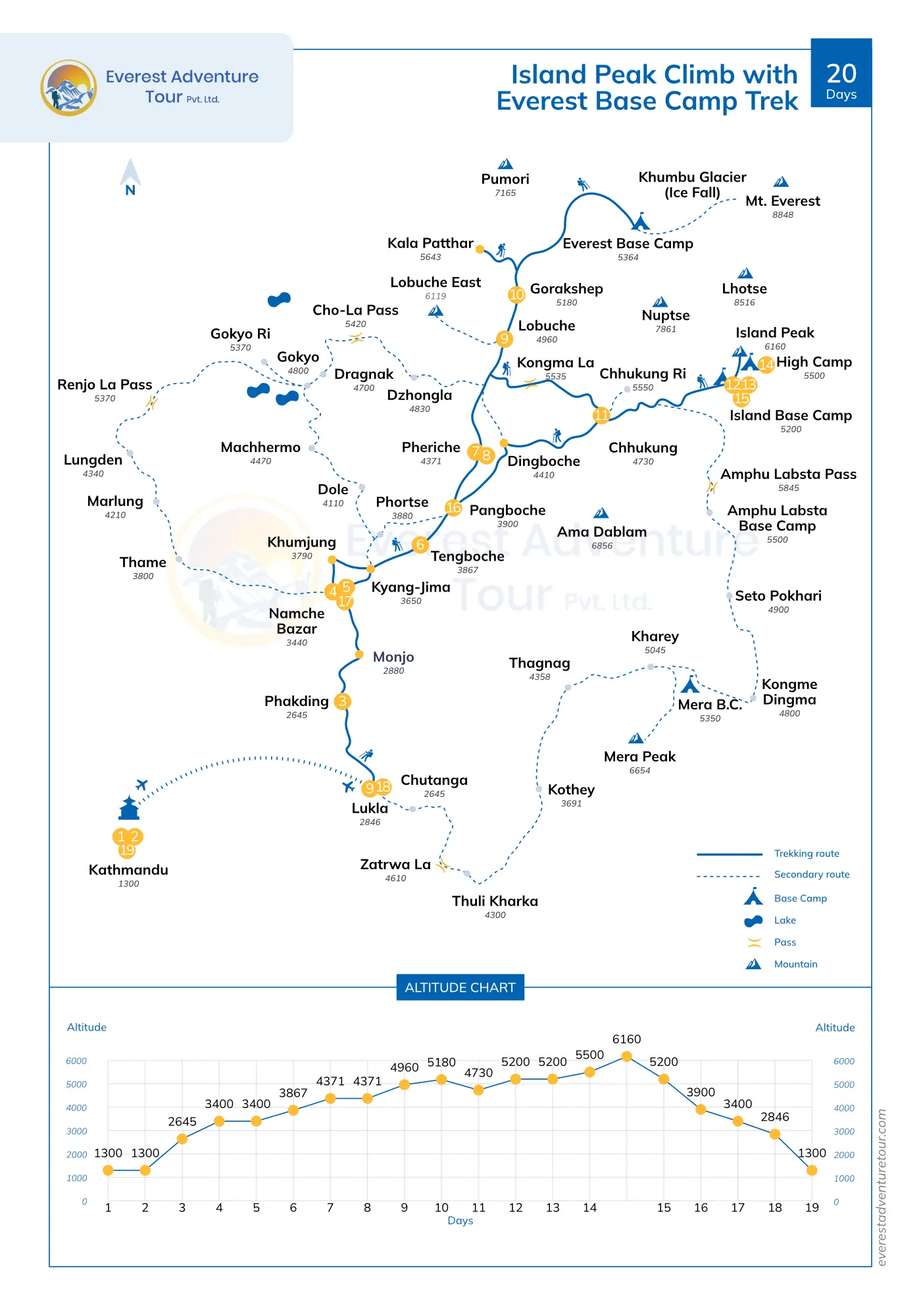
Route Map
Includes
- All Arrival and Departure Transfer from airport to hotel and vice-versa, vehicles according to group size.
- Three Star hotels in Kathmandu on bed and breakfast basis only.
- Domestic airfare from Kathmandu-Lukla-Kathmandu.
- Full board trekking includes twin sharing accommodation on best available local lodges, includes Breakfast, lunch, dinner with afternoon tea / snacks.
- Tented Camping for few overnights on climb with full support of camping cook, kitchen staff and climbing guide.
- Service of climbing guide, trekking staff as per size of a group with porters.
- Wages, meals, medical allowance of guides, trekking staff and porters.
- Applicable Peak Climbing Permits, includes Sagarmatha National Park Entrance Fees.
- Comprehensive Medical Kit carried by our guide if required for minor wounds and sickness.
- Sightseeing tour around Kathmandu valley as per the itinerary.
- Welcome or Farewell dinner in Kathmandu.
Doesn't Include
- Nepal Visa, Personal Medical & Travel Insurance.?
- Expenses of personal nature, meals in Kathmandu and gratitude or tipping for trekking staff, drivers, porters and guide, including extra snacks and refreshments.?
- Personal trekking / climbing gear, including sleeping bags and down jackets (if it is not included on the trip cost).?
- Emergency Evacuation if required by any means of transportation, including Helicopter Service.?
- Personal medical kit, as advised by you doctors.?
- Early return from the trek due to personal domestic or medical reasons, no refund will be entertained on breaking the journey.
- Excellent customer service. Our travel experts are ready to help you 24/7.
- Best price guaranteed.
- No credit card or booking fees.
- 100% financial protection.
- Environmentally-friendly tours.
Equipment List
- Thermal underwear (top and bottom)
- Moisture-wicking long-sleeved t-shirts
- Moisture-wicking underwear
- Fleece jacket or pullover
- Insulated down or synthetic jacket (lightweight and warm)
- Waterproof, windproof jacket (Gore-Tex or similar)
- Waterproof, windproof pants
- Trekking pants (convertible preferred)
- Warm beanie or wool hat
- Sun hat or baseball cap
- Neck gaiter, buff, or scarf
- Waterproof trousers (for rain and snow)
- Lightweight inner gloves (thermal or liner gloves)
- Insulated outer gloves or mittens (waterproof)
- Waterproof, broken-in hiking boots with ankle support
- Comfortable camp shoes or sandals (for evenings)
- Trekking socks (wool or synthetic, several pairs)
- Gaiters (optional, for snow and mud)
- Trekking backpack (30-40 liters) with rain cover
- Daypack (optional, for short hikes)
- Sleeping bag (rated to at least -10°C / 14°F)
- Insulated sleeping pad or foam mattress
- Adjustable trekking poles (with rubber tips)
- Insulated water bottles or hydration bladder (2-liter capacity recommended)
- Sunglasses with UV protection
- Headlamp with extra batteries
- Power bank and chargers (for electronics)
- Camera and extra batteries/memory cards
- Travel-size toiletries (toothbrush, toothpaste, biodegradable soap)
- Quick-dry towel
- Wet wipes and hand sanitizer
- Sunscreen (high SPF) and lip balm with SPF
- Personal first aid kit (bandages, blister pads, antiseptic, medication)
- Medications for altitude sickness (Diamox if prescribed)
- Pain relievers, anti-diarrheal, antihistamines
- Earplugs (for noisy lodges)
- Notebook and pen
- Portable solar charger (optional)
- Plastic zip-lock bags (to keep gear dry)
- Lightweight stuff sacks or packing cubes
- Snacks (energy bars, nuts, chocolates)
- Reusable water bottle or hydration system
- Small knife or multi-tool
- Passport-size photos (for permits if needed)
Frequently Asked Questions
While it’s technically possible to head directly to Island Peak Base Camp without visiting Everest Base Camp, Everest Adventure Tour highly recommends the longer route through Everest Base Camp and Kalapathar. This route is carefully designed for optimal acclimatization, gradual altitude gain, and physical preparedness. Climbing Island Peak (6,160 m) requires proper adaptation to high elevations, and visiting Everest Base Camp (5,364 m) and climbing Kalapathar (5,643 m) prior to the summit helps condition the body and mind. It also enhances your overall trekking experience by allowing you to explore more of the Khumbu region, building confidence and endurance for the climb ahead.
During the trek, accommodation is provided in clean, comfortable teahouses or lodges along the route. These range from basic to more luxurious lodges in areas like Namche Bazaar, offering Nepali, Indian, Tibetan, Continental, and Chinese cuisine. Meals are freshly prepared with options for vegetarians. As the altitude increases (e.g., Lobuche, Gorakshep), facilities become more basic, and attached bathrooms are generally unavailable due to freezing conditions.
On the Island Peak climb, accommodation shifts to tented camps. Our team provides spacious two-person tents with warm sleeping bags and foam mats. Food is prepared by our professional expedition cook in a kitchen tent, offering high-energy meals suited for high-altitude performance.
For your safety, Everest Adventure Tour requires all participants to have valid travel and medical insurance that covers high-altitude trekking and mountaineering (up to 6,500 meters). This insurance must include emergency evacuation, especially by helicopter, as well as coverage for trip cancellation, delayed flights, and medical treatment. Island Peak is located in a remote area where access to healthcare is limited, so having a robust insurance policy ensures peace of mind and financial protection in case of emergencies or unforeseen circumstances.
The minimum age recommended for the Island Peak Climb with Everest Base Camp Trek is 16 years, accompanied by a parent or guardian. The maximum age can go up to 70 years, depending on the individual’s physical fitness and medical condition. Everest Adventure Tour requires all climbers to be in good health, and those over 60 should undergo a medical check-up prior to booking. Even individuals with manageable health conditions can participate, provided they receive clearance from a doctor and inform our team in advance.
Yes, most teahouses from Lukla to Pheriche offer electricity powered by hydro or solar energy for charging devices like smartphones, cameras, and power banks. Charging is available for a small fee per item per hour. Wi-Fi and mobile networks (NCELL or NTC) are available in key areas such as Namche Bazaar, Tengboche, and Pangboche, although the signal may vary depending on the weather and terrain. During the Island Peak climb, there is no electricity or Wi-Fi, so it’s best to carry extra batteries or power banks and inform family of temporary communication blackout.
Yes, it is possible to undertake the Island Peak Climb without visiting Everest Base Camp, provided that trekkers are already well-acclimatized and have prior high-altitude trekking experience. Everest Adventure Tour can customize the itinerary accordingly. However, the standard route through EBC offers essential altitude exposure and terrain familiarization, especially useful for first-time climbers. Even seasoned trekkers benefit from the added days of hiking through varied terrain, which provides a more complete and safe Himalayan adventure.
Island Peak is a trekking peak but demands a high level of physical fitness, stamina, and determination. Trekkers should be able to walk 5–7 hours a day over rugged terrain at high altitudes. No prior climbing experience is mandatory, but basic mountaineering skills are helpful. Everest Adventure Tour provides a climbing training day at base camp, covering the use of crampons, ice axe, harness, and fixed rope techniques. Participants are encouraged to train for at least 3 months in advance, focusing on cardio, endurance, and strength exercises.
As with any high-altitude adventure, risks include altitude sickness (AMS), extreme weather, avalanches, and accidents during the climb. However, with proper acclimatization, experienced guides, and safety protocols, these risks are minimized. Everest Adventure Tour conducts health checks, ensures a gradual ascent, and equips teams with first-aid kits, oxygen cylinders, and satellite phones for emergency communication. Our guides are trained in wilderness first aid and rescue procedures to respond to emergencies promptly.
Essential climbing equipment includes crampons, harness, helmet, ice axe, jumar (ascender), carabiners, and climbing boots. Everest Adventure Tour provides most of the technical gear as part of the package. However, you’ll need to bring personal items like sleeping bags, trekking poles, headlamps, and appropriate clothing for sub-zero temperatures. A full gear checklist is provided upon booking, and gear rental is available in Kathmandu for those who do not own all the equipment.
Climbing Island Peak without a guide is not permitted by the Nepal Mountaineering Association (NMA). It’s mandatory to climb with a licensed climbing guide and support crew. Everest Adventure Tour arranges everything, including permits, equipment, training, food, and accommodation. Our guides are government-licensed, experienced mountaineers, and fluent in English. They ensure not just safety but also a more enriching experience through their knowledge of the Himalayan terrain, culture, and environment.