

- 1 - 1 Person US$ 1,900
- 2 - 5 Person US$ 1,600
- 6 - 12 Person US$ 1,500
- 13 - 20 Person US$ 1,450
Hotel in Kathmandu and Lodge / Tea House during trek
All meals during the trek
Highlights
- A classic Himalayan trek through Nepal’s restricted Upper Manaslu region
- Traverse from subtropical valleys to alpine highlands in a single journey
- Witness remote traditional villages practicing Tibetan Buddhist culture
- Explore ancient monasteries, mani walls, and prayer flags along the trail
- Trek through Manaslu Conservation Area – rich in biodiversity and wildlife
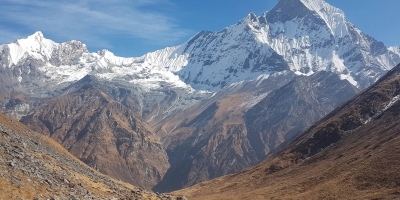
- Enjoy jaw-dropping views of Mt. Manaslu (8,163m) – world’s 8th highest peak
- Cross the dramatic and challenging Larke-La Pass (5,106m)
- Visit the scenic and culturally rich Sama Gaon and Samdo villages
- Day hike to Manaslu Base Camp, Birendra Lake, or Pungyen Gompa
- Experience a mix of Himalayan ethnic groups: Gurung, Nubri, and Tibetan descent
- Walk along the Budhi Gandaki River Gorge with thrilling suspension bridges
- Spot Himalayan wildlife: blue sheep, marmots, and possibly snow leopards
- Enjoy panoramic views of Himalchuli, Ganesh Himal, Ngadi Chuli, and Annapurna II
- Connect from Gorkha (Manaslu) to Manang (Annapurna) regions
Overview
The Manaslu Circuit Trek is a truly classic Himalayan journey that offers trekkers an immersive experience around Mt. Manaslu (8,163m / 26,781 ft) – the eighth-highest mountain in the world. This route takes you through some of Nepal's most untouched and culturally rich regions, once part of a restricted zone and only opened to foreign trekkers in 1991. Even today, the region maintains its mystical allure, protected under strict permit requirements due to its proximity to the Tibetan border. The trek is ideal for adventurers seeking dramatic mountain scenery, cultural diversity, and an off-the-beaten-path experience.
This spectacular circuit encircles the entire Manaslu Himalaya range, offering jaw-dropping views of peaks like Himalchuli, Ngadi Chuli, Ganesh Himal, and of course, Manaslu itself. It also traverses a variety of ecosystems—from steamy river gorges and bamboo forests to alpine meadows and glacial moraines. Starting from Machha Khola in the Gorkha district, the trek gradually ascends through the Budhi Gandaki River valley, passing charming Gurung, Magar, and Tibetan villages before reaching the remote highland settlements of Sama Gaon and Samdo.
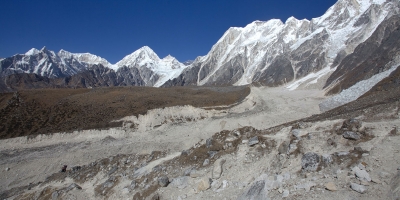
Along the trail, trekkers gain intimate access to Tibetan-influenced culture, with centuries-old monasteries, mani walls, and chortens lining the path. At Sama Gaon, there's a designated rest and acclimatization day where one can explore Pungyen Gompa, Birendra Tal (a glacial lake), or hike toward Manaslu Base Camp. This high-altitude acclimatization is essential as the trek culminates at the formidable Larke La Pass (5,106m / 16,751 ft), the highest point of the route. Crossing the pass offers a truly rewarding and panoramic spectacle of the Himalayan skyline, including views of Himlung, Cheo Himal, and Annapurna II.
After conquering the pass, the route descends into the lush forests and terraced hillsides of the Manang district, eventually merging with the Annapurna Circuit trail at Dharapani village. From there, the journey winds down with scenic drives back to Kathmandu via Besisahar. The entire circuit is not only a physically demanding trek but also a spiritually and culturally enriching journey through one of Nepal’s most unique landscapes. With Everest Adventure Tour, every detail from permits and logistics to guided expertise is handled with precision, ensuring trekkers focus solely on embracing the adventure of a lifetime.
Major Places for Manaslu Circuit Trek
The Manaslu Circuit Trek takes you through a series of diverse and captivating destinations, each offering unique cultural, scenic, and historical significance. Starting from Machha Khola, a small riverside town in the low hills of Gorkha district, the journey gradually ascends through subtropical forests, terraced fields, and narrow gorges along the Budhi Gandaki River. As the trek advances, the villages become more traditional and influenced by Tibetan culture. Jagat, a UNESCO tentative site, marks the entry point to the Manaslu Conservation Area, known for its ancient stone-paved paths and Buddhist chortens.
Some of the most significant highlights include Deng, Namrung, and Lo-Gaon (Lho)—each village offering spectacular views of Manaslu and neighboring peaks. Lo-Gaon, in particular, is famed for its hilltop monastery and panoramic view of Mt. Manaslu’s north face. Trekking further leads you to Sama Gaon, the largest and most culturally rich village on the route. This is not only a base for acclimatization but also a gateway to Manaslu Base Camp, Pungyen Monastery, and the glacial Birendra Tal.
Another vital stop is Samdo, the last permanent settlement before the Larke-La Pass. It is a remote hamlet with strong Tibetan roots and a hub for yak caravans once used for trade with Tibet. After crossing the high-altitude Larke-La Pass (5,106m), the trail descends into the Manang district, where Bhimthang, Gho, and Dharapani greet trekkers with forests, meadows, and more modern comforts.
Key Major Places:
- Machha Khola – Trek starting point in the low hills
- Jagat – Gateway to the restricted Manaslu Conservation Area
- Namrung – Stunning sunrise views and Tibetan-style houses
- Lo-Gaon (Lho) – Iconic views of Mt. Manaslu and Buddhist monastery
- Sama Gaon – Cultural center and acclimatization hub
- Samdo – Tibetan-style village near Nepal-Tibet border
- Larke-La Pass – The highest and most challenging part of the trek
- Bhimthang & Dharapani – Beautiful end-stage villages on the Annapurna side
Best Season for Manaslu Circuit Trek
The ideal time for the Manaslu Circuit Trek is during the two main trekking seasons in Nepal: spring (March to May) and autumn (mid-September to November). These periods offer the best weather, clearer skies, and more stable trail conditions, making your trekking experience both safe and visually rewarding. During autumn, the skies are crisp, the mountain views are at their sharpest, and the trails are dry. Post-monsoon freshness adds vibrancy to the landscapes, and the temperature is comfortable across all altitudes.
Spring, on the other hand, is a colorful season with blooming rhododendrons, lush forests, and milder temperatures. Although visibility can occasionally be slightly hazier than autumn, it is still a fantastic time to trek, especially if you enjoy vibrant flora and milder cold at higher elevations. Additionally, spring is the pre-monsoon season, meaning there's very little rainfall, making river crossings and high pass conditions favorable.
Off-season months, such as June to August (monsoon) and December to February (winter), are less ideal due to heavy rainfalls, landslides, and extreme cold with heavy snow, especially near Larke-La Pass. Trekkers attempting the circuit in these months should be well-prepared and preferably experienced in high-altitude trekking.
Best Trekking Seasons:
- Autumn (Mid-Sept to Nov): Clear skies, great visibility, ideal temperatures
- Spring (March to May): Wildflowers bloom, warmer weather, pleasant trekking
- Avoid Monsoon (June-Aug): Wet trails, leeches, and poor visibility
- Avoid Deep Winter (Dec-Feb): Snow-blocked pass, freezing temperatures
Manaslu Circuit Trekking Difficulty Level
The Manaslu Circuit Trek is classified as a moderate to strenuous trek due to its remote location, length, and high altitude. The trail covers a total distance of approximately 177 kilometers (110 miles), and spans 18 days, including driving and rest days. While no technical climbing is involved, the trek includes steep ascents and descents, narrow ridges, rocky trails, and high-altitude exposure—especially while crossing the Larke-La Pass (5,106m / 16,751 ft).
Trekkers need to be in good physical condition, capable of walking 5 to 8 hours a day, often on uneven, rugged terrain. One of the major challenges is the altitude gain, particularly from Sama Gaon upward, where the air gets thinner and acclimatization becomes crucial. However, the itinerary by Everest Adventure Tour is carefully designed with gradual altitude gain and an acclimatization day at Sama Gaon to minimize the risk of Acute Mountain Sickness (AMS).
Though challenging, the trek is achievable for most fit hikers with prior trekking experience, or strong determination and preparation. Hiring experienced guides and porters significantly enhances your safety and comfort, especially at higher altitudes and during the Larke-La crossing. It’s recommended to engage in cardio training, hiking, or stair-climbing exercises for at least 4–6 weeks before the trip.
Trek Difficulty Highlights:
- Total trek duration: 13 trekking days (excluding drive/rest days)
- Max altitude: 5,106m at Larke-La Pass
- Daily walking: 4–8 hours on average
- Trail type: Forest paths, rocky ridges, glacial moraines, suspension bridges
- Fitness required: Moderate to high with basic altitude awareness
Food and Accommodation for Manaslu Circuit Trek
Food and accommodation on the Manaslu Circuit Trek are provided through teahouse lodges, small family-run guesthouses that offer basic yet comfortable lodging and freshly prepared meals. In lower elevations like Machha Khola, Jagat, and Namrung, teahouses often have private twin rooms with shared bathrooms and dining halls with fireplaces. As you ascend higher to Sama Gaon, Samdo, and Dharmasala, facilities become more basic—single wooden rooms, bucket showers, and limited electricity are common.
Meals typically include traditional Nepali “Dal Bhat” (rice, lentils, vegetables), along with options like noodles, momos, soups, pancakes, pasta, Tibetan bread, and eggs. At higher altitudes, food variety is limited due to the remoteness, but still sufficient for nutrition and energy. Everest Adventure Tour ensures hygienic kitchen practices are followed, and safe drinking options (boiled or filtered water) are available or suggested through purification tablets.
Most teahouses provide Wi-Fi (for a fee) and charging facilities, though these may become unavailable beyond Sama Gaon or Samdo due to power shortages. Hot showers and battery charging also come with an additional cost, especially at higher altitudes. Guests are expected to bring their own sleeping bag, although blankets are usually provided.
Food & Accommodation Overview:
- Accommodation: Basic teahouses; twin sharing rooms; shared toilets
- Meals: Dal Bhat, Tibetan bread, pasta, soups, eggs, tea, coffee
- Drinks: Boiled water, herbal teas, safe drinking water with tablets
- Extras: Hot showers, battery charging, Wi-Fi available at extra charge
- Recommended to bring: Sleeping bag, water purification tablets, snacks
Network and Communication for Manaslu Circuit Trek
While the Manaslu Circuit Trek ventures through some of Nepal’s most remote and isolated regions, communication is still possible at various points along the route—though limited and often unreliable. In the lower regions like Machha Khola, Jagat, and Namrung, major Nepali mobile networks such as NTC (Nepal Telecom) and NCELL may offer weak to moderate connectivity, especially for phone calls and occasional SMS. However, as you ascend toward Sama Gaon, Samdo, and Dharmasala, the mobile signal becomes weaker or non-existent altogether.
Despite these limitations, many teahouses offer paid Wi-Fi services, typically using satellite-based connections. The speed and reliability vary drastically depending on weather and location. In villages like Sama Gaon or Lo-Gaon, you may find relatively stable connections for messaging or checking emails, but video calls or uploads are rarely supported. At Larke-La Pass and Dharmasala, no communication services are available at all. Trekkers are advised to inform loved ones of expected communication blackouts during high-altitude days.
For emergency communication, Everest Adventure Tour guides are equipped with mobile phones and may carry walkie-talkies or satellite phones, depending on the group size and conditions. Trekkers can also purchase a local SIM card in Kathmandu before the trek, but again, coverage is not guaranteed above 3,000 meters.
Communication Overview:
- Mobile coverage: Limited; strongest in lower villages
- Wi-Fi: Available in many teahouses (paid, slow, weather-dependent)
- No signal zones: Sama Gaon to Bhimphedi via Larke-La
- Emergency contacts: Satellite phone or walkie-talkie used by guides
- Tip: Inform family of blackout zones and use Everest Adventure Tour’s daily check-ins where possible
Manaslu Circuit Trekking Transportation
Transportation during the Manaslu Circuit Trek involves a combination of private vehicles and trekking routes, strategically arranged to connect the trailhead and endpoint. The journey begins in Kathmandu, with a private jeep or tourist vehicle arranged by Everest Adventure Tour, taking you to Machha Khola (900m) via Arughat and Soti Khola. This drive spans about 156 km and takes approximately 6–7 hours, depending on road and weather conditions. The route passes through scenic hilly countryside, terraced fields, and small towns—a visual prelude to the trek itself.
The return journey is from Dharapani to Besisahar and then back to Kathmandu. From Dharapani, a private jeep or shared vehicle transports trekkers down to Besisahar (760m) in about 4 hours, followed by another 5–6-hour drive on paved roads to the capital. While the return road is better maintained than the approach, both drives can be bumpy, especially during monsoon or post-monsoon seasons when landslides are common.
Everest Adventure Tour ensures safe, well-maintained 4WD jeeps for these sections, offering comfortable seating, space for backpacks, and experienced local drivers familiar with mountainous terrain. All transportation logistics—pickups, drop-offs, and luggage management—are included in the trek package.
Transportation Summary:
- Kathmandu to Machha Khola: 6–7 hrs by private jeep
- Dharapani to Besisahar: 4 hrs off-road drive
- Besisahar to Kathmandu: 5–6 hrs via paved highway
- Vehicles used: 4WD jeeps or tourist vans (based on group size)
- Tip: Carry motion sickness tablets for bumpy sections
Manaslu Circuit Trekking Permits
Due to its proximity to the Tibetan border and the ecological sensitivity of the region, the Manaslu Circuit Trek falls under restricted area trekking in Nepal. As such, trekkers are required to obtain special permits to enter and trek through the Manaslu region. These permits are regulated by the Nepal Immigration Department, and trekkers must be accompanied by a licensed guide and be in a group of at least two people—a rule strictly enforced.
The key permits required include the following:
- Manaslu Restricted Area Permit (MRAP) – Required from Jagat to Sama Gaon, with pricing based on the number of days spent in the restricted zone.
- Manaslu Conservation Area Permit (MCAP) – Required for the entire region to help fund conservation and local community projects.
- Annapurna Conservation Area Permit (ACAP) – Needed as the trek exits through Dharapani, part of the Annapurna Conservation Area.
- TIMS Card – Usually not required for Manaslu if MRAP is issued, but some agencies include it as part of protocol.
Permit acquisition is handled entirely by Everest Adventure Tour, who manage the paperwork, logistics, and group formation if needed. Passport-sized photos and a valid passport with visa are required. Fees may vary seasonally, especially for MRAP, which is more expensive in peak months (Sept–Nov).
Required Permits:
- MRAP: USD $100 per person (first 7 days), $15/day thereafter (Sept–Nov)
- MCAP: NPR 3,000 (~USD $25)
- ACAP: NPR 3,000 (~USD $25)
- TIMS: Often waived, but carried for safety documentation
- Note: Solo trekkers not allowed—must join a registered company like Everest Adventure Tour
Why Choose Manaslu Circuit Trek
If you're seeking a trek that combines raw natural beauty, cultural richness, and high-altitude adventure—the Manaslu Circuit Trek stands out as one of Nepal's most rewarding yet under-explored routes. Unlike the crowded trails of Everest and Annapurna, Manaslu offers a more secluded and peaceful experience, with trails that pass through Tibetan-style villages, Buddhist monasteries, and spectacular mountain vistas. The journey encompasses the 8th highest mountain in the world, Larke-La Pass, and some of the most stunning glacier-fed rivers and alpine valleys in Nepal.
What makes this trek even more appealing is the sense of cultural immersion. You’ll witness the way of life of remote Himalayan communities who still practice ancient Tibetan Buddhism, untouched by modernization. Trekkers often cite the hospitality of locals, the diversity of landscapes, and the raw authenticity of the region as unforgettable highlights. From lowland rice terraces to icy high passes, the variety of terrain and flora/fauna is simply unmatched.
Choosing the Manaslu Circuit Trek with Everest Adventure Tour means expert logistics, safe guiding, and meaningful experiences. Our well-planned itinerary includes ample acclimatization, quality accommodation, and a responsible trekking approach. We handle everything—permits, guides, transportation, meals—allowing you to focus on the journey.
Why Manaslu Circuit is a Top Choice:
- Off-the-beaten-path: Fewer trekkers, more solitude
- Cultural depth: Tibetan-influenced villages and monasteries
- Scenic variety: Rivers, forests, alpine valleys, and glacier views
- High-altitude thrill: Cross the iconic Larke-La Pass (5,106m)
- Sustainable adventure: Supports local economy and conservation
Important Note
Trek Mode: Best available teahouse/lodge accommodation throughout the trek
Trek Grade: Moderate to Adventurous (suitable for physically fit trekkers with some experience)
Highest Point: Larke-La Pass – 5,106 meters (16,752 feet) above sea level
Trek Region: Northern mid-western Nepal, in the Gandaki Province – covering Manaslu and parts of Manang district
Trek Duration: 13 nights / 14 days of trekking, with drives in and out
Total Trip Duration: 17 nights / 18 days from arrival in Kathmandu to international departure
Best Seasons for Manaslu Circuit Trek
The Manaslu Circuit Trek is best enjoyed during spring (March to May) and autumn (September to November)—the two major trekking seasons in Nepal offering the finest weather and scenic conditions.
Spring Season (March to May):
This season brings longer daylight hours, making for excellent trekking conditions and stunning mountain views. Mornings to mid-afternoons are generally clear and sunny, although late afternoons can bring occasional clouds or brief showers. Higher elevations may experience light snowfall, and mornings and nights are typically cold. The forests along the trail burst into bloom, especially with colorful rhododendrons, Nepal’s national flower, adding incredible color to the hillsides.
Autumn Season (September to November):
Widely regarded as the prime trekking season, autumn offers crystal-clear skies, stable weather, and excellent visibility of the snow-capped Himalayas. The temperatures are cooler compared to spring, and the days are shorter, with early sunsets and cold evenings and mornings. Snowfall is still possible at higher altitudes, but the skies often remain clear, especially during the early part of the season. The post-monsoon air is crisp and fresh, making it perfect for photography and scenic walks.
Culture and Religion in the Manaslu and Manang Region
The Manaslu Circuit takes trekkers through a diverse cultural landscape, starting in lower Gorkha, where you'll encounter communities of Gurung and Magar ethnic groups, practicing a blend of Hinduism and Buddhism.
From the village of Jagat onward, as you ascend into the higher Manaslu region, the culture shifts predominantly to Tibetan Buddhism. This area is inhabited by the Bhote people, whose ancestors migrated from southwestern Tibet during the 15th–16th centuries. Their culture closely mirrors that of their Tibetan roots, and their religion follows the Mahayana branch of Tibetan Buddhism, primarily from the Nyingma sect.
Along the trail, you’ll encounter ancient monasteries, mani walls (stone slabs inscribed with prayers), spinning prayer wheels, and chortens (stupas)—all key symbols of Tibetan Buddhist devotion. Local festivals such as Saga Dawa (celebrating Buddha’s birth, enlightenment, and death) and Gyalbo Losar (Tibetan New Year, held in February or early March) are celebrated with deep spiritual significance. These cultural experiences add profound meaning to the trek and provide deeper insight into life in the remote Himalayan highlands.
Trip Itinerary

Max. altitude

Accommodation

Meals
Max. altitude
Accommodation
Meals
Max. altitude
Accommodation
Meals
Max. altitude
Accommodation
Meals
Max. altitude
Accommodation
Meals
Max. altitude
Accommodation
Meals
Max. altitude
Accommodation
Meals
Max. altitude
Accommodation
Meals
Max. altitude
Accommodation
Meals
Max. altitude
Accommodation
Meals
Max. altitude
Accommodation
Meals
Max. altitude
Accommodation
Meals
Max. altitude
Accommodation
Meals
Max. altitude
Accommodation
Meals
Max. altitude
Accommodation
Meals
Max. altitude
Accommodation
Meals
Max. altitude
Accommodation
Meals
Max. altitude
Accommodation
Meals
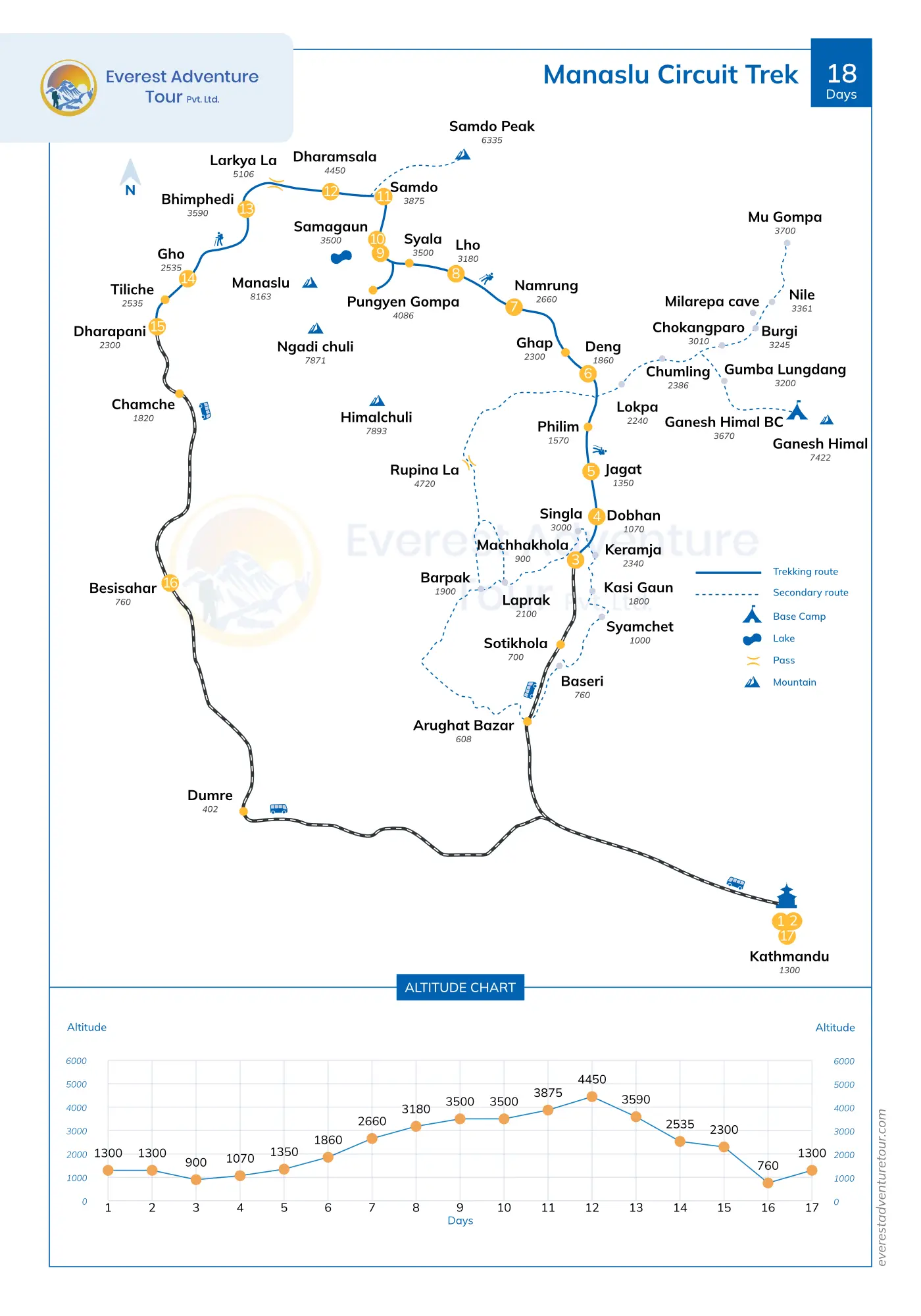
Route Map
Includes
- All Arrival and Departure Transfer from airport to hotel and vice-versa, vehicles according to group size.
- Three Star hotels in Kathmandu on bed and breakfast basis only.
- Transportation on start of trekking and after trek to and from Kathmandu.
- Full board trekking includes twin sharing accommodation on best available local lodges, includes Breakfast, lunch, dinner with afternoon tea / snacks.
- Service of guide, trekking staff as per size of a group with porters.
- Wages, meals, medical allowance of guides, trekking staff and porters.
- Applicable Special Trekking Permits for Restricted Areas for Manaslu and Tsum Valley. Includes MCA (Manaslu Conservation Area) and ACAP (Annapurna Conservation Area Project) Entrance Fees.
- Comprehensive Medical Kit carried by our guide if required for minor wounds and sickness.
- Sightseeing tour around Kathmandu valley as per the itinerary.
- Welcome or Farewell dinner in Kathmandu.
Doesn't Include
- Nepal Visa, Personal Medical & Travel Insurance.?
- Expenses of personal nature, meals in Kathmandu and gratitude or tipping? for trekking staff, drivers, porters and guide, including extra snacks and refreshments.?
- Personal trekking gear, including sleeping bags and down jackets (if it is not? included on the trip cost).?
- Emergency Evacuation if required by any means of transportation, including? Helicopter Service.?
- Personal medical kit, as advised by you doctors.?
- Early return from the trek due to personal domestic or medical reasons, no refund will be entertained on breaking the journey.
- Excellent customer service. Our travel experts are ready to help you 24/7.
- Best price guaranteed.
- No credit card or booking fees.
- 100% financial protection.
- Environmentally-friendly tours.
Equipment List
- Thermal underwear (top and bottom)
- Moisture-wicking long-sleeved t-shirts
- Moisture-wicking underwear
- Fleece jacket or pullover
- Insulated down or synthetic jacket (lightweight and warm)
- Waterproof, windproof jacket (Gore-Tex or similar)
- Waterproof, windproof pants
- Trekking pants (convertible preferred)
- Warm beanie or wool hat
- Sun hat or baseball cap
- Neck gaiter, buff, or scarf
- Waterproof trousers (for rain and snow)
- Lightweight inner gloves (thermal or liner gloves)
- Insulated outer gloves or mittens (waterproof)
- Waterproof, broken-in hiking boots with ankle support
- Comfortable camp shoes or sandals (for evenings)
- Trekking socks (wool or synthetic, several pairs)
- Gaiters (optional, for snow and mud)
- Trekking backpack (30-40 liters) with rain cover
- Daypack (optional, for short hikes)
- Sleeping bag (rated to at least -10°C / 14°F)
- Insulated sleeping pad or foam mattress
- Adjustable trekking poles (with rubber tips)
- Insulated water bottles or hydration bladder (2-liter capacity recommended)
- Sunglasses with UV protection
- Headlamp with extra batteries
- Power bank and chargers (for electronics)
- Camera and extra batteries/memory cards
- Travel-size toiletries (toothbrush, toothpaste, biodegradable soap)
- Quick-dry towel
- Wet wipes and hand sanitizer
- Sunscreen (high SPF) and lip balm with SPF
- Personal first aid kit (bandages, blister pads, antiseptic, medication)
- Medications for altitude sickness (Diamox if prescribed)
- Pain relievers, anti-diarrheal, antihistamines
- Earplugs (for noisy lodges)
- Notebook and pen
- Portable solar charger (optional)
- Plastic zip-lock bags (to keep gear dry)
- Lightweight stuff sacks or packing cubes
- Snacks (energy bars, nuts, chocolates)
- Reusable water bottle or hydration system
- Small knife or multi-tool
- Passport-size photos (for permits if needed)
Frequently Asked Questions
There is no strict upper or lower age limit for the Manaslu Circuit Trek, but participants should be in good physical condition and have the mental endurance for multi-day trekking at high altitudes. At Everest Adventure Tour, we’ve had trekkers from 12 to 70 years old complete the trek successfully. However, those under 18 must be accompanied by a guardian, and we recommend a medical consultation for trekkers over 60 or those with existing health conditions. The key is fitness, stamina, and acclimatization, not age.
The Manaslu region offers basic but comfortable teahouse accommodations, especially at lower elevations. As you ascend, the lodges become more rustic, particularly from Sama Gaon upward. Rooms usually include twin beds, blankets, and shared toilets. Meals are freshly cooked and typically include dal bhat (rice and lentils), noodles, soups, Tibetan bread, eggs, and momos. At Everest Adventure Tour, we ensure hygienic food and recommend dietary options that best suit your energy needs during the trek.
Yes, the Manaslu Circuit Trek has become increasingly popular among seasoned trekkers and those looking for a less commercialized alternative to Everest or Annapurna. Though still less crowded, it offers everything a classic Himalayan trek does—snow-capped peaks, rich culture, remote villages, and high-altitude passes. As more trekkers seek off-the-beaten-path experiences, Everest Adventure Tour has seen a rise in demand for this trek, making it one of our signature Himalayan adventures.
Not all lodges along the Manaslu Circuit offer reliable electricity or internet services, especially in higher villages like Samdo or Dharmasala. In lower villages, you’ll usually find solar or hydro-powered electricity, enough to charge devices for a small fee. Wi-Fi is available in some teahouses (usually paid and slow), but connectivity can be unpredictable due to weather and remoteness. At Everest Adventure Tour, we advise our clients to carry power banks and communicate with family before entering blackout zones.
The best times to trek the Manaslu Circuit are during the spring (March to May) and autumn (mid-September to November) seasons. These months offer the clearest skies, stable weather, and stunning mountain views. Spring also brings blooming rhododendrons and lush landscapes, while autumn features crisp air and vibrant cultural festivals. At Everest Adventure Tour, we schedule most of our Manaslu departures in these two seasons to ensure optimal conditions for safety and enjoyment.
Prior trekking experience is helpful but not strictly necessary. The Manaslu Circuit Trek is classified as moderate to challenging, mainly due to its length, altitude, and remote terrain. Trekkers who are physically fit, comfortable walking 5–7 hours a day, and mentally prepared for altitude challenges can complete the trek successfully. Everest Adventure Tour provides pre-departure guidance, and our experienced guides monitor your health and pace, making it manageable even for first-time high-altitude trekkers.
Yes, trekking the Manaslu Circuit requires a government-licensed guide and must be arranged through a registered trekking agency like Everest Adventure Tour. Solo trekking is not permitted in the restricted Manaslu region. Hiring a porter is optional but highly recommended, as the trek involves many days of walking with gear. Our team ensures your safety, navigational ease, cultural interpretation, and logistical support throughout the journey.
Trekkers need three main permits: the Manaslu Restricted Area Permit (MRAP), the Manaslu Conservation Area Permit (MCAP), and the Annapurna Conservation Area Permit (ACAP). These permits are mandatory due to the trek's restricted status and conservation area regulations. Everest Adventure Tour handles all permit processing as part of your booking package. Please provide a valid passport, visa, and passport-sized photos, and we take care of the rest—ensuring you meet all government regulations.
The highest point on the trek is the Larke-La Pass at 5,106 meters (16,751 feet). This is a challenging yet rewarding part of the journey, offering panoramic views of the Manaslu range, Himlung, Cheo Himal, and parts of Annapurna II. It typically takes 7–9 hours to cross from Dharmasala to Bhimphedi via the pass. Our itineraries include acclimatization days and gradual altitude gain to help trekkers cross the pass safely and comfortably.
Everest Adventure Tour specializes in expertly guided Himalayan treks, offering years of experience, licensed local guides, and strong connections within the trekking communities. We offer fully customizable itineraries, focus on safety, cultural immersion, and sustainability, and ensure each client receives personal attention. With our well-trained staff, responsible tourism practices, and commitment to quality, Everest Adventure Tour ensures that your Manaslu Circuit Trek is not just a journey—but a life-changing adventure.