

- 1 - 1 Person US$ 1,599
- 2 - 5 Person US$ 1,499
- 6 - 12 Person US$ 1,450
- 13 - 20 Person US$ 1,399
3*** Hotel in Kathmandu and Pokhara and Lodge during the trek.
Breakfast in Kathmandu and all meals during the trek.
Highlights
- Adventure around the world’s 10th highest mountain — Mt. Annapurna (8,091 m) and its vast massif
- Trekking through lush green hills to arid, high-altitude terrain resembling Tibetan plateau
- Crossing the dramatic Thorong-La Pass (5,416 m) — one of the highest trekking passes in the world
- Journey from the east to west side of the Annapurna Himalayas, experiencing diverse landscapes
- Walking from the Manang Valley to the Mustang region, rich in Tibetan Buddhist culture
- Immersion in local mountain cultures, from Hindu farming villages to Tibetan-influenced highland settlements
- Exploring charming villages like Chame, Pisang, Manang, Marpha, and Ghorepani
- Panoramic sunrise view from Poon Hill (3,210 m) over Annapurna, Dhaulagiri, and Manaslu ranges
- Visit to the sacred Hindu-Buddhist pilgrimage site of Muktinath Temple
- Trekking through the world's deepest gorge — the Kali Gandaki Valley between Dhaulagiri and Annapurna
- Optional side hikes to Ice Lake, Gangapurna Glacier, and Braga Monastery for acclimatization
- Enjoying a relaxing bath in natural hot springs at Tatopani after days of trekking
- Diverse climate zones in one trek — from subtropical jungles to alpine meadows and glacial deserts
- Scenic flight or drive between Pokhara and Kathmandu, offering views of the entire Himalayan range
Overview
‘Adventure around world’s 10th highest Annapurna and its massif mountain range’
The Annapurna Circuit Trek is one of the most iconic and dramatic trekking routes in the world, offering a rich blend of Himalayan scenery, cultural diversity, and natural beauty. Organized by Everest Adventure Tour, this remarkable 17-day journey encircles the towering Annapurna massif—10th highest mountain in the world—allowing trekkers to experience everything from lush subtropical forests and terraced fields to arid alpine landscapes and ancient highland villages.
Your adventure begins in Kathmandu, the cultural heart of Nepal, with a warm welcome and a chance to explore UNESCO World Heritage sites on the second day. From sacred temples to royal palaces, this cultural immersion sets the tone for a meaningful Himalayan journey. The overland drive that follows takes you westward, entering the scenic countryside and foothills of the Annapurna range. The drive is split into two days to ensure comfort—first to Besisahar and then further to Dharapani, marking the start of your trekking adventure.
As the trek begins, you gradually ascend through pine forests and traditional mountain settlements, reaching Chame, the district headquarters of Manang. The trail continues through the Marsyangdi River valley, offering stunning views of Annapurna II and Lamjung Himal, eventually arriving at Pisang, where the Tibetan influence becomes more evident. The next leg leads you to Manang, a high-altitude village nestled in a stunning valley surrounded by snow-capped giants. This is not just a scenic stop, but also a crucial place for acclimatization. A rest day in Manang includes options to hike to Ice Lake, Gangapurna Glacier, or the ancient Braga Monastery, offering panoramic views and insights into local Buddhist culture.
After proper acclimatization, the trek heads higher towards Yak Kharka and eventually High Camp, marking the final approach to the toughest and most exhilarating part of the journey—Thorong-La Pass. At 5,416 meters (17,697 feet), crossing Thorong-La is both a physical and emotional highlight of the trek. Adorned with colorful prayer flags, this pass connects the Manang and Mustang districts and offers sweeping views of the surrounding peaks and high valleys.
Descending from the pass, you enter the mystical region of Mustang, arriving at the sacred site of Muktinath—a revered pilgrimage destination for both Hindus and Buddhists. From here, a scenic drive takes you to Tatopani, a charming village famed for its natural hot springs—perfect for a rejuvenating soak after days of trekking. The journey continues with a gradual climb to Ghorepani, set amidst enchanting rhododendron and pine forests. Early next morning, a short hike leads to Poon Hill, a famed viewpoint offering breathtaking sunrise views over Dhaulagiri, Annapurna, and Manaslu ranges.
The final segment of the trek descends through beautiful hill villages to Hille, followed by a scenic drive to Pokhara, Nepal’s picturesque lake city. After a relaxing night, a short flight returns you to Kathmandu, giving you time to reflect on your incredible Himalayan experience before your international departure.
This carefully crafted itinerary by Everest Adventure Tour balances high-altitude adventure with cultural exploration and natural beauty. To ensure comfort and avoid long, tiring drives, the route breaks down the journey into manageable segments. Moreover, to optimize time and safety, sections of the trail affected by new roads—especially between Muktinath and Tatopani—are covered by jeep drives, skipping unnecessary walking on dusty roads without missing key experiences.
Whether you’re drawn to the stunning vistas, spiritual sites, or the challenge of crossing one of the highest trekking passes in the world, the Annapurna Circuit Trek offers an unparalleled adventure—truly one of the most rewarding experiences in the Himalayas.
Major Places on the Annapurna Circuit Trek
The Annapurna Circuit Trek covers a diverse and culturally rich route that showcases Nepal’s dramatic changes in topography, climate, and local traditions. With Everest Adventure Tour, every major stop on this journey is carefully planned to provide both scenic beauty and immersive experiences. From bustling towns to remote mountain villages, trekkers traverse through the heart of the Annapurna Himalayas.
The adventure begins in Kathmandu, Nepal’s capital, offering a deep dive into the nation's cultural heritage with guided tours to historic landmarks such as Swayambhunath (Monkey Temple), Pashupatinath, and the ancient city of Patan. These sacred and historical sites offer a glimpse into Nepal’s spiritual and architectural legacy.
The trail itself officially starts from Dharapani, after driving through Besisahar, following the Marsyangdi River. As the elevation rises, trekkers pass through Chame, a small town known for its hot springs and impressive views of Lamjung Himal. Next is Pisang, where trekkers can observe the changing culture from Hindu-influenced lower regions to Tibetan Buddhist communities.
One of the trek's highlights is Manang (3,540 m), a spectacular alpine village surrounded by snow-covered peaks. It's a designated acclimatization stop, offering optional hikes to Ice Lake, Gangapurna Glacier, and Braga Monastery. After Manang, the trail climbs to Yak Kharka and then to High Camp, before tackling the highest point—Thorong-La Pass (5,416 m).
Crossing the pass leads to Muktinath, a sacred pilgrimage site for Hindus and Buddhists alike. The trek then descends to Tatopani, known for its rejuvenating hot springs, and climbs again to Ghorepani, situated in the lush rhododendron forests. An early morning hike to Poon Hill (3,210 m) offers one of the best sunrise views over Dhaulagiri and Annapurna ranges. The trek concludes at Pokhara, a peaceful lakeside city perfect for relaxation before flying back to Kathmandu.
Key Highlights
- Kathmandu Heritage Tour
- Picturesque villages: Chame, Pisang, Manang
- Acclimatization in Manang
- Sacred site of Muktinath
- Poon Hill sunrise view
- Relaxing finish in Pokhara
Best Season for Annapurna Circuit Trek
Timing is crucial for any high-altitude trek, and the Annapurna Circuit is no exception. Due to the trek’s wide range of altitudes—from 760 meters to 5,416 meters—the climate and conditions vary dramatically throughout the journey. Everest Adventure Tour recommends planning your trek during the two best trekking seasons in Nepal: spring (March to May) and autumn (September to November).
Autumn (September to November) is considered the peak trekking season for the Annapurna Circuit. During this period, the weather is stable, with clear blue skies and excellent visibility of the Himalayas. The temperatures are moderate, and the trails are dry, making for comfortable trekking conditions. Additionally, festivals like Dashain and Tihar fall during this time, offering trekkers a unique chance to witness Nepalese culture in its most vibrant form.
Spring (March to May) is the second-best season, especially appealing for nature lovers. The trails are adorned with blooming rhododendrons and wildflowers, particularly in the lower sections like Ghorepani. While mornings are typically clear, occasional afternoon clouds may occur. Temperatures begin to warm up after winter, making high-altitude trekking more manageable.
Winter (December to February) is colder, and snow may block the Thorong-La Pass, while monsoon (June to August) brings heavy rains and landslides, especially in the lower trail sections. Both are generally not recommended unless you're an experienced trekker with proper gear.
Recommended Trekking Seasons
- Autumn (Sept-Nov): Best weather, crystal-clear views
- Spring (Mar-May): Flower blooms, milder climate
- Avoid Monsoon and Winter for safety and trail accessibility
Annapurna Circuit Trekking Difficulty Level
The Annapurna Circuit Trek is classified as a moderate to challenging trek. It does not require technical climbing skills, but it does demand good physical fitness, mental preparation, and acclimatization to high altitudes. With elevations reaching up to 5,416 meters (Thorong-La Pass), trekkers must be prepared for significant altitude gain and long trekking days. Everest Adventure Tour ensures a well-paced itinerary with acclimatization days and optional side hikes to reduce the risk of Acute Mountain Sickness (AMS).
One of the most challenging parts of the trek is the crossing of Thorong-La Pass, which involves a steep and steady climb over rocky, high-altitude terrain. This section can be physically exhausting due to thin air and cold temperatures. However, with a slow and steady pace, hydration, and adequate rest, most trekkers manage this without issue.
In terms of trekking hours, most days involve 4 to 6 hours of walking on varied terrain. The trails pass through forested hills, river gorges, suspension bridges, and high barren plateaus. The journey from Tatopani to Ghorepani, although lower in altitude, involves a continuous uphill climb through hundreds of stone steps—a test of endurance, especially after days of trekking.
To reduce unnecessary physical strain and time on dusty roads, Everest Adventure Tour strategically incorporates jeep transfers from Muktinath to Tatopani and from Hille to Pokhara, making the experience more enjoyable and less fatiguing.
Trekking Difficulty Summary
- Grading: Moderate to Challenging
- Highest Altitude: Thorong-La Pass (5,416 m)
- Physical Requirements: Good fitness, mental resilience
- Risks: Altitude sickness, steep climbs
- Support: Professional guides, porters, acclimatization days
With proper preparation, guided support, and the right mindset, the Annapurna Circuit Trek offers a rewarding experience suitable for both seasoned hikers and first-time Himalayan trekkers.
Food and Accommodation for Annapurna Circuit Trek
When trekking with Everest Adventure Tour, you can expect reliable and comfortable tea house accommodations along the entire Annapurna Circuit route. These locally-run lodges are designed to cater to trekkers’ basic needs, providing cozy rooms, hot meals, and warm hospitality. While the facilities become more basic at higher elevations, every stop offers a clean place to sleep, often with stunning mountain views right outside your window.
Rooms are typically twin-sharing, with shared or attached bathrooms depending on the location. In lower altitudes like Chame, Pisang, or Manang, the tea houses are well-developed, offering electricity, Wi-Fi (for a small fee), and hot showers. As you gain altitude, especially in Yak Kharka and High Camp, amenities become limited, but Everest Adventure Tour ensures that the best available lodges are reserved in advance to guarantee your comfort.
Food is another important component of your journey. Most tea houses provide a diverse menu with Nepali, Tibetan, Indian, and Western dishes. You’ll find everything from the staple Dal Bhat (lentils and rice) to pasta, fried rice, momos (dumplings), and pancakes. Staying well-nourished is vital at high altitudes, and our guides will assist you in choosing meals that aid acclimatization and maintain your energy.
Key Highlights:
- Twin-sharing rooms with clean beds and blankets
- Traditional Nepali meals with Western options
- Hot meals and drinks available throughout the trek
- Hot showers and Wi-Fi available in lower regions
- Higher altitude tea houses are more basic but comfortable
Network and Communication for Annapurna Circuit Trek
Communication on the Annapurna Circuit has greatly improved in recent years, though it still depends on the location and altitude. With Everest Adventure Tour, we ensure you're informed about where and when you can expect mobile signal or internet access. While it’s possible to stay somewhat connected throughout much of the trek, there are remote areas where communication becomes limited.
In major villages such as Chame, Pisang, Manang, and Muktinath, mobile networks like NTC (Nepal Telecom) and NCELL provide decent signal coverage. However, in higher regions like Yak Kharka and High Camp, the signal is either very weak or non-existent. For emergency communication, Everest Adventure Tour guides are equipped with mobile or satellite phones where necessary, ensuring safety and peace of mind.
Most tea houses offer Wi-Fi, especially in the lower and mid-sections of the trail. The service may come at an additional charge and could be slow or unreliable due to limited infrastructure and weather disruptions. Trekking in the Himalayas also presents a great opportunity to digitally disconnect and fully immerse in the natural surroundings and local culture.
Network Essentials:
- NTC has better coverage than NCELL in high-altitude areas
- Wi-Fi available in most lodges at an extra cost
- Limited or no signal around Thorong-La Pass and High Camp
- Satellite phone support available via guides in emergencies
- Consider using a local SIM card for better network access
Annapurna Circuit Trekking Transportation
Transportation is a key part of the Annapurna Circuit Trek experience. Everest Adventure Tour provides all necessary ground and air transportation, ensuring comfort and safety from your arrival in Kathmandu to your departure after the trek. The journey is designed to avoid long, tiring drives by breaking routes into manageable segments, allowing you to enjoy the scenery and rest adequately.
The trek begins with a private jeep or tourist bus ride from Kathmandu to Besisahar (Day 3), followed by another drive to Dharapani the next day. This two-stage approach avoids an exhausting single-day journey over rough terrain. After the trek, once you've crossed Thorong-La Pass and reached Muktinath, a jeep drive takes you to Tatopani, bypassing dusty motorable roads and saving multiple days of trekking through less scenic sections.
From Hille, after descending from Poon Hill, you’ll be driven to Pokhara, a scenic lakeside city, followed by a short 25-minute flight back to Kathmandu. These flights not only save time but also give a stunning aerial perspective of the Himalayas.
Transportation Overview:
- Private vehicle or tourist bus from Kathmandu to Besisahar
- Jeep transfers on rough off-road sections (Dharapani, Tatopani)
- Scenic flight from Pokhara to Kathmandu
- All transport managed and arranged by Everest Adventure Tour
- Safe, reliable drivers and well-maintained vehicles throughout
Annapurna Circuit Trekking Permits
To trek the Annapurna Circuit legally, you must obtain two key permits: the ACAP (Annapurna Conservation Area Permit) and the TIMS (Trekkers’ Information Management System) card. Everest Adventure Tour takes care of all permit arrangements for you, saving time and avoiding bureaucratic hassles.
The ACAP permit is mandatory to enter and trek through the Annapurna Conservation Area, which covers a vast area filled with unique biodiversity and cultural heritage. The funds collected help support conservation efforts, local communities, and infrastructure development in the region. The TIMS card serves as a tracking system to ensure trekkers’ safety in remote locations. It also assists authorities during emergencies and search-rescue operations.
Your guide will carry copies of these permits, which are checked at various checkpoints throughout the trail, such as in Dharapani, Chame, and Manang. To issue these permits, you’ll need to provide a passport copy and two passport-sized photos at the time of booking.
Permit Essentials:
- ACAP Permit: NPR 3,000 for foreigners
- TIMS Card: NPR 2,000 for independent trekkers (lower for group trekkers)
- Issued in Kathmandu or Pokhara before the trek begins
- Everest Adventure Tour handles all paperwork and costs
- Required for entry and passage through Annapurna Conservation Area
Why Choose Annapurna Circuit Trek
The Annapurna Circuit Trek is not just a trek—it's a journey through Nepal’s heartland, blending awe-inspiring mountain scenery with rich cultural encounters and spiritual depth. It is consistently ranked among the Top 10 trekking routes in the world, and for good reason. With Everest Adventure Tour, this adventure becomes even more rewarding, thanks to our expertly crafted itinerary, experienced guides, and full-service support.
What sets the Annapurna Circuit apart is the diversity it offers—geographically, culturally, and visually. You begin in lush subtropical zones and gradually ascend into high-altitude alpine landscapes, passing through traditional villages, monasteries, and terraced farmlands. The views are ever-changing, featuring iconic peaks such as Annapurna I, II, III, Gangapurna, Tilicho, Dhaulagiri, and Manaslu. The thrill of crossing Thorong-La Pass (5,416 m), one of the highest trekking passes in the world, is a highlight that few experiences can match.
Moreover, the cultural immersion is equally enriching. You’ll witness the blend of Hindu and Tibetan Buddhist traditions, observe ancient architecture, and interact with warm-hearted locals. Whether it's sipping tea in Manang or watching the sunrise from Poon Hill, every moment is deeply memorable.
Why Trek Annapurna Circuit with Everest Adventure Tour:
- Highly experienced local guides and porters
- Carefully paced itinerary with acclimatization
- Top-quality accommodation and meals
- Strategic use of transportation to enhance comfort
- Full logistics and permit handling
- Personalized service and 24/7 trek support
Whether you're a seasoned trekker or a passionate adventurer looking to explore the Himalayas for the first time, the Annapurna Circuit Trek with Everest Adventure Tour promises a transformative journey like no other.
Important Note
Trip Itinerary

Max. altitude

Accommodation

Meals
Max. altitude
Accommodation
Meals
Max. altitude
Accommodation
Meals
Max. altitude
Accommodation
Meals
Max. altitude
Accommodation
Meals
Max. altitude
Accommodation
Meals
Max. altitude
Accommodation
Meals
Max. altitude
Accommodation
Meals
Max. altitude
Accommodation
Meals
Max. altitude
Accommodation
Meals
Max. altitude
Accommodation
Meals
Max. altitude
Accommodation
Meals
Max. altitude
Accommodation
Meals
Max. altitude
Accommodation
Meals
Max. altitude
Accommodation
Meals
Max. altitude
Accommodation
Meals
Max. altitude
Accommodation
Meals
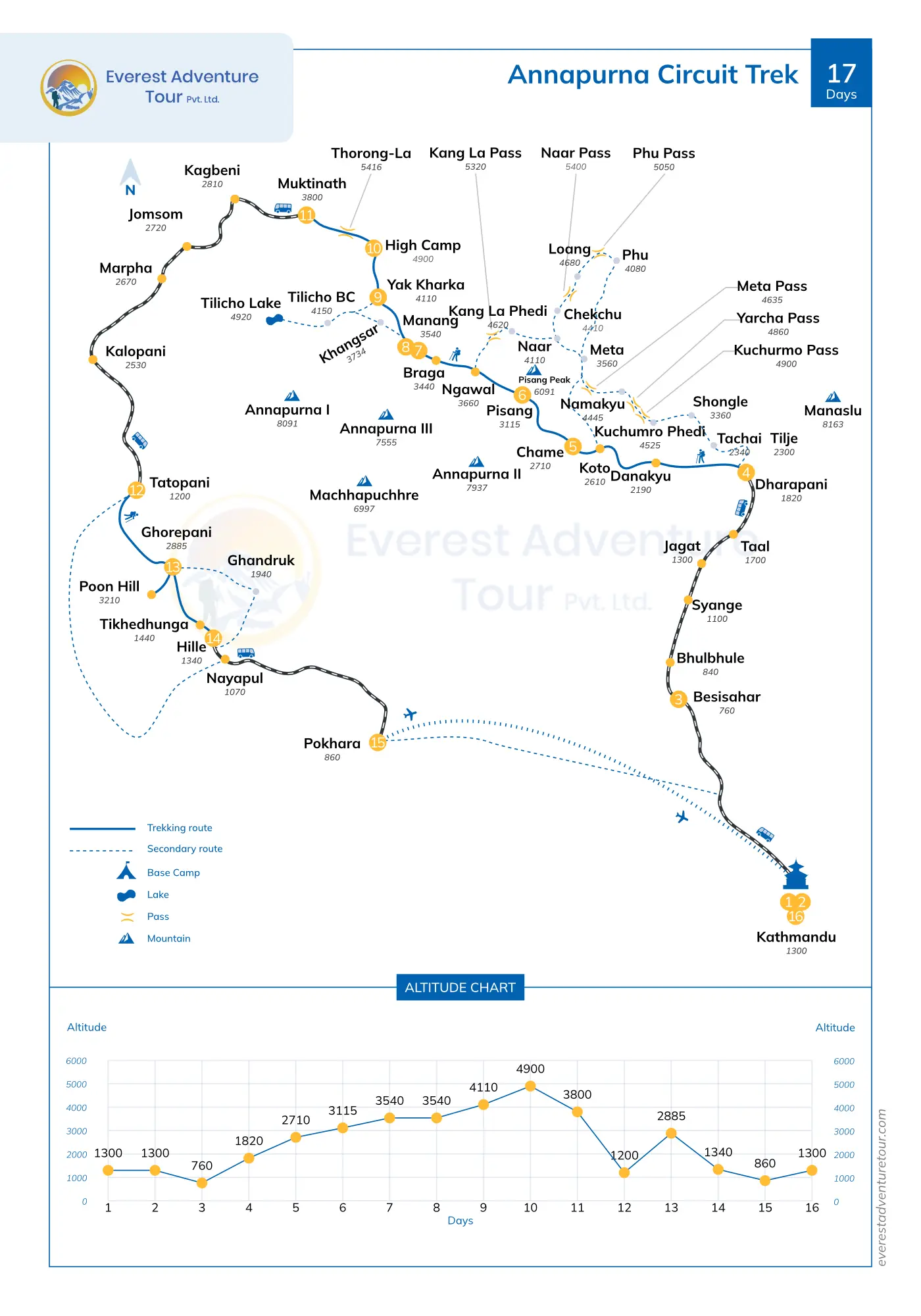
Route Map
Includes
- All Arrival and Departure Transfer from airport to hotel and vice-versa, vehicles according to group size.
- Twin sharing room on best tourist standard hotels in Kathmandu & Pokhara on bed and breakfast basis only. (For single supplement at extra cost on informing Everest Adventure Tour on booking).
- Transportation on start of trekking and after trek from Kathmandu and to Pokhara. Includes domestic airfare from Pokhara to Kathmandu.
- Full board trekking includes twin sharing accommodation on best available local lodges, includes Breakfast, lunch, dinner with afternoon tea / snacks.
- Service of guide, trekking staff as per size of a group with porters.
- Wages, meals, medical allowance of guides, trekking staff and porters.
- Applicable Special Trekking Permits TIMS (Trekking Information Management Systems). Includes ACAP (Annapurna Conservation Area Project) Entrance Fees.
- Comprehensive Medical Kit carried by our guide if required for minor wounds and sickness.
- Sightseeing tour around Kathmandu valley as per the itinerary.
- Welcome or Farewell dinner in Kathmandu.
Doesn't Include
- Nepal Visa, Personal Medical & Travel Insurance.?
- Expenses of personal nature, meals in Kathmandu and gratitude or tipping? for trekking staff, drivers, porters and guide, including extra snacks and refreshments.?
- Personal trekking gear, including sleeping bags and down jackets (if it is not? included on the trip cost).?
- Emergency Evacuation if required by any means of transportation, including? Helicopter Service.?
- Personal medical kit, as advised by you doctors.?
- Early return from the trek due to personal domestic or medical reasons, no refund will be entertained on breaking the journey.
- Excellent customer service. Our travel experts are ready to help you 24/7.
- Best price guaranteed.
- No credit card or booking fees.
- 100% financial protection.
- Environmentally-friendly tours.
Equipment List
- Thermal underwear (top and bottom)
- Moisture-wicking long-sleeved t-shirts
- Moisture-wicking underwear
- Fleece jacket or pullover
- Insulated down or synthetic jacket (lightweight and warm)
- Waterproof, windproof jacket (Gore-Tex or similar)
- Waterproof, windproof pants
- Trekking pants (convertible preferred)
- Warm beanie or wool hat
- Sun hat or baseball cap
- Neck gaiter, buff, or scarf
- Waterproof trousers (for rain and snow)
- Lightweight inner gloves (thermal or liner gloves)
- Insulated outer gloves or mittens (waterproof)
- Waterproof, broken-in hiking boots with ankle support
- Comfortable camp shoes or sandals (for evenings)
- Trekking socks (wool or synthetic, several pairs)
- Gaiters (optional, for snow and mud)
- Trekking backpack (30-40 liters) with rain cover
- Daypack (optional, for short hikes)
- Sleeping bag (rated to at least -10°C / 14°F)
- Insulated sleeping pad or foam mattress
- Adjustable trekking poles (with rubber tips)
- Insulated water bottles or hydration bladder (2-liter capacity recommended)
- Sunglasses with UV protection
- Headlamp with extra batteries
- Power bank and chargers (for electronics)
- Camera and extra batteries/memory cards
- Travel-size toiletries (toothbrush, toothpaste, biodegradable soap)
- Quick-dry towel
- Wet wipes and hand sanitizer
- Sunscreen (high SPF) and lip balm with SPF
- Personal first aid kit (bandages, blister pads, antiseptic, medication)
- Medications for altitude sickness (Diamox if prescribed)
- Pain relievers, anti-diarrheal, antihistamines
- Earplugs (for noisy lodges)
- Notebook and pen
- Portable solar charger (optional)
- Plastic zip-lock bags (to keep gear dry)
- Lightweight stuff sacks or packing cubes
- Snacks (energy bars, nuts, chocolates)
- Reusable water bottle or hydration system
- Small knife or multi-tool
- Passport-size photos (for permits if needed)
Frequently Asked Questions
?It is not so difficult crossing over Thorang-La Pass, only in deep snow condition can be quite tough and challenging. More or less it is quite moderate climb with long steep descend. Taking time and having frequent stops will overcome the tough sections and difficulty of breathing. Annapurna circuit an adventure with high pass of Thorang-La of above 5,416 meters high, we have set the itinerary days flexible. Having enough time for acclimatization, as well having shorter days in some parts of the walks. However choosing the right season and with best guide of Everest Adventure Tour will be best to enjoy this exciting adventure.
?Trekkers will be surprised to find good food menu of varieties, from Tibetan, Nepali, Indian and Chinese to Continental. Includes long list of snacks and drinks for the customer delights in most lodges on treks. The lodge accommodation are nice and lovely according to the choices of the trekkers. From budget, standard to luxury accommodation, either attached or non-attached bath and toilets.
Trekkers should remember as the trek leads higher areas around Yak Kharka, High Camp and in Pisang village. The attached bath and toilets are not available due to freezing temperatures in the night and morning. Where all plumbing systems freeze, and stops the flow of water which will be filled with ice.
On higher areas the lodge provides rooms with common toilets and bathrooms, which is much better than having in rooms. Due to harsh climate and terrain conditions, where all trekkers should understand and needs to compromise.
However, all lodges are clean with good rooms, having large dining with potbellied stoves to make the environment warm and cozy.
The only simple accommodation and foods will be in High Camp, rest of the major villages and settlements. Provides better room accommodation and range of foods quality.
?All lodges have hydro-power to run electricity, but at Yak Kharka and High Camp have electricity, run by solar power. Trekkers can charge their electronic items and gadgets. A fee is charged per hour for each items, as for internet and Wi-Fi, have connection. Depending upon the areas in deep gorge and valley, as well weather wise, can be disturbing with bad receptions. The best place is Chame, Manang and onwards from Muktinath. Other places works well with local SIM, which can be bought in Kathmandu at reasonable cost.
?Annapurna Circuit involves high altitude and crossing over 5,416 meters pass. Some days can be quite longer as per ones physical fitness and experience on outdoor activities. The minimum age we allow is above 16 years, and maximum age of 70 years. But all should be in good physical shape and in sound medical health and having medical and travel insurance for this adventurous treks.
As this trek involves high altitude, anything can happen like normal sickness or altitude sickness like AMS (Acute Mountain Sickness).
All trekkers when booked with Everest Adventure Travel needs to purchase Travel and Medical Insurance. Which should cover expenses of immediate and fast transportation like Helicopter with all medical bills incurred. The Travel insurance should cover in case if one has to use helicopter services, if the flight get delayed or cancelled. The other reasons is if the trail is blocked by sudden landslides or avalanches, as well with heavy snow-fall. Where trekkers have to return back to Pokhara or Kathmandu due to bad weather or unfortunate incidents.
Physical preparation is crucial for enjoying the Annapurna Circuit. Regular cardio exercises such as hiking, running, cycling, or swimming at least 8-12 weeks before the trek help build stamina. Strength training for legs and core is also beneficial. Everest Adventure Tour offers pre-trek briefings with fitness tips and suggests gradual altitude acclimatization to minimize fatigue and altitude sickness risks.
While the Annapurna Circuit is well-traveled and generally safe, trekking alone is not recommended, especially for first-timers. Unexpected altitude sickness, weather changes, or injuries can happen, and having a guide or group improves safety. Everest Adventure Tour provides experienced local guides who are familiar with the terrain and culture, offering essential support and ensuring a secure trekking experience.
The best seasons for the Annapurna Circuit are autumn (September to November) and spring (March to May). These months offer clear skies, moderate temperatures, and stable weather conditions, making trekking safer and more enjoyable. Everest Adventure Tour plans trips around these optimal times but can also accommodate winter and monsoon seasons with extra precautions for those seeking off-season adventure.
The Annapurna Circuit passes through diverse communities rich in culture and tradition. Trekkers witness Hindu and Tibetan Buddhist influences in villages, monasteries, festivals, and daily life. You’ll visit historic sites such as Braga Monastery and the sacred Muktinath Temple. Everest Adventure Tour encourages respectful cultural exchanges and offers insights into local customs, making the trek an enriching cultural journey.
Everest Adventure Tour provides full logistical support, including permits, transportation, accommodation bookings, and meals. Our experienced guides and porters ensure safety, assist with acclimatization, and share local knowledge to enhance your trek. We monitor weather and health conditions continuously, offer emergency support, and ensure that your Annapurna Circuit experience is comfortable, safe, and unforgettable.