

- 1 - 1 Person US$ 799
- 2 - 5 Person US$ 720
- 6 - 9 Person US$ 699
- 10 - 15 Person US$ 679
- 16 - 20 Person US$ 620
Hotel in Kathmandu and Tea house / Lodge during the trek
Breakfast in Kathmandu and all meals during the trek
Highlights
- The closest Himalayan trekking region from Kathmandu – just a 6–7 hour scenic drive to the trailhead.
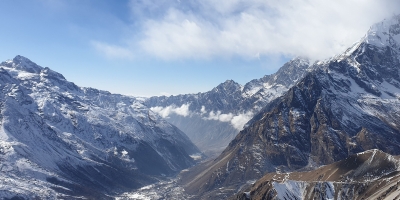
- Spectacular valley views surrounded by snow-capped peaks, including Langtang Lirung (7,234 m).
- Moderate trek through lush forests, waterfalls, bamboo groves, and alpine meadows.
- Rich cultural immersion in Tamang and Tibetan Buddhist heritage – monasteries, chortens, and mani walls.
- Diverse flora and fauna within Langtang National Park, including rhododendrons, red pandas, and Himalayan birds.
- Taste traditional yak cheese at the local cheese factory in Kyanjin Gompa.
- Explore sacred and scenic landmarks like Kyanjin Gompa, Langshisa Valley, and the glacier viewpoints.
- Day hikes to panoramic viewpoints such as Tserko-Ri (4,984 m) and Kyanjin-Ri (4,773 m).
- Wildlife spotting opportunities, including monkeys, Himalayan Thar, musk deer, and possibly snow leopards.
Overview
The Langtang Valley Trek is one of Nepal’s most captivating moderate trekking adventures, ideal for trekkers of all ages and experience levels. Organized by Everest Adventure Tour, this journey offers a perfect blend of natural beauty, cultural richness, and high Himalayan scenery. Just a short drive north from Kathmandu, Langtang Valley offers an accessible but deeply immersive trekking experience. This is a trek where you'll walk through tranquil forests, explore charming Tamang villages, and gradually ascend to the windswept alpine valley of Kyanjin Gompa – all beneath the towering gaze of the snow-covered Langtang Himalayas.
Langtang Valley is situated in the Rasuwa District, directly north of Kathmandu and close to the border of Tibet/China. The region is part of the Langtang National Park, Nepal’s first Himalayan conservation area established in 1976. With an area covering 1,710 sq. km, the park protects a biodiverse ecosystem that includes red pandas, Himalayan black bears, musk deer, and snow leopards. Along the trails, you’ll pass through lush forests filled with oak, maple, pine, and blooming rhododendron trees. This biologically rich environment is as spiritually rich, with monasteries, mani walls, and prayer wheels symbolizing the deep-rooted Tibetan Buddhist culture of the region.
One of the highlights of this trek is reaching Kyanjin Gompa (3,870 m), a picturesque settlement nestled within the upper Langtang Valley and surrounded by awe-inspiring peaks such as Langtang Lirung (7,234 m) and Langtang Ri. Here, you’ll have the chance to acclimatize and hike to nearby viewpoints like Kyanjin-Ri or Tserko-Ri – both offering stunning panoramic vistas of the Central Himalayas. This section of the trek not only rewards you with incredible alpine scenery but also provides cultural encounters with local Tamang and Tibetan communities, giving a rare glimpse into high-mountain lifestyles preserved for generations.
With Everest Adventure Tour, your trek is carefully organized to maximize safety, comfort, and cultural engagement. Beginning with your arrival in Kathmandu, the 12-day itinerary includes guided heritage site tours, comfortable tea house accommodation, and a well-paced trekking schedule. Whether you’re a first-time trekker or a seasoned adventurer, the Langtang Valley Trek provides an unforgettable experience in a relatively quieter region of Nepal, away from the busier Everest and Annapurna routes. The journey concludes with a return to Kathmandu, leaving you with lifelong memories of majestic mountains, serene landscapes, and the warm hospitality of the Langtang people.
Major Places for Langtang Valley Trek
The Langtang Valley Trek offers a rich blend of cultural villages, scenic landscapes, and breathtaking viewpoints, making it one of the most well-rounded trekking destinations in Nepal. With Everest Adventure Tour, trekkers are guided through an immersive journey that covers diverse environments and iconic locations, all set against the majestic backdrop of the Langtang Himalayas.
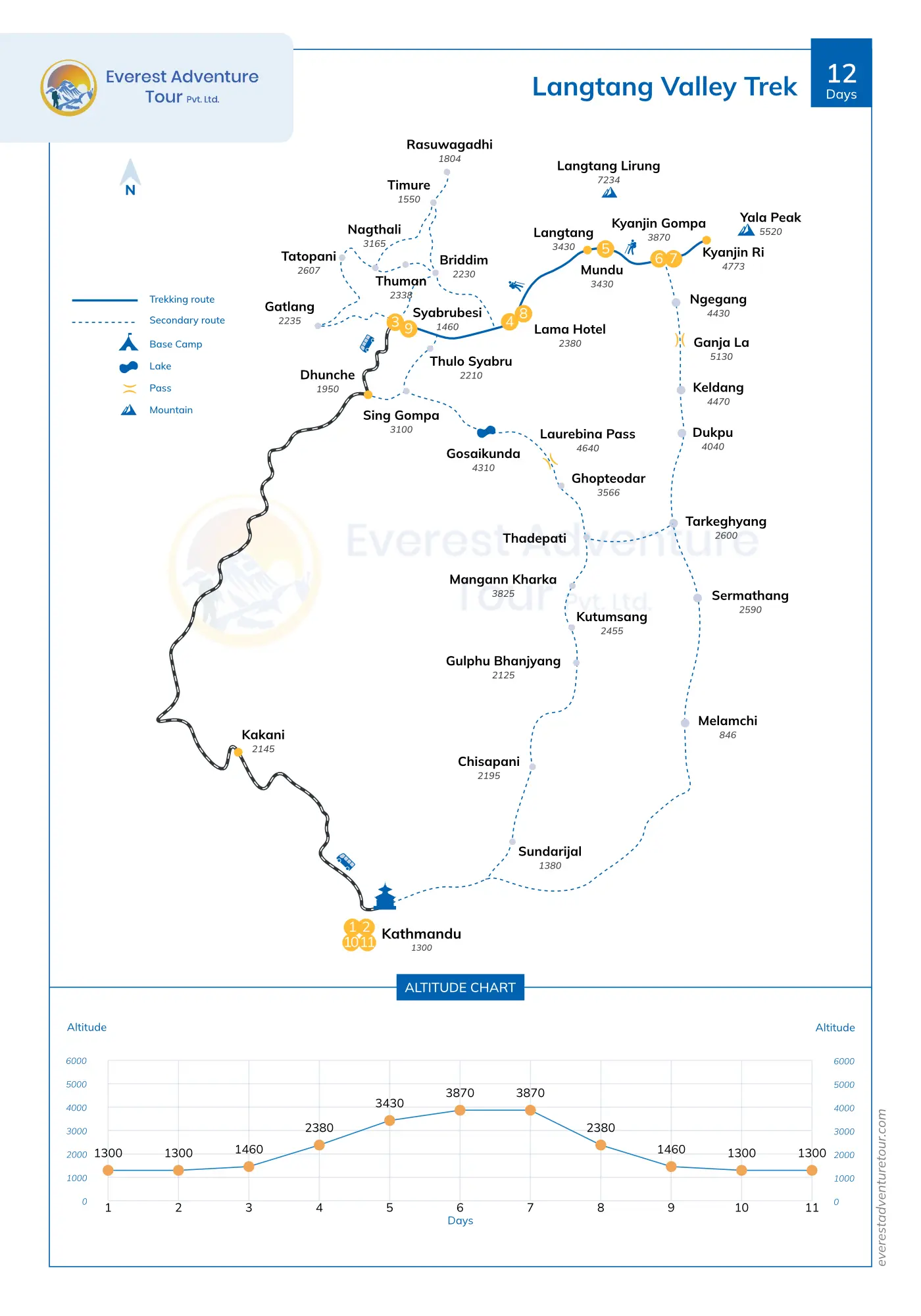
The trek begins with a drive to Syabrubesi, a small yet vibrant town at 1,460 meters, acting as the trailhead for the trek. From here, you’ll trek through dense forests and along the Langtang Khola river to reach Lama Hotel (2,380 m), a peaceful stop surrounded by greenery. Continuing onward, you’ll pass through the remnants of the old Langtang Village, which was tragically destroyed in the 2015 earthquake, and finally reach Mundu, a quiet village that offers stunning views of the surrounding peaks.
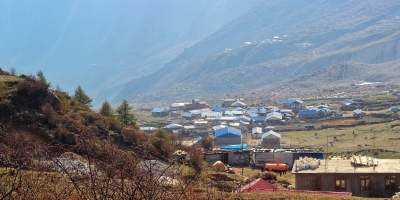
The heart of the trek is Kyanjin Gompa (3,870 m), a beautiful village with an ancient monastery, yak farms, and Himalayan cheese factories. This is also the base for day hikes to Kyanjin-Ri (4,773 m) or Tserko-Ri (4,984 m), both providing panoramic views of snow-capped peaks including Langtang Lirung, Dorje Lakpa, and Yala Peak.
Major Highlights:
- Syabrubesi – the trek's starting point with vibrant local culture.
- Lama Hotel – forested stop along the Langtang River.
- Mundu & Langtang Village – sites of cultural and historic interest.
- Kyanjin Gompa – scenic and spiritual hub of the valley.
- Kyanjin-Ri / Tserko-Ri – top viewpoints for Himalayan panoramas.
Best Season for Langtang Valley Trek – With Everest Adventure Tour
Choosing the right season for the Langtang Valley Trek is essential for a safe, enjoyable, and visually rewarding experience. Everest Adventure Tour recommends trekking during Nepal’s two main trekking seasons: spring (March to May) and autumn (September to November). These months provide the most stable weather, clear skies, and comfortable temperatures.
Spring season (March to May) is particularly beautiful, as the trails are alive with blooming rhododendrons, magnolias, and other wildflowers. The visibility is generally excellent, allowing for spectacular views of the Langtang Himalayas. Temperatures are mild during the day, although mornings and evenings can still be cool, especially at higher altitudes like Kyanjin Gompa.
Autumn season (September to November) is often considered the best time overall due to its crisp air, post-monsoon greenery, and stable conditions. During these months, the skies are usually crystal clear, making it perfect for photography and high mountain views. This is also the peak season, so expect to share trails with other trekkers, though Langtang remains quieter than Everest or Annapurna.
Other Seasons:
- Winter (December to February): Possible but cold; high passes and viewpoints may be snow-covered.
- Monsoon (June to August): Not recommended due to slippery trails, landslides, and poor visibility.
Best Trekking Seasons Summary:
- Spring (March–May): Blooming flowers, pleasant weather.
- Autumn (Sept–Nov): Clear skies, stable conditions.
- Winter (Dec–Feb): Cold, fewer trekkers, snow views.
- Monsoon (June–Aug): Risky; not ideal due to heavy rain.
Langtang Valley Trekking Difficulty
The Langtang Valley Trek is considered a moderate-level trek, making it suitable for beginners with good fitness levels as well as experienced trekkers seeking a shorter Himalayan adventure. With Everest Adventure Tour, trekkers are guided through a well-paced itinerary that helps with acclimatization and minimizes physical strain.
The trek reaches a maximum altitude of Kyanjin Gompa (3,870 m), with optional hikes to Tserko-Ri (4,984 m) or Kyanjin-Ri (4,773 m), which do require good stamina due to their steep climbs and higher elevation. However, there are no high passes or technical climbing involved, making it less demanding compared to Everest Base Camp or the Annapurna Circuit.
Daily trekking hours range between 4 to 6 hours, with gradual ascents and descents through forested trails, river crossings, and alpine meadows. The main challenge lies in the altitude and occasional steep sections. It’s essential to stay hydrated, walk at a steady pace, and allow your body time to adjust, especially during the climb from Lama Hotel to Kyanjin Gompa.
Physical Preparation Tips:
- Cardiovascular endurance (jogging, cycling, hiking)
- Strength training (for knees and legs)
- Altitude awareness (learn about AMS symptoms)
Trekking Difficulty Overview:
- Moderate trekking grade – no technical skills needed
- Highest point (optional): Tserko-Ri, 4,984 m
- Suitable for beginners with basic fitness
- Good acclimatization and support with Everest Adventure Tour
Food and Accommodation for Langtang Valley Trek
When you trek with Everest Adventure Tour, you can expect comfortable and hygienic food and accommodation throughout the Langtang Valley journey. The region is well-developed in terms of tea house infrastructure, offering basic but cozy places to sleep and eat, with a local touch.
Accommodation along the route consists mostly of family-run tea houses. These provide twin-sharing rooms with wooden beds, mattresses, pillows, and blankets. Bathrooms are mostly shared, and hot showers are available for a small fee. The higher you go, the more basic the facilities become, but they remain clean and welcoming. Most teahouses also have a common dining area, often heated by a traditional stove.
Food on the trek is varied and nourishing, designed to fuel trekkers through the long walking days. You’ll find a mix of local Nepali meals like dal bhat (rice, lentils, and vegetables), as well as international options like pasta, noodles, pancakes, fried rice, and omelets. At Kyanjin Gompa, don’t miss the chance to try local yak cheese, made at the village’s traditional cheese factory. Boiled water, bottled water, and purification tablets are all available options for drinking water.
Food & Accommodation Highlights:
- Comfortable tea house stays with basic amenities
- Nutritious meals served 3 times a day
- Local specialties: Dal Bhat, yak cheese, momo (dumplings)
- Everest Adventure Tour ensures hygienic standards and advance bookings
- Warm hospitality from local Tamang families
Network and Communication for Langtang Valley Trek
Staying connected during your Himalayan adventure is important for both personal and emergency reasons. With Everest Adventure Tour, we ensure you're well-informed about what to expect regarding network coverage and communication on the Langtang Valley Trek. While this region is relatively remote, there have been steady improvements in mobile and internet access over the years.
In lower areas such as Syabrubesi, Lama Hotel, and Mundu, mobile networks (especially NTC and Ncell) are sporadically available. However, as you ascend higher into the Langtang Valley, especially near Kyanjin Gompa, the signal can become weak or nonexistent. Some teahouses do offer Wi-Fi services, but the connection is often slow and comes with an extra charge. It’s generally reliable enough for sending messages or emails, but not suitable for video calls or large downloads.
For trekkers who need more reliable communication, Everest Adventure Tour can help arrange local SIM cards with data packs or even satellite phone rental for emergency use. Guides are also equipped with necessary contact tools for emergency situations. We always recommend informing family and friends that connectivity may be limited during the trek.
Communication Highlights:
- Mobile networks available in lower altitudes (NTC/Ncell)
- Weak to no signal beyond Lama Hotel and Kyanjin Gompa
- Wi-Fi available in some teahouses (paid, slow speed)
- Satellite phones can be arranged for emergency use
- Everest Adventure Tour guides carry reliable communication tools
Langtang Valley Trekking Transportation With Everest Adventure Tour
The Langtang Valley Trek starts with a scenic and sometimes bumpy road journey rather than a flight, making it unique among Nepal’s major trekking routes. With Everest Adventure Tour, all ground transportation is organized in advance to ensure comfort, safety, and punctuality throughout the trek.
The journey from Kathmandu to Syabrubesi takes around 6 to 7 hours, covering approximately 122 kilometers. Depending on group size and preference, transportation is arranged via a private jeep, tourist bus, or shared local jeep. The road passes through hilly terrain, forests, and local villages, providing an exciting prelude to your trekking adventure. Although parts of the route can be rough due to landslides or seasonal wear, our experienced drivers ensure a safe and enjoyable ride.
Upon completing the trek, the same route is taken back from Syabrubesi to Kathmandu. Private vehicles are highly recommended for added comfort and flexibility. Public transport is available but often crowded and less predictable in terms of schedule and stops. For those looking for a more comfortable experience, Everest Adventure Tour can arrange 4WD vehicles which are ideal for the rougher sections of the journey.
Transportation Highlights:
- Drive-based trek: no domestic flights required
- Kathmandu to Syabrubesi: 6–7 hours via jeep/bus
- Safe, private vehicles arranged by Everest Adventure Tour
- 4WD option available for extra comfort
- Scenic drive through local villages and lush landscapes
Langtang Valley Trekking Permits
Before embarking on the Langtang Valley Trek, every trekker is required to obtain specific trekking permits, which are essential for entering and trekking through the Langtang National Park. Everest Adventure Tour takes care of all permit arrangements, ensuring a hassle-free experience for our clients.
There are two mandatory permits:
- Langtang National Park Entry Permit – This is required for all trekkers entering the protected region. The park is home to diverse flora and fauna, and your permit fee contributes to conservation efforts.
- TIMS Card (Trekkers’ Information Management System) – This helps ensure your safety by tracking trekkers’ whereabouts. It’s managed by the Nepal Tourism Board and the Trekking Agencies' Association of Nepal (TAAN).
Both permits can be obtained in Kathmandu before departure. If you're trekking with Everest Adventure Tour, these are processed in advance. Your guide will carry copies during the trek in case they are requested at various checkpoints along the route.
Permit Fee Structure (as of 2024):
- Langtang National Park Permit: NPR 3,000 (Approx. USD $25)
- TIMS Card: NPR 2,000 (Approx. USD $15) for individual trekkers
Permit Highlights:
- Required permits: Langtang National Park & TIMS Card
- Everest Adventure Tour handles all permit logistics
- Permit checkpoints along the trail ensure regulated access
- Fees support trail maintenance, conservation, and safety
- No restricted area permit needed (unlike Manaslu or Mustang)
Why Choose Langtang Valley Trek
The Langtang Valley Trek is one of Nepal’s most underrated yet deeply fulfilling trekking experiences. Compared to the crowded trails of Everest or Annapurna, Langtang offers tranquility, cultural richness, and stunning Himalayan scenery within a shorter time frame. With Everest Adventure Tour, you’ll not only explore the natural beauty of the region but also connect deeply with its local communities and spiritual landmarks.
Langtang Valley is often referred to as the "Valley of Glaciers" due to its proximity to multiple snow-capped peaks and glacial rivers. The trail takes you through dense forests, past waterfalls, and into Tamang villages that still preserve traditional Tibetan-influenced culture. You'll witness prayer flags fluttering in the wind, pass ancient Buddhist monasteries, and enjoy panoramic mountain views without needing to trek to extreme altitudes.
What sets Langtang apart is its accessibility. It’s one of the few treks in Nepal that does not require a domestic flight, making it more reliable during unpredictable weather. It’s also a less commercialized trail, offering a more authentic trekking experience. With Everest Adventure Tour, everything is well-organized — from accommodation to experienced guides and permits — so you can focus on enjoying your journey.
Reasons to Choose Langtang Valley Trek:
- Short and scenic trek close to Kathmandu
- Less crowded and more peaceful than Everest/Annapurna
- Culturally rich villages and Buddhist heritage
- Ideal for beginners and experienced trekkers alike
- Professionally guided and fully organized by Everest Adventure Tour
Important Note
Trip Itinerary
Route Map
Includes
- All Arrival and Departure Transfer from airport to hotel and vice-versa, vehicles according to group size.
- Three Star hotels in Kathmandu on bed and breakfast basis only.
- Transportation on start of trekking and after trek to and from Kathmandu.
- Full board trekking includes twin sharing accommodation on best available local lodges, includes Breakfast, lunch, dinner with afternoon tea / snacks.
- Service of guide, trekking staff as per size of a group with porters.
- Wages, meals, medical allowance of guides, trekking staff and porters.
- Applicable Trekking Permits TIMS (Trekking Information Management Systems). Includes Langtang National Park entrance Fees.
- Comprehensive Medical Kit carried by our guide if required for minor wounds and sickness.
- Sightseeing tour around Kathmandu valley as per the itinerary.
- Welcome or Farewell dinner in Kathmandu.
Doesn't Include
- Nepal Visa, Personal Medical & Travel Insurance.?
- Expenses of personal nature, meals in Kathmandu and gratitude or tipping for trekking staff, drivers, porters and guide, including extra snacks and refreshments.?
- Personal trekking gear, including sleeping bags and down jackets (if it is not? included on the trip cost).?
- Emergency Evacuation if required by any means of transportation, including? Helicopter Service.?
- Personal medical kit, as advised by you doctors.?
- Early return from the trek due to personal domestic or medical reasons, no refund will be entertained on breaking the journey.
- Excellent customer service. Our travel experts are ready to help you 24/7.
- Best price guaranteed.
- No credit card or booking fees.
- 100% financial protection.
- Environmentally-friendly tours.
Equipment List
- Thermal underwear (top and bottom)
- Moisture-wicking long-sleeved t-shirts
- Moisture-wicking underwear
- Fleece jacket or pullover
- Insulated down or synthetic jacket (lightweight and warm)
- Waterproof, windproof jacket (Gore-Tex or similar)
- Waterproof, windproof pants
- Trekking pants (convertible preferred)
- Warm beanie or wool hat
- Sun hat or baseball cap
- Neck gaiter, buff, or scarf
- Waterproof trousers (for rain and snow)
- Lightweight inner gloves (thermal or liner gloves)
- Insulated outer gloves or mittens (waterproof)
- Waterproof, broken-in hiking boots with ankle support
- Comfortable camp shoes or sandals (for evenings)
- Trekking socks (wool or synthetic, several pairs)
- Gaiters (optional, for snow and mud)
- Trekking backpack (30-40 liters) with rain cover
- Daypack (optional, for short hikes)
- Sleeping bag (rated to at least -10°C / 14°F)
- Insulated sleeping pad or foam mattress
- Adjustable trekking poles (with rubber tips)
- Insulated water bottles or hydration bladder (2-liter capacity recommended)
- Sunglasses with UV protection
- Headlamp with extra batteries
- Power bank and chargers (for electronics)
- Camera and extra batteries/memory cards
- Travel-size toiletries (toothbrush, toothpaste, biodegradable soap)
- Quick-dry towel
- Wet wipes and hand sanitizer
- Sunscreen (high SPF) and lip balm with SPF
- Personal first aid kit (bandages, blister pads, antiseptic, medication)
- Medications for altitude sickness (Diamox if prescribed)
- Pain relievers, anti-diarrheal, antihistamines
- Earplugs (for noisy lodges)
- Notebook and pen
- Portable solar charger (optional)
- Plastic zip-lock bags (to keep gear dry)
- Lightweight stuff sacks or packing cubes
- Snacks (energy bars, nuts, chocolates)
- Reusable water bottle or hydration system
- Small knife or multi-tool
- Passport-size photos (for permits if needed)
Frequently Asked Questions
The Langtang Valley Trek is a moderate and short Himalayan adventure, making it suitable for all age groups, including families with children and senior trekkers aged 75 to 80 years, as long as they are in reasonable health. The trek involves some uphill walking, especially on the second day when ascending to Lama Hotel, and later during the optional hike to Kyanjin-Ri. However, the gradual pace of the trek, combined with ample rest breaks and expert guidance from Everest Adventure Tour, ensures even elderly trekkers can manage comfortably. Anyone with pre-existing health conditions should consult their physician before committing, but the trek has been successfully completed by trekkers of all generations, making it a perfect multi-age travel experience.
Trekkers are often pleasantly surprised by the quality and variety of food available along the Langtang Valley route. Most teahouses serve freshly prepared meals including Nepali dal bhat, Tibetan noodles, Indian curries, Chinese-style stir-fry, and continental dishes like pasta and pancakes. There’s also a good selection of snacks, hot drinks, and bakery items, especially at Kyanjin Gompa. Accommodation options range from budget to standard teahouses, depending on the location. Most rooms are clean, simple, and cozy, with shared toilets and showers. At lower elevations like Syabrubesi, you might find attached bathrooms. Dining rooms are generally heated, providing a warm and welcoming communal space. Everest Adventure Tour ensures you stay at pre-booked, hygienic lodges throughout the trek.
Yes, Langtang Valley is among the top three most popular trekking routes for moderate-level adventures in Nepal. Trekkers choose Langtang for its proximity to Kathmandu, stunning natural landscapes, and rich cultural experiences. Unlike the more commercialized Everest and Annapurna regions, Langtang offers a quieter, more authentic experience while still providing excellent infrastructure for trekking. The valley is a favorite among those seeking an immersive Himalayan experience within a short timeframe, typically 7 to 10 days. With beautiful forests, high alpine meadows, glacial rivers, and traditional Tamang villages, it offers all the hallmarks of a great trek without the need for long travel or domestic flights.
Most teahouses along the Langtang Valley route have electricity, either through hydro-power or solar panels, allowing trekkers to charge their devices such as phones, cameras, and power banks. However, there is typically a small fee per hour or per item. Internet access via Wi-Fi is available in many lodges, especially in Syabrubesi and Kyanjin Gompa, though the connection may be slow or unstable due to the remote location and weather conditions. In between stops, mobile data may work with Nepali SIM cards (NTC or Ncell), which you can purchase in Kathmandu. Everest Adventure Tour guides are also equipped with emergency communication options.
The most enchanting time to see wildflowers in Langtang Valley is during spring, from March to May. During this season, the forests come alive with vibrant blooms, especially various species of rhododendrons, Nepal’s national flower. You’ll also see magnolias, primroses, and countless alpine wildflowers carpeting the hillsides and meadows. The trail turns into a natural floral garden, offering breathtaking scenery and a delightful fragrance in the air. Spring also coincides with milder temperatures and clear skies, making it one of the best times overall to trek in Langtang. Photographers and nature lovers will particularly enjoy this magical time of year.
The Langtang Valley Trek reaches a maximum elevation of 3,870 meters at Kyanjin Gompa, with optional hikes to viewpoints like Tserko-Ri (4,984 m). While this altitude is moderate by Himalayan standards, some trekkers may still experience mild symptoms of altitude sickness, such as headaches or fatigue. However, the well-paced itinerary offered by Everest Adventure Tour ensures gradual acclimatization. The ascent is slow, with proper rest stops along the way, allowing the body to adjust. Staying hydrated, avoiding alcohol, and walking at a steady pace are key. Your guide is trained to recognize symptoms and will assist immediately if needed.
No prior trekking experience is required to join the Langtang Valley Trek, making it an ideal route for first-time trekkers. It’s categorized as a moderate trek, with daily walking of 4–6 hours, mostly on well-defined trails through forests, riversides, and alpine terrain. While a basic level of physical fitness and stamina is necessary, you don’t need to be a seasoned mountaineer. Everest Adventure Tour provides experienced guides and a carefully designed itinerary to suit beginners. If you have experience trekking at altitude, it will certainly help, but even newcomers can complete this trek comfortably with proper preparation.
To trek in the Langtang region, you will need two permits: the Langtang National Park Entry Permit and the TIMS Card (Trekkers’ Information Management System). These are mandatory for all trekkers, including solo travelers. The National Park permit helps preserve the area’s rich biodiversity and supports local conservation, while the TIMS card ensures trekking safety and registration. Everest Adventure Tour handles all permit processing, so trekkers don’t need to worry about paperwork or queues. Permits are issued in Kathmandu and checked at entry points during the trek.
The trek is considered moderate in difficulty, suitable for anyone with average physical fitness. The trail includes some steep ascents, especially when climbing from Syabrubesi to Lama Hotel, and on the optional hike to Kyanjin-Ri or Tserko-Ri. However, the trekking days are not overly long, and the pace is relaxed. Everest Adventure Tour ensures the itinerary allows enough rest, acclimatization, and gradual elevation gain. If you are comfortable walking for 5 to 6 hours a day over mixed terrain and carry a small daypack, you’ll enjoy the trek without major issues.
Everest Adventure Tour is a trusted name in Himalayan trekking, offering professionally organized, fully supported trekking experiences. Our Langtang Valley Trek package includes experienced local guides, pre-arranged accommodation, transportation, and all necessary permits. We prioritize safety, comfort, and authentic cultural experiences, taking care of all logistics so you can fully immerse yourself in the journey. With years of experience in the region and a deep respect for local traditions, Everest Adventure Tour ensures you explore Langtang in a responsible, enriching, and memorable way.